
Reported Speech: Statements— B1 Grammar Exercises
Published March 14, 2026
Exercise 1 — Multiple Choice
She said that she ____ going to the party.
He told me that he ____ finished his homework.
They mentioned that they ____ a new project next month.
She explained that she ____ to the store earlier.
He said that he ____ a great time at the concert.
They reported that they ____ the meeting yesterday.
She told him that she ____ her keys at home.
He stated that he ____ to travel next summer.
She informed us that she ____ her exam results.
They announced that they ____ a new policy next year.
Your friend tells you, "I'm moving to Berlin next month." A week later, you're explaining the news to someone else. You don't repeat her exact words; you say, "She told me she was moving to Berlin the following month." The tense moved back a step, the pronoun changed, and next month became the following month because a week has passed since she said it. That whole shift is reported speech.
Reported speech (also called indirect speech) reports what someone said without quoting them directly. Two things change: the verb tense usually shifts back one step, and time and place words often change to fit the new moment of speaking.
Form
A reported statement has two parts: a reporting verb (usually say or tell) and a that-clause containing the reported message. The word that is optional in conversation.
Compare the direct statement with its reported version:
| Direct speech | Reported speech |
|---|---|
| Anna said, "I work in Madrid." | Anna said (that) she worked in Madrid. |
| Tom said, "I am studying French." | Tom said (that) he was studying French. |
| The doctor said, "You need rest." | The doctor told me (that) I needed rest. |
Backshift: how the tenses change
When the reporting verb is in the past (said, told, explained), the verb in the reported clause usually shifts one tense back. This is called backshift. If you're not confident with the underlying tenses, review past simple, past continuous, and present perfect before tackling backshift.
| Direct | Reported | Example |
|---|---|---|
| Present simple | Past simple | "I live here." → He said he lived there. |
| Present continuous | Past continuous | "I am working." → She said she was working. |
| Past simple | Past perfect (or unchanged) | "I saw him." → He said he had seen him. / He said he saw him. |
| Present perfect | Past perfect | "I have finished." → She said she had finished. |
| Will | Would | "I will call." → He said he would call. |
| Be going to | Was / were going to | "I am going to apply." → She said she was going to apply. |
| Can | Could | "I can swim." → She said she could swim. |
| May | Might | "I may come." → He said he might come. |
| Must (obligation) | Had to | "I must leave." → She said she had to leave. |
| Must (deduction) | Must (unchanged) | "That must be Anna." → He said it must be Anna. |
Note that would, could, might, and should don't change, as they're already past forms. For a refresher on the present-tense modals before applying backshift, see can, could, should and must, might, may, have to.
When backshift is not needed
Backshift is not always required. There are three situations where you can keep the original tense.
1. The reporting verb is in the present
If you're reporting something using says, tells, or is saying, no backshift happens. The original tense stays.
- Anna says she works in Madrid. (Direct: "I work in Madrid.")
- The text says the meeting starts at 9.
- The recorded message tells passengers the train is delayed.
- She's telling everyone she's getting married.
2. The statement is still true
When the reported information is a general fact or still true at the moment of speaking, you can choose to keep the present tense. Backshift is also possible; both are correct.
- Direct: "Water boils at 100 degrees."
Reported: My teacher said water boils at 100 degrees. (still true)
Also correct: My teacher said water boiled at 100 degrees. - Direct: "I live in Tokyo."
Reported: Yuki told me she lives in Tokyo. (she still does)
Also correct: Yuki told me she lived in Tokyo. - Direct: "The shop opens at nine."
Reported: The sign said the shop opens at nine.
3. You're reporting something said very recently
When you're relaying something the speaker just said, the present tense often stays. The original moment is still active.
- She just said she's tired.
- He just told me he can't come tonight.
- The boss just said the meeting is cancelled.
Time and place words
When the moment of reporting is different from the moment of speaking, time and place words usually shift too. The new word fits the speaker's now, not the original speaker's now.
| Direct | Reported |
|---|---|
| now | then |
| today | that day |
| tonight | that night |
| tomorrow | the next day / the following day |
| yesterday | the day before / the previous day |
| next week | the following week |
| last month | the month before |
| this | that |
| here | there |
Direct: Marco said, "I'll see you tomorrow."
Reported: Marco said he would see me the next day.
Don't apply these changes mechanically. If you're reporting on the same day, today can stay as today. The shift only happens when the time has actually changed. For a wider set of words used to link past, present, and future, see time connectors.
Pronouns
The rule for pronouns is simple: replace each pronoun with the one that correctly identifies the same person from the new speaker's point of view. That usually means a shift, but it depends on who is speaking now and who they're talking to. Review subject and object pronouns if these forms feel uncertain.
- The default case: pronouns shift.
The reporter is no longer the original speaker, so I, my, and we usually become he/she, his/her, or they.
Direct: Lucia said, "I lost my keys."
Reported: Lucia said she had lost her keys. - When you report your own words, I stays as I.
Direct: I said, "I am tired."
Reported: I said (that) I was tired. - When the original "you" is now the person you're talking to, you stays as you.
Direct: Mark said to me, "You are late."
Reported (telling you what Mark said about you): Mark said you were late. - When "we" includes the new speaker, it stays as we.
Direct: My brother said, "We need a new car." (he means our family)
Reported: My brother said we needed a new car.
Say or tell?
Both verbs report statements, but the structure is different. The wrong choice here is one of the most common reported-speech errors.
tell + someone + (that) + clause: person required
- She said (that) the train was late.
- She told me (that) the train was late.
- She said me that the train was late.
- She told that the train was late.
Other reporting verbs include explain, mention, admit, add, reply, warn, and promise. Most follow the say pattern (no person, or "to + person"): He explained to me that…, She admitted that… A wider range of reporting verbs and their patterns is covered in advanced reported speech.
Putting it all together
Here's a short dialogue and the full reported version. Every shift happens in one block: reporting verb, tense, pronoun, time word, and place word.
"I am working from home today. I finished the report yesterday and I will send it to you tomorrow."
Sara told me (that) she was working from home the day before. She had finished the report two days before and would send it to me that day.
Notice how each piece moves: am working → was working, finished → had finished, will → would, I → she, you → me. The time words shift to match the new moment of speaking: Monday's today becomes the day before, Sunday (Sara's yesterday) becomes two days before, and Tuesday (Sara's tomorrow) becomes that day. Home stays the same because it isn't tied to a specific location word like here.
Common mistakes
| Wrong | Right | Why |
|---|---|---|
| He said me he was tired. | He told me he was tired. | Say doesn't take a direct person; tell does. |
| She told that she was sick. | She told us that she was sick. | Tell always needs a person. |
| He said he is hungry. | He said he was hungry. | Backshift after said: present → past. |
| She said she would come tomorrow. | She said she would come the next day. | Time words shift too — tomorrow moves to the next day when the day has changed. |
| He said he will arrive at six. | He said he would arrive at six. | Will shifts to would after a past reporting verb. |
| She said that "she was tired". | She said (that) she was tired. | No quotation marks in reported speech. |
| He told he had finished. | He said he had finished. | If there's no person, use say, not tell. |
Reported speech vs direct speech
| Direct speech | Reported speech |
|---|---|
| Uses quotation marks. | No quotation marks. |
| Repeats the speaker's exact words. | Reports the message in the speaker's own words. |
| Tense matches the original moment. | Tense usually shifts back when the reporting verb is past. |
| Pronouns and time words stay the same. | Pronouns and time/place words often change. |
| "I'll meet you here tomorrow," Sara said. | Sara said she would meet me there the next day. |
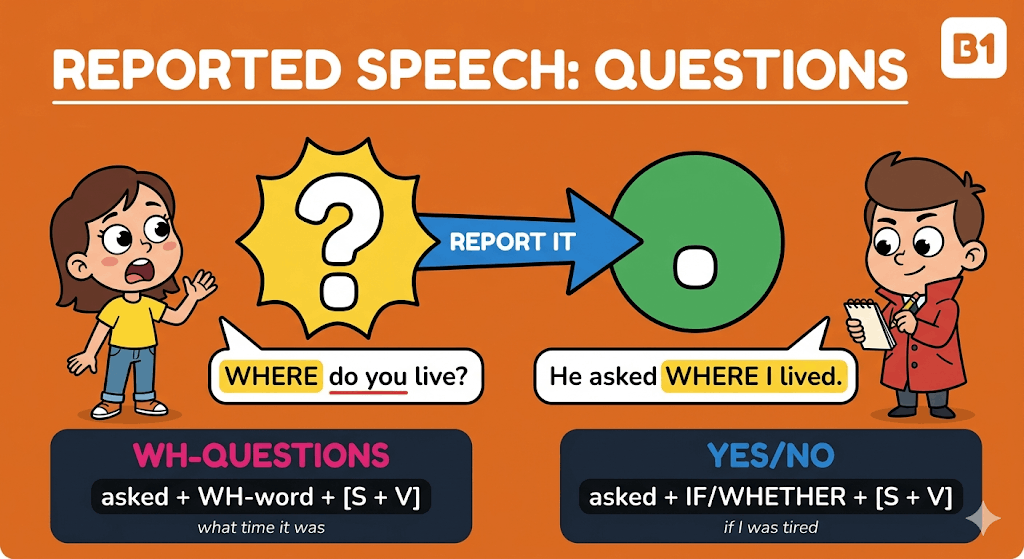
The same shifts apply when reporting questions, but the word order changes too — see reported speech: questions.
Quick summary
- After a past reporting verb (said, told), shift the verb in the reported clause one tense back.
- Use tell when you mention the listener; use say when you don't.
- Change pronouns and time/place words to fit the new moment of speaking — but only when the time, place, or person actually changes.
- If the reporting verb is in the present, the statement is still true, or the original was said very recently, backshift is optional in speech.
- In exams and formal writing, backshift unless you have a clear reason not to.
- Drop the quotation marks. That is optional.
Related topics
- Reported Speech: Questions: how the rules change when you report a question instead of a statement.
- Modals: must, might, may, have to: review the modal forms before applying backshift to them.
- Advanced Reported Speech: reporting verbs beyond say and tell, and reporting without backshift.
Comments