
Past Continuous— A2 Grammar Exercises
Published March 14, 2026
Exercise 1 — Multiple Choice
I ____ my book when the phone rang.
They ____ a movie when the lights went out.
She ____ her homework when her friend called.
We ____ dinner when the guests arrived.
He ____ a song when I walked in.
I ____ a shower when the water stopped.
They ____ in the park when it started to rain.
She ____ a letter when the dog barked.
We ____ a game when the power went out.
I ____ my keys when I found the wallet.
Picture this: it's 8 p.m. last night. You're not asking what someone did; you're asking what they were in the middle of. What were you doing at 8 p.m.? I was cooking dinner. The action started earlier, and at 8 p.m. it was still going. That's the job of the past continuous: an action in progress at a moment in the past.
This tense always has two parts: was or were, and a verb ending in -ing. Once you know the form, the uses come quickly.
Form
| Subject | Auxiliary |
|---|---|
| I, he, she, it | was |
| you, we, they | were |
Positive, negative, question
| Form | Example |
|---|---|
| Positive | I was reading a book. |
| Positive | They were playing football. |
| Negative | I wasn't reading a book. |
| Negative | They weren't playing football. |
| Yes/No question | Was she studying? |
| Wh- question | What were you doing? |
For questions, swap the subject and the auxiliary: You were sleeping → Were you sleeping? The main verb keeps its -ing ending in every form.
In speech and informal writing, you'll almost always hear the short forms wasn't and weren't. The full forms was not and were not sound formal or emphatic. In quick speech, was and were are often unstressed and sound like /wəz/ and /wə/, which is why they're easy to miss when listening.
Spelling: adding -ing
Most verbs just take -ing: play → playing, read → reading, eat → eating. A few rules change the spelling:
| Rule | Example |
|---|---|
| Verb ends in silent -e → drop the -e | make → making, write → writing |
| Short verb ending in consonant + vowel + consonant → double the last consonant | run → running, sit → sitting, swim → swimming |
| Verb ends in -ie → change to -y | lie → lying, die → dying |
When to use the past continuous
An action in progress at a moment in the past
The action started earlier and was still happening at the time you mention. The time is usually a clock time, a date, or a moment.
- What were you doing at 8 p.m.? I was cooking dinner.
- At 9 p.m. last night, Lucas was watching a film.
- This morning at 7 o'clock, the children were sleeping.
- Where were they going at 8 a.m.?
Two actions happening at the same time
Use the past continuous for both verbs when two long actions were going on together. You can join them with while, or use two separate sentences. When you use while, either clause can come first and the meaning stays the same.
- While Anna was cooking, her husband was setting the table.
- Anna's husband was setting the table while she was cooking.
- The dog was barking. The baby was crying. It was a noisy afternoon.
An action interrupted by another action
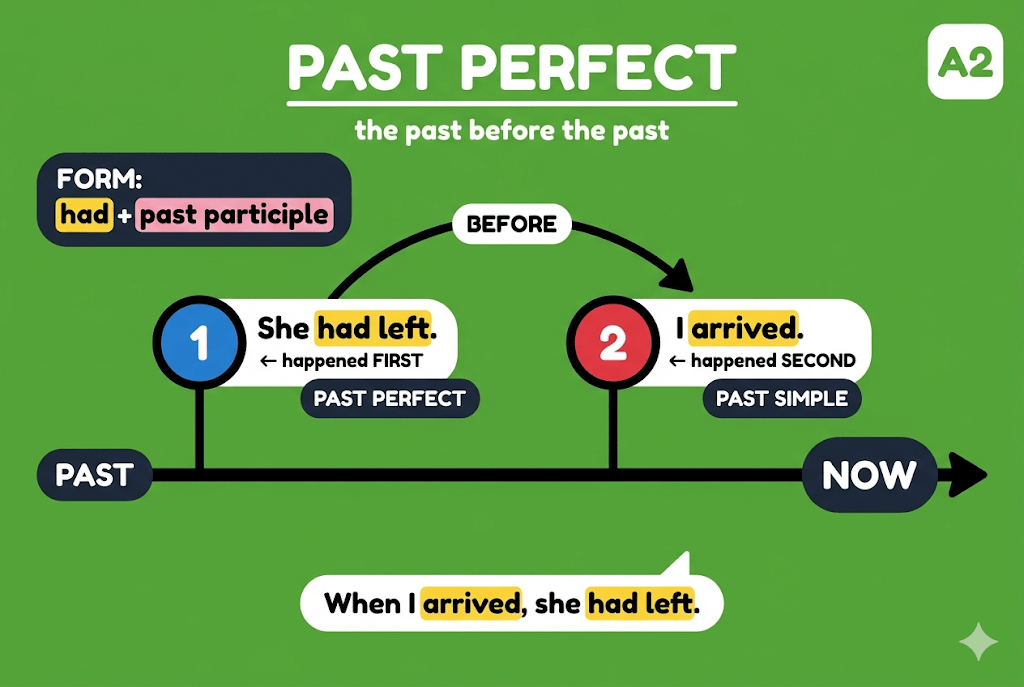
A long action was in progress (past continuous) when something short happened (past simple) and broke into it.
- I was having dinner when the phone rang.
For the full comparison and more examples of this pattern, see past simple vs past continuous.
Background description in a story
Past continuous sets the scene. It tells you what was already going on before the main events arrive in the past simple.
- It was raining hard. People were running for shelter. Suddenly, a car stopped in front of me and the driver shouted my name.
- The café was getting busy. Waiters were carrying trays between the tables. Then the lights went out.
Signal words
Certain words often appear with the past continuous:
| Type | Examples |
|---|---|
| Clock times | at 7 p.m., at midnight, at 10 o'clock yesterday |
| Time periods | all morning, all day, the whole evening |
| Linking words | while, as, when |
Tip After while and as, you usually find the past continuous. After when, you usually find the past simple. Compare: While I was reading… / When the phone rang…
State verbs
Some verbs are called state verbs: they describe a situation, not an action. They're not normally used in the continuous form. Common examples:
- know, understand, remember, believe, think (= believe)
- like, love, hate, prefer, need
- have (= own), own, belong
- see, hear (= perceive)
Use the past simple with these verbs, even when you mean "at that moment".
- I was understanding the lesson. → I understood the lesson.
- She was believing him. → She believed him.
Some of these verbs are fine in the continuous when the meaning changes. I was thinking about you (= you were in my mind) is correct, but I was thinking he was right (= believing) is not. The same goes for have: We were having dinner (= eating) is fine, but I was having a car (= owning) is not.
Common mistakes
I was eat dinner at 8 p.m. → I was eating dinner at 8 p.m.
You need was/were and -ing together. Don't drop the -ing.
They was playing in the garden. → They were playing in the garden.
Use were with they, we, you. Use was only with I, he, she, it.
What you were doing yesterday at 6? → What were you doing yesterday at 6?
In questions, was or were comes before the subject.
I was understanding the lesson. → I understood the lesson.
State verbs (understand, know, believe, like…) don't take the continuous. Use the past simple.
She was runing in the park. → She was running in the park.
Short verbs ending in consonant + vowel + consonant double the last letter before -ing.
I was watching TV yesterday. → I watched TV yesterday.
For a finished action with a general past time (yesterday, last week), use the past simple. The past continuous needs a specific moment or another action interrupting it.
Which sentence fits?
Choose the correct form for each gap. Answers are below.
- At 11 p.m. last night, my parents _____ (sleep).
- What _____ you _____ (do) at 5 o'clock yesterday?
- While I _____ (walk) home, I _____ (see) an old friend.
- The sun _____ (shine) and the birds _____ (sing). It was beautiful.
- Mark _____ (read) a book when his sister _____ (come) into the room.
Answers: 1. were sleeping. 2. were you doing. 3. was walking / saw (long action + short action). 4. was shining / were singing. 5. was reading / came (long action + short action).
Quick summary
- Form: was/were + verb + -ing.
- Use was with I, he, she, it; were with you, we, they.
- Main use: an action in progress at a moment in the past.
- Often combined with the past simple to show an interrupted action.
- Don't use it with state verbs like know, understand, believe, like.

Comments