
Future with Will: Predictions and Offers— A2 Grammar Exercises
Published March 14, 2026
Exercise 1 — Multiple Choice
I think it ____ rain tomorrow.
She ____ help you with your homework.
They ____ finish the project by next week.
I promise I ____ call you later.
He thinks it ____ be sunny on Saturday.
We ____ visit the museum next month.
I believe they ____ win the match.
She ____ take care of the dog while you are away.
They think it ____ snow this winter.
I ____ help you with your project if you want.
You look out the window at dark clouds: It will rain later. Your friend struggles with a heavy bag: I'll carry it for you. The waiter asks what you want: I'll have the soup, please. All three sentences use will for the future, but for different reasons.
Will is one of the main ways to talk about the future in English, especially for predictions and decisions made in the moment. The form is simple, but the meaning changes with the situation, and the same word covers several different jobs.
Form
Will is the same for every subject. You don't add -s for he, she, or it. After will, you use the base form of the verb: no to, no -ing, no -ed.
subject + will + base verb
Positive, negative, and question
| Form | Full | Short |
|---|---|---|
| Positive | I will help you. | I'll help you. |
| Negative | I will not help you. | I won't help you. |
| Question | Will you help me? | n/a |
The short forms are very common in speaking and informal writing: I'll, you'll, he'll, she'll, it'll, we'll, they'll. The negative short form is always won't.
When to use will
1. Predictions about the future
Use will when you think or believe something will happen in the future. This is your opinion or guess, not a fact. You often use will with words like think, believe, hope, expect, and probably.
- I think it will rain tomorrow.
- She will be a great teacher one day.
- Our team won't win the match.
- I'm sure you will like the film.
- The kids will probably be tired after the trip.
- I hope it won't be cold tonight.
2. Offers and promises
Use will when you decide to do something at the moment of speaking, especially to help someone. This is a very common use of will in everyday conversation.
- That bag looks heavy. I'll carry it for you.
- Don't worry about the dishes, I'll wash them.
- I'll call you when I get home, I promise.
- We'll send you the documents by Friday.
- I'll never forget what you did for me.
3. Quick decisions at the moment of speaking
Use will when you decide something right now, while you are speaking. The decision is not planned; it comes from the situation in front of you. The difference from an offer is simple: an offer means doing something for someone else; a quick decision is just choosing for yourself what to do next. This is why you use will when ordering in a restaurant or shop. Don't use going to here: the decision is happening as you speak, so will is the natural choice.
- The phone is ringing. I'll get it.
- What would you like? I'll have the chicken soup, please.
- It's hot in here. I'll open the window.
- I'm thirsty. I think I'll get a glass of water.
4. Asking someone to do something
Use Will you…? to ask for help or to ask someone to do something. It's direct and friendly between people who know each other: friends, family, classmates. For strangers or in formal situations, Could you…? and Would you…? sound more polite. Using Will you…? with a stranger can sound a little blunt.
- Will you close the door, please?
- Will you help me with this exercise?
- Will you pass me the salt?
- Will you wait for me outside?
Time expressions
These words often appear with will for future time:
- tomorrow: He'll arrive tomorrow.
- next week / month / year: We'll move next month.
- tonight: I'll call you tonight.
- in + time (in an hour, in two days): The film will start in ten minutes.
- soon: She'll be here soon.
- later: I'll do it later.
- one day / someday: One day, you'll understand.
Common mistakes
She wills come tomorrow.
She will come tomorrow.
Never add -s to will. The form is the same for every subject.
I will to help you.
I will help you.
Don't use to after will. Use the base form of the verb.
He will going to the party.
He will go to the party.
Don't use the -ing form after will. And don't mix will and going to in the same verb phrase.
Will you to open the window?
Will you open the window?
In questions, put will before the subject and use the base verb. No to.
I willn't be late.
I won't be late.
The negative short form is won't, not willn't. There's no such word as willn't.
The phone is ringing. I'm going to get it.
The phone is ringing. I'll get it.
For a decision made right now, in the moment, use will, not going to. Going to is for plans you already had.
Will vs going to
Both will and going to talk about the future, but they often mean different things. The difference is about when you decided and what kind of prediction you're making.
| Will | Going to |
|---|---|
| Decision made now, while speaking | Plan or intention decided before speaking |
| I'll have a coffee, please. (deciding while looking at the menu) |
I'm going to have a coffee with Maria later. (already planned) |
| Prediction based on your opinion or belief | Prediction based on evidence you can see now |
| I think it will rain tomorrow. (what you believe) |
Look at those clouds — it's going to rain. (you can see it) |
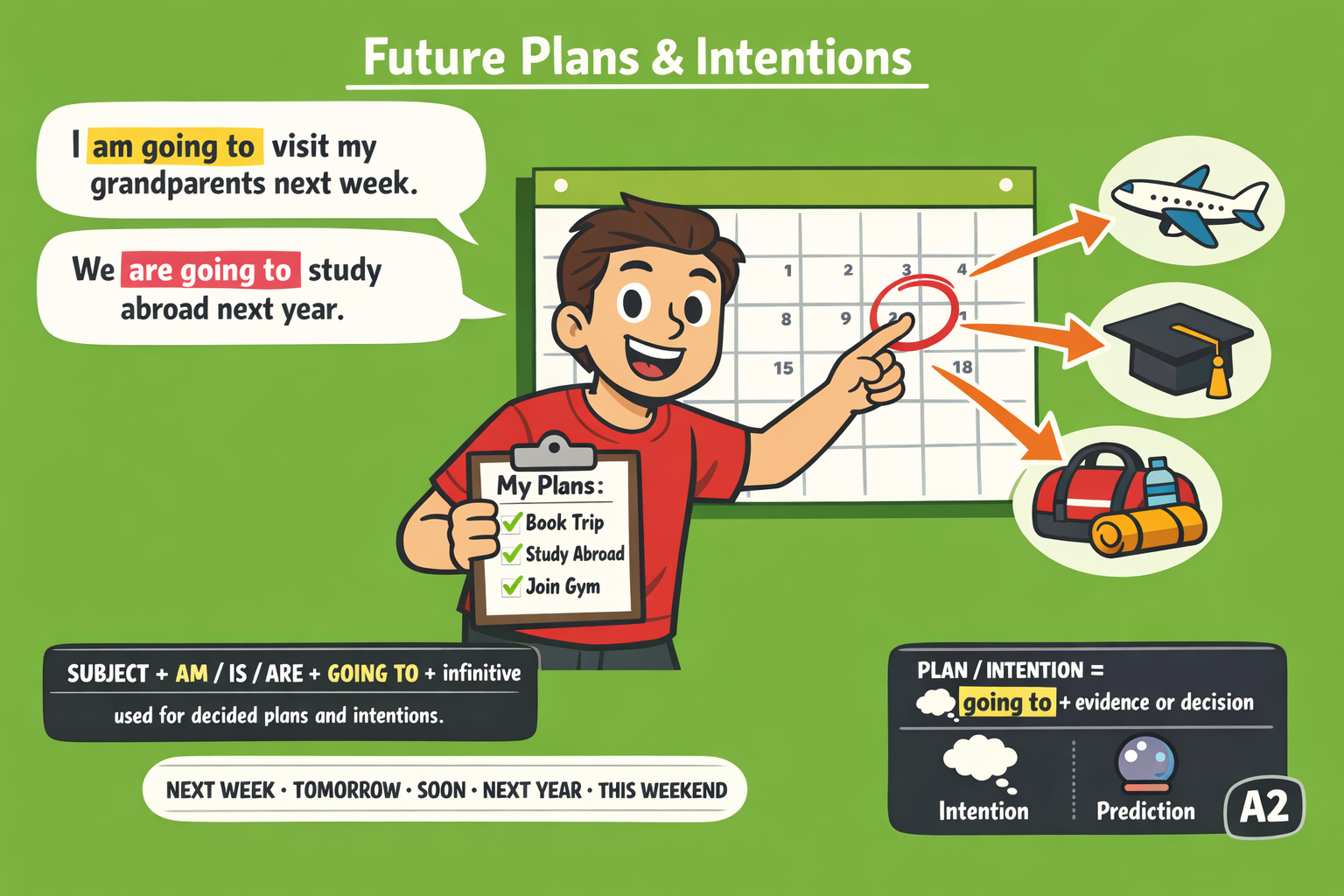
For more on the planned-future form, see be going to.
Quick summary
- Use will for predictions, offers, promises, quick decisions, and requests.
- The form is the same for every subject: will + base verb.
- The negative short form is won't. Never willn't.
- For an offer or a decision made in the moment, use 'll, not going to.
- For a plan you already had, use going to, not will.
Related topics
- Be going to: for plans and predictions with evidence.
- Present simple: for timetables and scheduled future events.
- First conditional: uses will for future results: If it rains, we'll stay home.

Comments