
Reported Speech: Questions— B1 Grammar Exercises
Published March 14, 2026
Exercise 1 — Multiple Choice
She asked me, 'What time is it?' I told her ____.
He wanted to know, 'Are you coming to the party?' I replied ____.
She asked, 'Where do you live?' I answered ____.
They inquired, 'Why are you late?' I explained ____.
He asked, 'Can you help me?' I said ____.
She wanted to know, 'Will you join us?' I replied ____.
He asked, 'Did you finish your homework?' I said ____.
She asked, 'How long have you lived here?' I replied ____.
He asked, 'What are you doing?' I said ____.
She asked, 'Have you seen my keys?' I replied ____.
Sara asked you yesterday, "Where do you live?" Now you're telling a friend about that conversation. You don't repeat her exact words; you say Sara asked me where I lived. The question loses its question word order, the verb shifts back in time, and the question mark disappears. That's reported speech for questions.
Reporting questions is more complex than reporting statements because three things change at once: word order, tense, and (for yes/no questions) the linking word.
Form
The structure depends on whether the original question starts with a question word (where, when, why, how, what, who) or expects a yes/no answer.
The reported question follows statement word order. There's no auxiliary do/does/did, no inversion, and no question mark.
| Direct question | Reported question |
|---|---|
| "Where do you work?" | He asked me where I worked. |
| "When did she arrive?" | I asked when she had arrived. |
| "Are you ready?" | She asked if I was ready. |
| "Have you finished?" | He asked whether I had finished. |
Statement vs question: don't mix the patterns
Reported statements and reported questions follow related but different patterns. Mixing them is one of the most common B1 errors.
| Reported statement | Reported question |
|---|---|
| She said she was tired. | She asked if I was tired. |
| He told me he worked in Berlin. | He asked me where I worked. |
| Reporting verb: say, tell. | Reporting verb: ask, want to know, wonder. |
| Linking word: that (often dropped). | Linking word: if/whether or a question word. |
Tense back-shift
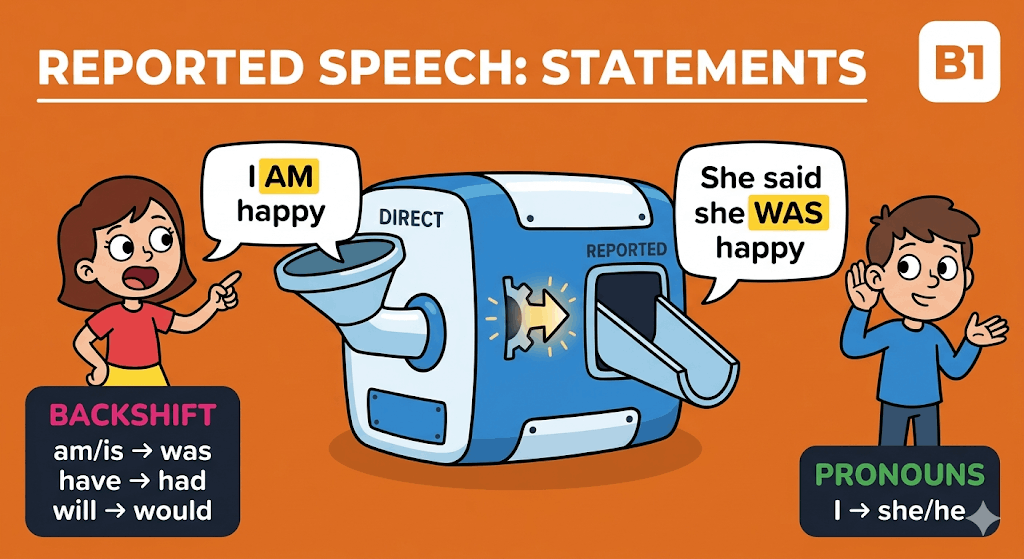
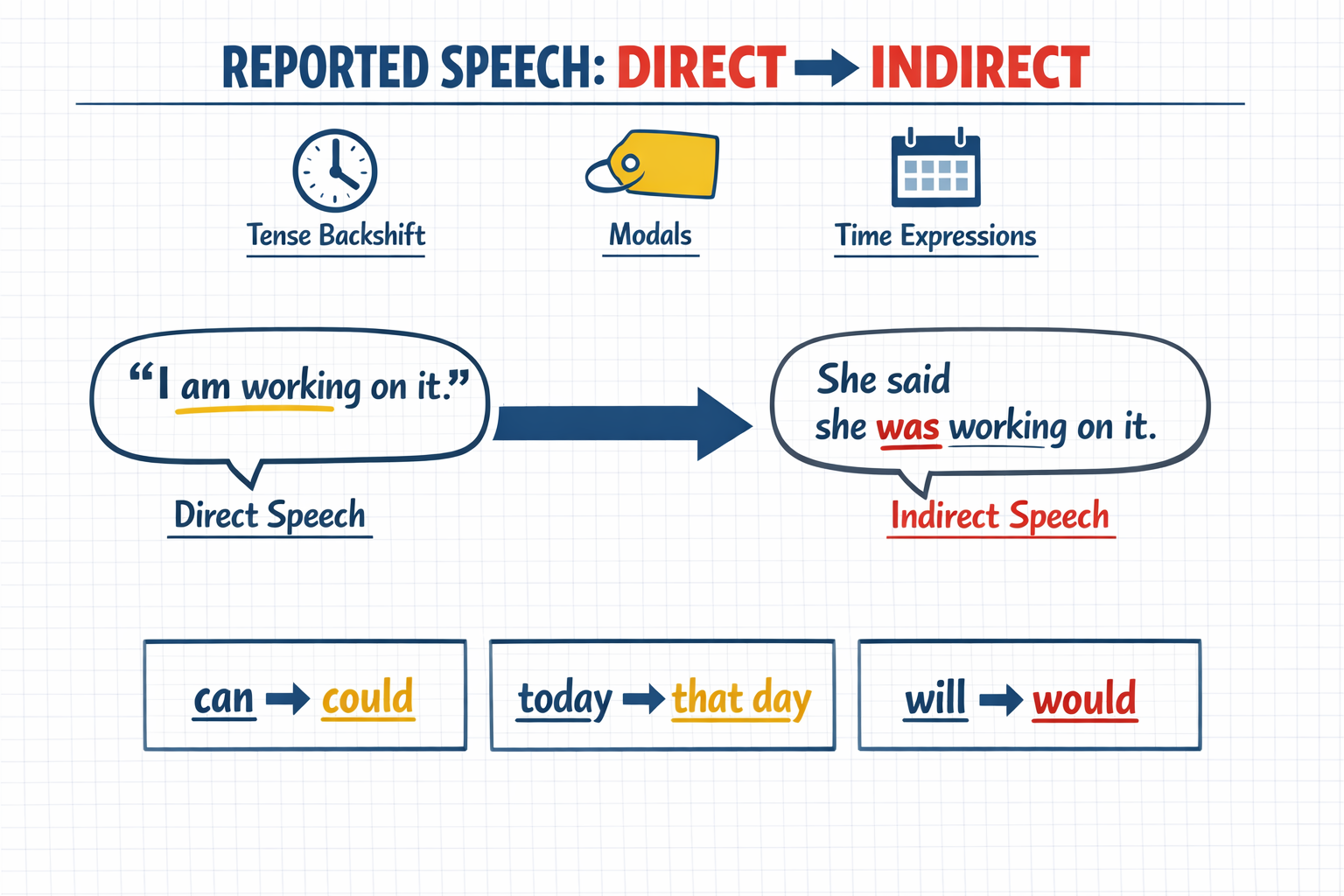
When the reporting verb (asked, wanted to know) is in the past, the verb in the reported question usually moves one tense back. This is the same back-shift used in reported statements.
| Direct | Reported |
|---|---|
| present simple → | past simple |
| present continuous → | past continuous |
| past simple → | past perfect |
| present perfect → | past perfect |
| will → | would |
| can → | could |
| may (possibility, not permission) → | might |
The may → might rule applies only to may meaning "possibly", for example: "He may be late" → She said he might be late. Permission may ("May I leave?") behaves differently and isn't covered by this back-shift.
When the reporting verb is present, no back-shift
Back-shift only happens when the reporting verb itself is in the past. If you're reporting in the present (describing a habit, a current request, or an ongoing situation), the original tense stays exactly as it was.
- "Where do you live?" → He always asks where I live.
- "Are you coming?" → She wants to know if you are coming.
- "What time is it?" → He is asking what time it is.
Don't apply back-shift mechanically. Look at the reporting verb first: past reporting verb → back-shift; present reporting verb → no change.
Reporting wh- questions
Keep the question word and put the subject before the verb. The auxiliary do/does/did disappears.
- "What time does the train leave?" → She asked what time the train left.
- "Why are you crying?" → He wanted to know why I was crying.
- "How long have you lived here?" → They asked how long I had lived there.
Reporting yes/no questions
Yes/no questions have no question word, so you need to add if or whether as the linking word.
- "Do you speak French?" → She asked if I spoke French.
- "Are they coming to the party?" → I asked whether they were coming to the party.
- "Did you call the doctor?" → He asked if I had called the doctor.
- "Can you swim?" → He asked if I could swim.
- "Have you eaten?" → She asked whether I had eaten.
- "Will you help me?" → He asked if I would help him.
If or whether? In speech and informal writing, use if: it's more natural and far more common. Use whether in formal writing, and always when the question offers alternatives: She asked whether I wanted tea or coffee. Both if and whether are correct in the simple yes/no examples above.
Reporting verbs
The most common verb for reporting questions is ask. You can also use want to know, wonder, enquire. Note that say and tell are not used to report questions.
| Direct | Reported |
|---|---|
| "Where are you going?" | She asked me where I was going. |
| "Is it raining?" | He wanted to know if it was raining. |
| "How much does it cost?" | I wondered how much it cost. |
Ask can take an object (ask me, ask him) but doesn't have to: She asked where I lived and She asked me where I lived are both correct. Use ask + object when it matters who was asked (The teacher asked Marco where he was from); use ask alone when the listener is obvious from context or simply not important to the report.
Pronoun, time and place changes
Other words shift along with the verb, depending on who is reporting and when. These changes are logical, not mechanical — they reflect the new speaker and the new time.
| Direct | Reported |
|---|---|
| I, you | he, she, I (depending on context) |
| my, your | his, her, my |
| this, these | that, those |
| here | there |
| now | then |
| today | that day |
| yesterday | the day before |
| tomorrow | the next day |
- Pronoun shift only: Marco said to Anna, "Do you want my book?" → Marco asked Anna if she wanted his book.
- This/that shift only: "Is this seat free?" → He asked if that seat was free.
- Time shift only: "Did you sleep well yesterday?" → She asked if I had slept well the day before.
- All shifts combined: "Are you coming here tomorrow?" → He asked if I was going there the next day.
Common mistakes
Keeping question word order.
She asked me where do I live.
She asked me where I lived.
Reported questions follow statement word order: subject + verb.
Keeping the auxiliary do/does/did.
He asked what did I want.
He asked what I wanted.
The auxiliary disappears in reporting. The main verb carries the tense.
Forgetting if or whether in yes/no questions.
She asked I was tired.
She asked if I was tired.
Yes/no questions need a connector — there's no question word to link the two clauses.
Using that after ask.
He asked that I was coming.
He asked if I was coming.
That is for statements, not questions.
Using say or tell for questions.
She told me where did I work.
She asked me where I worked.
Reporting questions takes ask, want to know, wonder — not say or tell.
Keeping the question mark.
He asked where I lived?
He asked where I lived.
A reported question is a statement about a question. End it with a full stop.
Forgetting to back-shift the verb in writing.
She asked if I am hungry.
She asked if I was hungry.
When the reporting verb is past, back-shift the reported verb. In informal speech you can sometimes keep the original tense if the fact is still true (see below) — but in writing and exams, always back-shift.
When back-shift is optional
If the original information is still true at the moment of reporting, spoken English sometimes keeps the original tense. Both versions are correct in conversation.
- "Where do you live?" → She asked where I live. (I still live there.)
- "Where do you live?" → She asked where I lived. (Standard back-shift, also correct.)
For exams and written English, always apply the back-shift. The back-shifted version is never wrong; the unshifted version only works when the fact is still true and the register is informal.
Embedded questions in statements
The same word-order rule applies when a question is embedded inside a longer statement, not just after a reporting verb. Phrases like I don't know, I'm not sure, I wonder, can you tell me all trigger the same pattern: question word + subject + verb, no inversion, no do/does/did.
- "What time is it?" → I don't know what time it is.
- "Where did she go?" → I'm not sure where she went.
- "Is the shop open?" → I wonder if the shop is open.
This is also how polite indirect questions work: Could you tell me where the station is? No back-shift here, because the introducing verb (could you tell me) is present.
Quick summary
- Reported questions use statement word order: subject + verb.
- Drop the auxiliary do/does/did — the main verb carries the tense.
- For wh- questions, keep the question word.
- For yes/no questions, add if or whether (if for informal, whether for formal or alternatives).
- Back-shift the verb when the reporting verb is past; keep the original tense when the reporting verb is present.
- Use ask, want to know, wonder — never say or tell.
- End with a full stop, not a question mark.
Related topics
- Reported speech: statements: the partner topic, covering how to report what people said rather than asked.
- Modal verbs: must, might, may, have to: modal verbs change form in reported speech, so this is useful background.
- Passive voice: frequently appears in reporting verbs at higher levels (it was reported that…).
Comments