
Future Plans and Intentions— A2 Grammar Exercises
Published March 14, 2026
Exercise 1 — Multiple Choice
I ____ go to the cinema tomorrow.
She ____ visit her grandparents next week.
They ____ have a picnic if the weather is nice.
We ____ start the project next month.
He ____ buy a new car soon.
I ____ learn Spanish next year.
They ____ travel to Europe this summer.
She ____ finish her homework later.
We ____ visit the museum on Saturday.
I ____ call you later this evening.
You bought a plane ticket last week: I'm going to visit my sister in Madrid. Your friend chose a new university course: She's going to study medicine. Your team has a meeting on Tuesday: We're meeting the new client at 10. These are all future plans: things you decided before this conversation.
For plans, intentions, and arrangements in English, you mainly use two structures: be going to for plans, intentions, and predictions with evidence, and the present continuous for fixed arrangements. They overlap, but each one fits some situations better than the other.
Form: be going to
Use am / is / are + going to + the base form of the verb. Be changes with the subject; going to and the base verb don't change.
subject + am / is / are + going to + base verb
| Subject | Form | Example |
|---|---|---|
| I | am going to / 'm going to | I'm going to call my mum tonight. |
| he / she / it | is going to / 's going to | She's going to start a new job. |
| you / we / they | are going to / 're going to | They're going to buy a house. |
The negative short forms are: I'm not going to, he's not / he isn't going to, we're not / we aren't going to. Both short forms are common; use whichever sounds natural.
Positive, negative, and question
| Form | Example |
|---|---|
| Positive | We are going to move next month. |
| Negative | We aren't going to move next month. |
| Question | Are you going to move next month? |
| Wh-question | What are you going to do on Saturday? |
| Wh-question | Where is she going to stay? |
When to use be going to
1. Plans and intentions decided before now
Use be going to for something you already decided to do. The plan exists in your head before you speak about it. You don't need a date, a ticket, or anything fixed; you just need to have made the decision.
- I'm going to learn Italian next year.
- Mark is going to start the gym on Monday.
- We're going to visit my grandparents this weekend.
- I'm not going to eat meat anymore.
- My parents are going to sell their car.
- I'm going to look for a new flat after the holidays.
2. Predictions based on what you see now
Use be going to when you can see or hear evidence right now that something will happen. You're not guessing; you have a reason in front of you.
- Look at those black clouds, it's going to rain.
- Be careful! You're going to fall.
- The bus is full. We're not going to get a seat.
- She looks pale; I think she's going to be sick.
- Listen to that engine; the car is going to break down.
- He hasn't studied at all. He's not going to pass the exam.
Present continuous for fixed arrangements
You can also use the present continuous (am / is / are + verb-ing) to talk about the future. The meaning is similar to be going to, but more specific: the arrangement is fixed; you've agreed on a time, booked a place, or made a real commitment with another person.
subject + am / is / are + verb-ing
- I'm meeting Sara at 7 p.m. tomorrow.
- We're flying to Berlin on Friday morning.
- Tom is having dinner with his boss tonight.
- They're getting married in June.
You almost always need a time expression with the present continuous for future. Without one, the same sentence usually means "right now": I'm meeting Sara → I am meeting her at this moment. I'm meeting Sara at 7 → a future arrangement.
Time expressions for future plans
These signal words tell the listener you're talking about the future:
- tomorrow, tonight
- next week / month / year / Monday
- this weekend / evening / summer
- in + time period: in two hours, in three days, in 2027
- on + day or date: on Friday, on the 5th
- at + time: at 8 p.m., at the weekend
- soon, later
Common mistakes
I going to study tonight.
I'm going to study tonight.
Don't forget am / is / are. Be going to needs three parts.
She is going to studies medicine.
She is going to study medicine.
After going to, use the base form. No -s, no -ed, no -ing.
I'll visit my aunt next weekend. We planned it last month.
I'm going to visit my aunt next weekend. We planned it last month.
For a plan you already made, use be going to, not will. Use will only for decisions made right now.
I'm meeting the dentist. (sounds like "now")
I'm meeting the dentist on Tuesday at 3.
The present continuous for future plans almost always needs a time expression. Without one, the same sentence usually means "right now", and the listener won't know you mean the future.
Do you going to come tonight?
Are you going to come tonight?
Questions with be going to start with am / is / are, never do / does.
I'm going buy a new phone.
I'm going to buy a new phone.
Don't forget to. The structure is be going to + base verb.
Be going to vs present continuous
Both structures talk about future plans, and they often work in the same sentence. The difference is small but real: be going to is about your intention; the present continuous is about a fixed arrangement with a time, place, or other people involved.
| be going to | present continuous |
|---|---|
| Plan or intention (not fixed yet) | Fixed arrangement (time, place, or people set) |
| I'm going to learn to drive. (I've decided; no lessons booked yet) |
I'm taking my first driving lesson on Saturday. (booked, time fixed) |
| We're going to celebrate Anna's birthday somehow. | We're having dinner at Anna's place on Friday at 8. |
One important difference: only be going to works for predictions with evidence. You can say It's going to rain, but not It's raining to mean a future prediction: that just means it's raining right now.
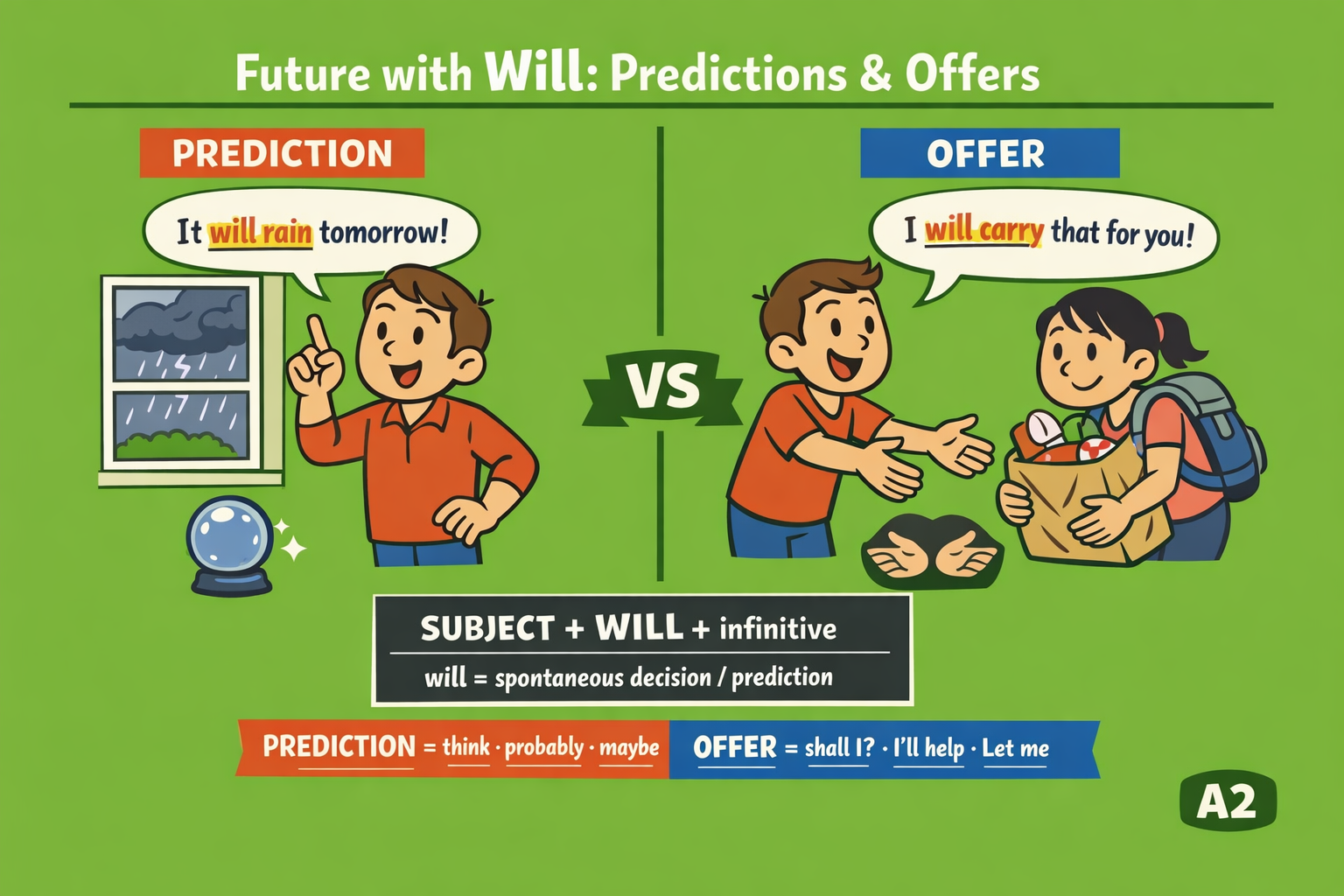
Be going to vs will
Learners often mix these up. The key difference is when you decided.
| be going to | will |
|---|---|
| Decided before the conversation | Decided during the conversation |
| I'm going to have pasta tonight; I bought the ingredients this morning. | I'll have the pasta, please. (ordering, deciding now) |
For more on this structure, see future with will.
Quick summary
- Use be going to for plans, intentions, and predictions with evidence.
- Use the present continuous for fixed arrangements with a specific time.
- Don't use will for plans you already made; use be going to.
- After going to, always use the base form of the verb.
- The present continuous for future almost always needs a time expression.
Related topics
- Future with will: for predictions, offers, and decisions made in the moment.
- Present continuous: the present-time use of the same structure.
- Present simple: for timetables and scheduled future events.
Comments