
Advanced Past Tenses: Simple, Continuous and Perfect— C1 Grammar Exercises
Published March 23, 2026
Exercise 1 — Gap Fill Select
By the time she arrived, we already finished the meeting.
When I called you yesterday, you dinner.
She in Paris for five years before moving to London.
They the project when the manager arrived.
I the report before the deadline last week.
By 8 PM, he for three hours.
While she the presentation, the computer crashed.
They the documents before the meeting started.
I all day, so I was very tired by evening.
She when the phone rang.
By the time the auditors arrived, the finance team had been preparing for the inspection for three weeks, and most of them were running on coffee and adrenaline. A single sentence can weave together three past tenses, each placing its event on a different layer of the timeline.
At C1, the question is no longer which past tense is grammatical but which one most precisely encodes the speaker's intended viewpoint. The same chronological facts can be told through several tense combinations, and each combination communicates something different.
The system uses four core forms (past simple, past continuous, past perfect simple, and past perfect continuous) to mark sequence, duration, completeness, and relevance within past time. Mastery means deploying them in narrative, in hypothetical structures, in reported speech, and in formal written register where the choice of aspect carries real meaning.
The four forms at a glance
Past Simple Subject + V2 / -ed
Past Continuous Subject + was / were + V-ing
Past Perfect Subject + had + past participle
Past Perfect Continuous Subject + had been + V-ing
| Tense | Positive | Negative | Question |
|---|---|---|---|
| Past Simple | She resigned in October. | She didn't resign in October. | Did she resign in October? |
| Past Continuous | They were negotiating when the news broke. | They weren't negotiating at the time. | Were they negotiating at the time? |
| Past Perfect | The flight had departed before we reached the gate. | The flight hadn't departed by then. | Had the flight departed by then? |
| Past Perfect Continuous | He had been working there for a decade. | He hadn't been working there long. | Had he been working there long? |
The core distinction: sequence and viewpoint
The choice between these tenses is rarely about when something happened in absolute terms. It's about how the speaker positions one past event in relation to another. Past simple narrates the main line; past continuous frames the background activity around it; past perfect reaches back to mark what was already complete before that line began; past perfect continuous does the same but emphasises duration or visible trace rather than completion.
Ask yourself two questions before choosing the tense:
1. Is this event on the main narrative line, or earlier than it?
2. Do I want to highlight the completion of an action or its ongoing nature?
Narrative use: building layered past time
Past simple: the spine of the story
The past simple carries the sequence of completed events on the main timeline. Each verb advances the narrative one step.
- The minister arrived at the conference, delivered a brief statement, and left without taking questions.
- Sales fell sharply in the third quarter and recovered only in December.
Past continuous: the surrounding scene
The past continuous sets the scene around past simple events. It describes an activity already in progress when something else happened, or two parallel activities running simultaneously. The basic mechanics are covered in past simple vs past continuous; at C1, the same form takes on the additional functions discussed below.
- I was reviewing the contract when she called.
- While the committee was deliberating, journalists were gathering outside the building.
Past continuous for repeated, often irritating, behaviour
With always, constantly, forever, the past continuous marks repeated past actions and typically carries a tone of complaint or exasperation. The simple past would state the fact neutrally; the continuous adds the speaker's attitude.
- He was always interrupting in meetings.
- She was constantly complaining about the workload.
- My old neighbours were forever leaving their bins on the pavement.
Past perfect: the earlier layer
The past perfect reaches into the time before a past reference point. The reference point is established by another past verb in the surrounding context (usually past simple) or by a time expression that locates an earlier moment relative to the main narrative. In isolation, a sentence like I had finished the report sounds incomplete because the reader is waiting for the later event the past perfect is pointing back from.
- By the time the report was published, the company had already lost half its market share.
- She realised she had left her passport at the hotel.
Past perfect continuous: duration before a past point
The past perfect continuous emphasises how long an activity lasted up to a past reference point, or shows that its effects were still visible. The distinction from the past perfect simple is one of focus, not chronology.
- When the prosecution finally rested, the trial had been running for fourteen weeks.
- His eyes were red because he had been crying.
Past perfect simple vs past perfect continuous
This is the contrast that most distinguishes a C1 speaker from a B2 one. Both forms locate an event earlier than another past moment, but they package it differently; the same simple/continuous distinction the present perfect continuous makes in present time, shifted one layer back.
| Past Perfect Simple | Past Perfect Continuous |
|---|---|
| Action completed before another past point. | Action in progress up to or just before another past point. |
| Focus on the result or fact. | Focus on the duration or visible aftermath. |
| She had written three drafts before she was satisfied. (They were finished.) | She had been writing all morning when the power cut out. (She was still at it.) |
| By March, the agency had handled sixty cases. | By March, the agency had been handling a growing backlog. |
| Used with stative verbs (know, own, believe, understand). | Generally avoided with stative verbs. |
With stative verbs, the simple form is obligatory: She had known him for years, not She had been knowing him for years.
Past tenses beyond narrative
In hypothetical structures
Past tense forms in English do double duty: they mark past time, and they mark distance from reality. This distancing function is why the second conditional uses past simple for unreal present situations, why it's time takes a past form for a present obligation, and why the past perfect extends naturally to mark past unreality in the advanced conditionals and the wish / if only structure. The tense is past in form; the time reference is unreal, not historical.
- If she knew the answer, she would say so. (present unreal)
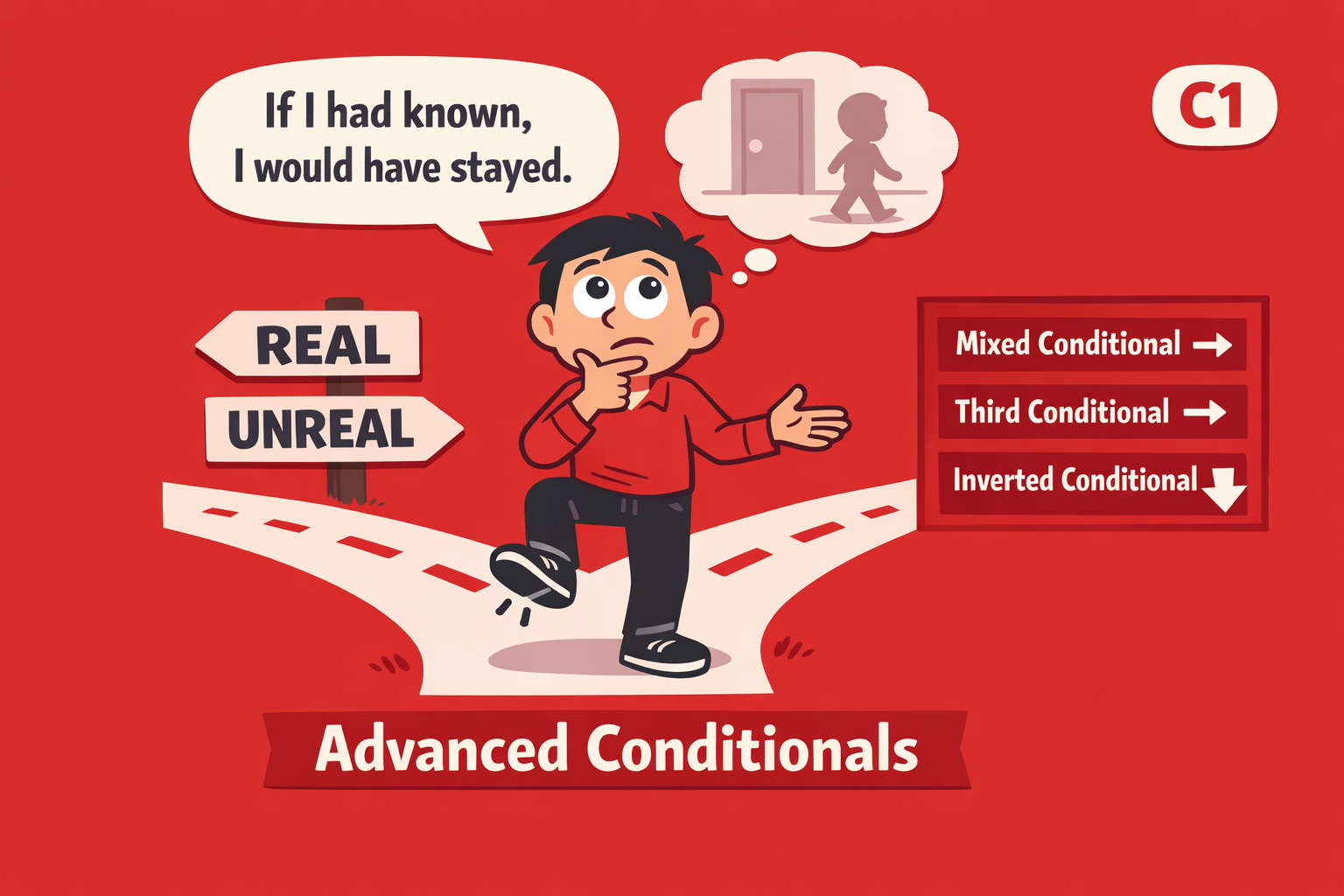
- If we had left earlier, we would have caught the train. (past unreal)
- I wish I had said something at the meeting. (regret about the past)
- It's time we addressed the budget shortfall. (present, but distanced)
In reported speech
Backshift in reported speech is a sequence-of-tenses convention: when the reporting verb is in the past, the reported tense typically shifts one step back. Present becomes past, past simple becomes past perfect, and past perfect serves as the floor; no further backshift applies beyond it. Backshift can be suspended when the reported statement remains universally true at the moment of reporting.
- "I am writing a complaint." → He said he was writing a complaint.
- "I wrote the report yesterday." → She said she had written the report the previous day.
- "We had finished the audit." → They claimed they had finished the audit.
In formal and academic register
In written analysis (history, case studies, literary commentary) the past perfect appears far more frequently than in conversation because writers routinely establish chronological depth. Spoken English often substitutes the past simple where the past perfect would be technically more accurate; in writing, the precision matters.
Consider a typical paragraph of historical analysis:
By 1914, the empire had absorbed three smaller principalities and had been negotiating trade concessions with two more. When the assassination took place in June, diplomats were already drafting the response that would shape the following decade.
Four past forms operate inside two sentences: past perfect for prior completion, past perfect continuous for ongoing prior activity, past simple for the central event, and past continuous for parallel action. Collapsing them all into the past simple would lose the chronological depth the genre demands.
Common mistakes at C1
Errors at this level rarely concern form. They cluster around aspect, viewpoint, and the inappropriate use of one tense where another would carry the intended meaning more precisely.
Last summer I had visited my grandmother in Devon.
Last summer I visited my grandmother in Devon.
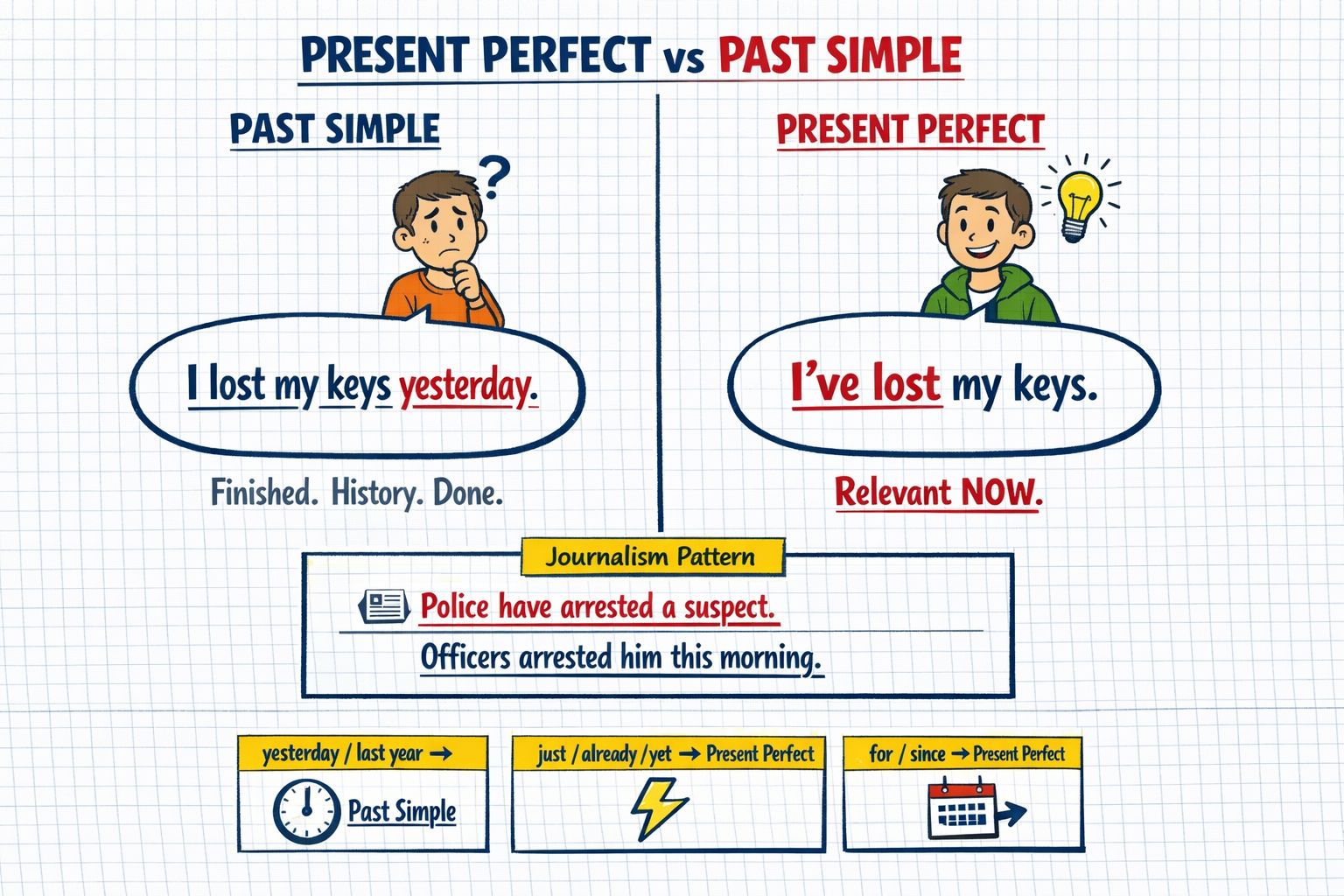
When a past time expression simply locates the event (last summer, yesterday, in 2019) and there's no earlier reference point to look back from, use the past simple. This is the same logic that governs present perfect vs past simple at B2: a fixed past time anchor rules out the perfect.
I woke up, I had brushed my teeth, and I had gone to work.
I woke up, brushed my teeth, and went to work.
A sequence of completed actions on the main narrative line takes the past simple. The past perfect is reserved for events that genuinely sit on an earlier layer: using it for every prior action in a sequence is a frequent B2-to-C1 over-correction.
She had been owning the company for a decade.
She had owned the company for a decade.
See the table above on stative verbs.
When the police arrived, the thieves were leaving already.
When the police arrived, the thieves had already left.
If one action is finished before another, use the past perfect: not the past continuous.
I was knowing him since school.
I had known him since school.
For a state lasting up to a past point, use the past perfect simple, not the past continuous.
If I would have known, I would have called.
If I had known, I would have called.
In the third conditional, the if-clause takes past perfect, never would have.
He was working there for ten years when he retired.
He had been working there for ten years when he retired.
When duration leads up to a past reference point, the past perfect continuous is required. The past continuous expresses an activity in progress at a past moment, not one whose duration extends up to it.
Signal expressions
These expressions point reliably toward particular tenses, though context can override them.
| Expression | Typical tense | Example |
|---|---|---|
| by the time, by then | Past perfect | By the time the doors opened, the queue had stretched around the block. |
| no sooner… than, hardly… when | Past perfect (+ inversion) | No sooner had he sat down than the phone rang. |
| while, as | Past continuous | While we were discussing the figures, the auditor took notes. |
| for, since (in past context) | Past perfect / past perfect continuous | He had been campaigning for months before the vote. |
| already, just, never (before) | Past perfect | I realised I had just made a serious mistake. |
| when (sequential) | Past simple, past simple | When the lights went out, everyone screamed. |
Treat these as defaults, not rules. Several shift with context:
By the time only triggers the past perfect in past contexts. In a future frame, it takes the present simple in its own clause and the future perfect in the main clause: By the time we arrive, dinner will be ready.
For / since with a past time anchor takes the past perfect, but in present contexts it pairs with the present perfect: I've worked here since 2018.
When with two past simples signals sequence, but when + past continuous describes a background activity: When I called, she was driving.
Aspect over chronology: the C1 mindset
At lower levels, learners are taught past tenses as a sequence: what happened first, second, third. At C1 that framing breaks down: the same chronological facts yield different meanings depending on which tenses carry them, and the choice signals focus, register, and the kind of text the sentence belongs in.
Consider four versions of the same event:
- She trained for the marathon and completed it in under four hours. Bare narration; news report or CV bullet.
- She had been training for months when she completed the marathon in under four hours. Foregrounds effort and duration; sports journalism, biography, personal interview.
- She had trained rigorously, and on race day she completed the marathon in under four hours. Preparation as a completed, prior phase; formal profile or analytical writing.
- She had trained for months, had recovered from a stress fracture, and completed the marathon in under four hours. Stacked prior events compressing back-story; written narrative.
A C1 user chooses among these consciously, matching aspect to message and register to genre.
Quick summary
• Past simple carries the main narrative line; past continuous wraps activity around it.
• Past perfect points to a layer earlier than the main past time being discussed: don't use it for events that simply happened in the past.
• Past perfect simple emphasises completion; past perfect continuous emphasises duration or visible trace.
• Past tenses carry hypothetical meaning in conditionals, wish, and it's time: distance from reality, not historical fact.
• At C1, tense choice is about viewpoint and aspect, not just chronology.

Comments