
Second Conditional— B1 Grammar Exercises
Published March 14, 2026
Exercise 1 — Multiple Choice
If I ____ a bird, I would fly around the world.
If she ____ a millionaire, she would travel every month.
If they ____ more time, they would learn to play the guitar.
If I ____ you, I would take that job offer.
If we ____ a car, we would drive to the beach every weekend.
If he ____ a better job, he would be happier.
If I ____ a time machine, I would visit the past.
If she ____ a chance, she would change her career.
If they ____ more money, they would donate to charity.
If I ____ a superhero, I would save the world.
Imagine you don't speak Italian. A friend asks: "What would you do if you got lost in Rome?" You answer: If I got lost, I would use a map app. You're not really lost; it's a hypothetical situation. The verb after if is past, but the meaning is about now or any time. That's the second conditional.
The second conditional describes unreal or unlikely situations in the present or future, and their imagined results. It's the structure you reach for when you talk about dreams, hypotheticals, advice, and things that are simply not the case.
Form
The sentence has two parts: the if-clause (the condition) and the main clause (the result). The order can be reversed, and when the main clause comes first, you don't need a comma.
- If I had more time, I would learn Spanish.
- I would learn Spanish if I had more time.
| Form | Example |
|---|---|
| Positive | If she studied harder, she would pass the exam. |
| Negative | If she didn't study harder, she wouldn't pass the exam. |
| Question | What would she do if she failed? |
The past simple after if doesn't refer to past time. It signals that the situation is hypothetical: the speaker is imagining, not reporting.
Were instead of was
With I, he, she, it, the second conditional traditionally uses were instead of was in the if-clause. This is the subjunctive form, and it's the safe choice in formal writing and exams.
- If I were you, I would apologise.
- If she were taller, she could reach the top shelf.
In modern British and American English, was is now common in non-fixed sentences: If she was taller, she could reach the top shelf is widely heard and increasingly seen in writing. The exception is the fixed phrase If I were you, which keeps were almost always, even in casual speech. For exam purposes, use were.
Usage
Hypothetical situations in the present or future
The condition isn't true now and probably won't be. The speaker is imagining an alternative reality.
- If I spoke Mandarin, I would work in Shanghai. (I don't speak Mandarin.)
- If we had a bigger flat, the children would have their own rooms. (Our flat isn't bigger.)
Giving advice with If I were you
This is the most common use of the second conditional in everyday English. It softens advice and makes it less direct than a command.
- If I were you, I would take the earlier train.
- If I were you, I wouldn't tell her yet.
Unlikely future events
When the speaker thinks something is possible but improbable, they shift from the first conditional to the second.
- If I won the lottery, I would travel the world. (Winning is very unlikely.)
- If aliens landed in my garden, I would film them. (Not going to happen.)
Imagining and dreaming
Used to talk about wishes and "what if" scenarios: daydreams, choices in different lives, preferences in unreal situations.
- If I could live anywhere, I would choose Lisbon.
- If you met a famous person, who would it be?
Polite requests and softened proposals
The second conditional structure makes requests and suggestions gentler than direct ones, by framing them as hypothetical rather than demanded.
- If you had a moment, would you check this for me?
- It would be easier if you sent me the file by email.
The hypothetical framing is what makes these polite: the speaker isn't insisting on the condition, just imagining it.
Could in the if-clause
Could can appear in the if-clause meaning "were able to". The structure stays second conditional, but the condition shifts from a state to an ability.
- If I could speak French, I would move to Paris.
- If she could come to the meeting, we would start earlier.
This is common with skills and abilities: speaking a language, playing an instrument, getting somewhere on time.
Could and might in the result clause
You don't always have to use would. Could and might work in the main clause when the result is a possibility rather than a certain outcome.
- If I had a car, I could drive you to the airport. (ability)
- If she practised more, she might win the competition. (possibility, not certainty)
Compare with would, which presents the result as the imagined consequence: If she practised more, she would win the competition: a confident prediction in the imagined world.
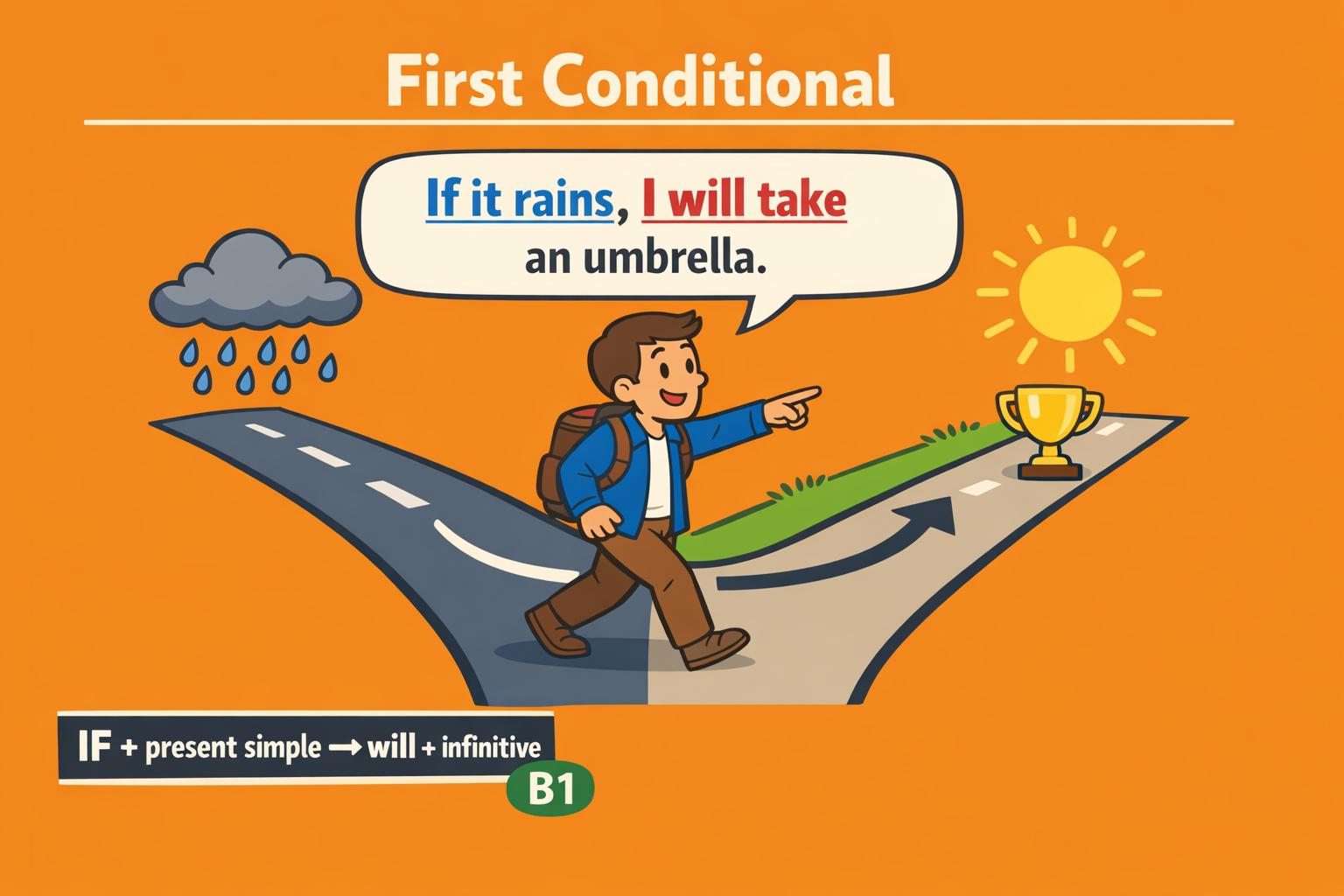
First conditional vs second conditional
This is the key choice for B1 learners. Both structures talk about possible situations; the difference is how realistic the speaker thinks they are.
| First conditional: real / possible | Second conditional: unreal / unlikely |
|---|---|
| If + present simple, will + base verb | If + past simple, would + base verb |
| If it rains, I will take an umbrella. | If I lived in the desert, I would miss the rain. |
| The speaker thinks rain is genuinely possible. | The speaker doesn't live in the desert. |
| If she studies, she will pass. | If she studied, she would pass. |
| Realistic — she might actually study. | Hypothetical — she's not studying. |
The choice often reflects the speaker's attitude rather than objective reality. Compare:
- If I get the job, I'll celebrate. (confident, sounds likely)
If I got the job, I'd celebrate. (doubtful, sounds unlikely) - If you marry him, you'll be happy. (encouraging, sounds positive)
If you married him, you'd be happy. (skeptical, distances the speaker from the idea)
The same situation can take either form. The grammar reveals what the speaker really thinks about it.
Common mistakes
Using would in the if-clause.
If I would have more money, I would buy a car.
If I had more money, I would buy a car.
Would belongs only in the result clause. The if-clause takes the past simple.
Mixing first and second conditional.
If I won the lottery, I will buy a house.
If I won the lottery, I would buy a house.
Past simple in the if-clause must pair with would in the main clause — not will.
Treating the past simple as past time.
If I lived in Paris last year, I would visit the Louvre every weekend.
If I lived in Paris, I would visit the Louvre every weekend.
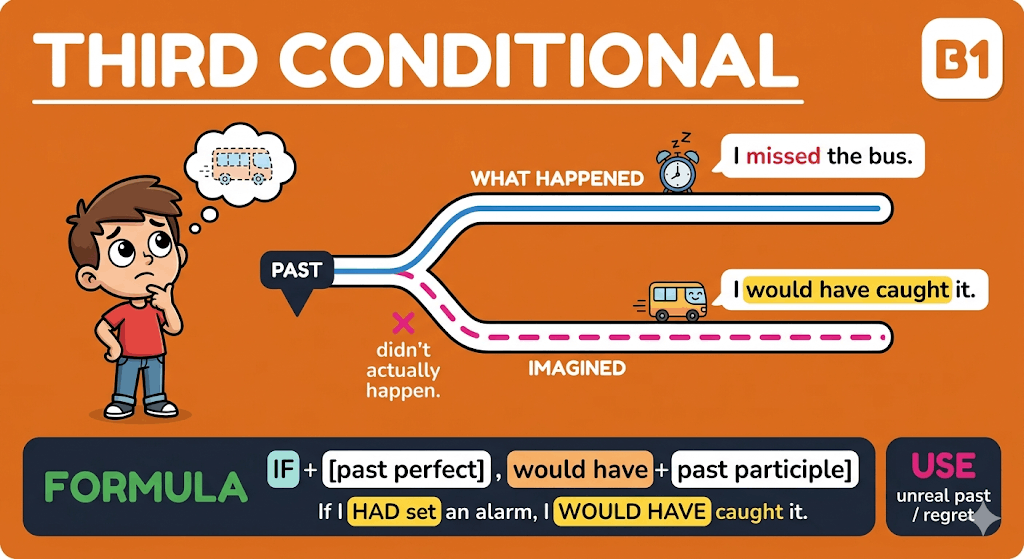
The second conditional refers to present or future, not past. For past situations, use the third conditional (If I had lived in Paris, I would have visited…).
Using will instead of would.
If she had time, she will help us.
If she had time, she would help us.
Hypothetical results take would, never will.
Using was with If I were you.
If I was you, I would resign.
If I were you, I would resign.
The fixed advice phrase always uses were, regardless of register.
Second conditional and I wish
The second conditional uses the same verb form as I wish + past simple — both express situations the speaker imagines but doesn't have. They often appear together.
- I wish I had more time. → If I had more time, I would learn Spanish.
- I wish I spoke French. → If I spoke French, I would move to Paris.
Wish + past simple is technically a B2 topic, but if you've understood the second conditional, you already know the structure — the past tense expresses a present unreal situation in both cases.
Quick summary
- Form: If + past simple, + would + base verb.
- Use it for unreal or unlikely situations in the present or future — never the past.
- The past simple after if doesn't mean past time.
- Use were (not was) with I, he, she, it in formal contexts and always in If I were you.
- Could can appear in the if-clause to mean "were able to".
- Could and might can replace would in the main clause when the result is possible rather than certain.
- Choose between first and second conditional based on how likely the situation feels — not just whether it's grammatically possible.
Related topics
- First conditional: the realistic counterpart; the most important comparison to make.
- Mixed conditionals: what happens when the condition and the result belong to different time frames.
- Modal verbs: must, might, may, have to: useful background for using might and could in the result clause.

Comments