
Wish, if only, it's time — unreal past— B2 Grammar Exercises
Published March 25, 2026
Exercise 1 — Gap Fill Select
I I had studied harder for the exam last week.
If only she more careful when driving yesterday.
It's time you your homework before watching TV.
I I could travel more often, but I don't have enough money.
If only I more time to finish the project last month.
It's time we to bed; it's already midnight.
I wish I so rude to my friend yesterday.
If only he the meeting yesterday; we could have discussed the problem.
It's time you your mistakes and apologized.
I wish it raining so we could go for a walk.
You're shivering on a Berlin street corner in November with no coat. What comes out of your mouth? I wish I had brought a jacket. The action is over, the regret is now, and the grammar that carries this feeling is the unreal past, the same backshift that runs through the second and third conditionals, repurposed for regret, frustration, and overdue action.
Wish, if only, and it's (high/about) time all share one strange feature: they use past tense forms to talk about the present or the future. The verb looks like a past, but the meaning isn't. That gap between form and time is what learners have to get used to.
The three structures at a glance
Each expression uses the unreal past, but the time reference differs depending on which past form follows.
| Expression | Followed by | Refers to | Meaning |
|---|---|---|---|
| wish / if only | past simple | Present | I want this to be different now. |
| wish / if only | past perfect | Past | I regret what happened. |
| wish / if only | would + base verb | Future / behaviour | I'm annoyed and want change. |
| it's time | past simple | Present / overdue | This should already be happening. |
Wish + past simple: present dissatisfaction
Use this when you're unhappy with a present situation and want it to be different. The past tense is unreal; it doesn't mean the past.
- I wish I had more free time. (I don't, and I'd like to.)
- Sara wishes her flat were closer to the office.
- We wish we didn't live so far from the sea.
- I wish you weren't leaving tomorrow.
With be, formal English uses were for all subjects. Was is common in speech but avoided in writing and exams.
- I wish I were taller. formal / written
- I wish I was taller. informal speech
Wish + past perfect: past regret
Use this for regret about something that did or didn't happen in the past. The action is over and can't be changed.
- I wish I had studied harder for the exam. (I didn't, and now it's too late.)
- Marco wishes he hadn't sent that email.
- They wish they had booked the flights earlier.
- I wish you had told me sooner.
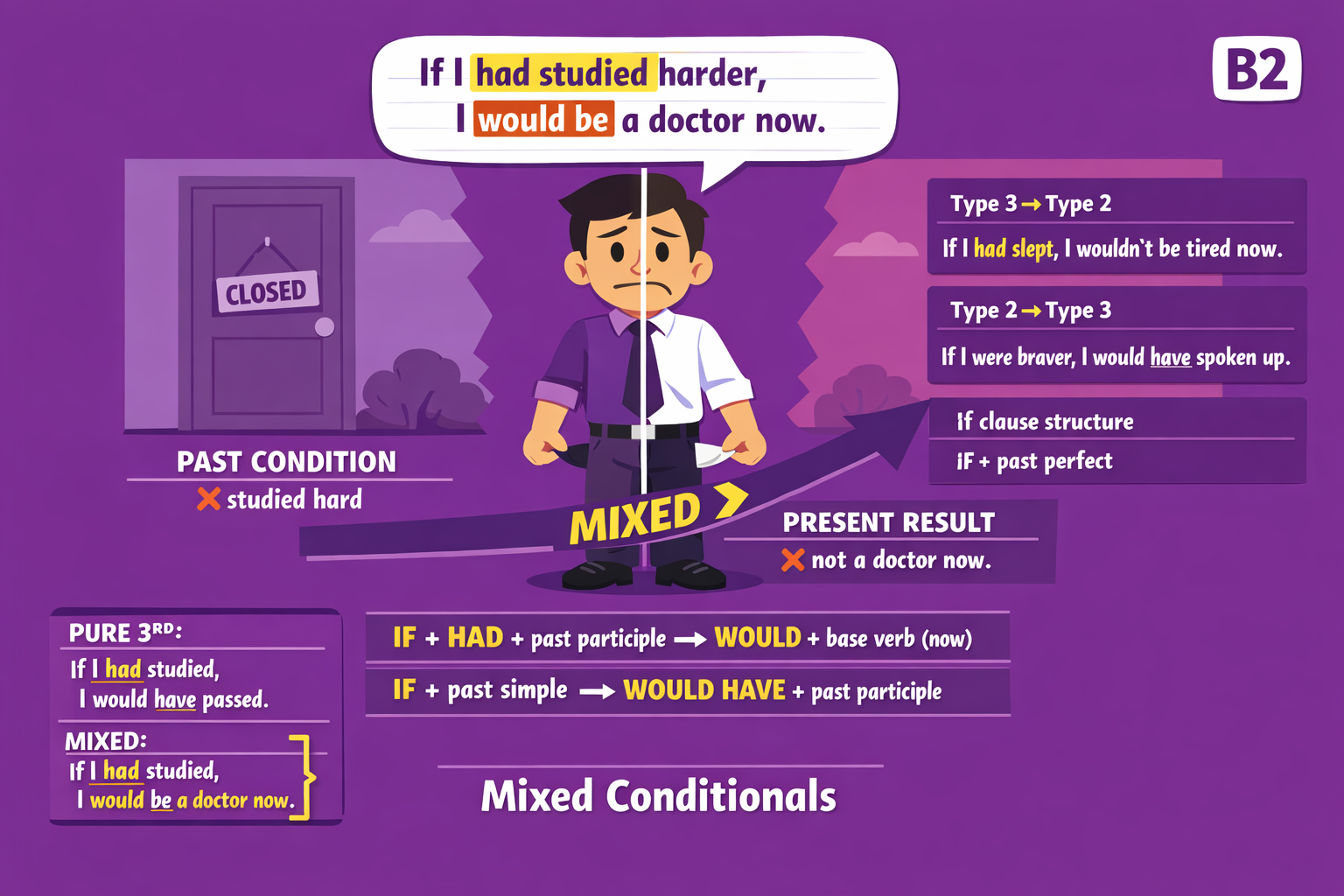
This is closely related to the third conditional; both deal with unreal past situations and the feeling that things could have gone differently.
Wish + would: annoyance and desired change
Use this to complain about someone else's behaviour or about a situation outside your control, with the implication that you want it to change.
- I wish the neighbours would turn the music down.
- She wishes her boss wouldn't email her at weekends.
- I wish it would stop raining.
I wish I would exercise more.
I wish I exercised more.
If only: stronger feeling, same patterns
If only follows exactly the same three patterns as wish, but carries more emotional weight: stronger regret, stronger longing, stronger frustration. It's also more dramatic in tone, common in speech and fiction, less common in neutral writing.
| Pattern | Example |
|---|---|
| + past simple | If only I knew the answer. |
| + past perfect | If only we had left earlier. |
| + would | If only the rain would stop. |
It's (high/about) time: overdue action
Use this to say that something should already be happening, and the delay is becoming a problem. Despite the past form, the meaning is firmly present and slightly urgent.
- It's time you went to bed. (You haven't yet, and you should have by now.)
- It's high time we left. (Strong: we're already late.)
- It's about time the council fixed this road. (Mild irritation: this is overdue.)
High time sounds the most urgent. About time adds a note of complaint or sarcasm. Plain it's time is the neutral version.
Common mistakes
I wish I had more money.
After wish, you need a past form for present meaning — not the present simple.
I wish I were taller.
Don't use wish + would about yourself or about fixed states. Would is for actions you want someone or something to do.
I wish I had studied harder for yesterday's test.
Past regret needs the past perfect, not the past simple.
It's time you went home.
After it's time + subject, use the past simple — even though you mean now.
If only she were here now.
For present states, use the past simple (or were), not would.
Wish vs. hope
Both translate to a single verb in many languages, but in English they're not interchangeable. Hope is for things that might still happen. Wish is for things that aren't true or aren't likely.
| Hope | Wish | |
|---|---|---|
| Time reference | Possible future or present | Unreal / contrary to fact |
| Verb form after | Present or future | Past forms (unreal past) |
| Example | I hope it doesn't rain tomorrow. | I wish it weren't raining now. |
| Example | I hope you passed. (You might have.) | I wish you had passed. (You didn't.) |
Quick summary
- The past form after wish, if only, and it's time doesn't mean past — it means unreal.
- Wish + past simple → present dissatisfaction.
- Wish + past perfect → past regret.
- Wish + would → annoyance with someone else's behaviour (never your own).
- If only uses the same patterns with stronger feeling.
- It's (high/about) time + past simple → something is overdue.
- Use were (not was) with all subjects in formal writing.
Comments