
Inversion: all types— C1 Grammar Exercises
Published March 23, 2026
Exercise 1 — Gap Fill Select
Never I seen such a breathtaking view.
Rarely she arrive late to meetings.
Only after the meeting we understand the full situation.
Had I known about the traffic, I left earlier.
Scarcely the guests arrive when the show started.
No sooner the meeting ended than the phone rang.
Not only she win the award, but she also gave a great speech.
Seldom we see such dedication in a team.
Under no circumstances you open this door without permission.
Little he realize the consequences of his actions.
"Never in my life had I seen such a sight." The auxiliary had jumps in front of I, and the sentence gains an emphasis and literary weight that "I had never seen such a sight in my life" simply doesn't have. That reversal of subject and auxiliary is inversion, and at C1 it spans far more than dramatic openings.
The two structural patterns
Almost every type of inversion follows one of two structures.
[Trigger] + auxiliary + subject + main verb
Rarely have I seen such dedication.
[Adverbial of place / direction] + full verb + subject
On the table stood a vase of lilies.
Pattern 1 is the inversion you'll meet most often in formal writing and exam tasks. Pattern 2 is mostly literary or descriptive, and crucially it only works when the subject is a full noun phrase, never a pronoun.
Inversion after negative and restrictive adverbials
This is the most frequent and most tested type. When a negative or restrictive expression moves to the front of the clause, subject–auxiliary inversion is obligatory. This builds on B2 inversion with negative adverbials and adds the wider C1 inventory.
| Trigger | Meaning | Example |
|---|---|---|
| Never / Rarely / Seldom | Frequency negation | Never had she felt so betrayed. |
| Hardly / Scarcely / Barely … when | One event immediately follows another | Hardly had the meeting begun when the fire alarm went off. |
| No sooner … than | Same as above; note than, not when | No sooner had I sat down than the phone rang. |
| Not only … but also | Adding a second, often stronger point | Not only does he speak Mandarin, but he also reads classical Chinese. |
| Not until / Only when / Only after | Restriction in time | Not until the figures arrived did we realise the scale of the loss. |
| Only by / Only in this way | Restriction in manner | Only by working together can we meet the deadline. |
| Little (= "not much") | Negation of awareness or knowledge | Little did the committee know what was about to happen. |
| Under no circumstances / On no account / At no time | Strong prohibition or denial | Under no circumstances should the door be left unlocked. |
| In no way / By no means | Categorical denial | In no way does this excuse the delay. |
With only when, only after, and not until, treat the entire fronted expression (including its subordinate clause) as a single unit. Inversion lands in the main clause that follows it, not inside the subordinate clause.
- Only when did she apologise, I forgave her.
- Only when she apologised did I forgive her.
Inversion in conditionals
Three conditional structures can drop if and invert instead. The result is more formal, characteristic of written English, legal documents, and careful speech. The logic of advanced conditionals still holds; only the surface form changes.
| Standard form | Inverted form |
|---|---|
| If I should hear anything, I'll call. | Should I hear anything, I'll call. |
| If she were to resign, the board would meet. | Were she to resign, the board would meet. |
| If we had known earlier, we would have acted. | Had we known earlier, we would have acted. |
Only these three patterns invert: should, were, and had. The first conditional with if + present simple cannot invert this way.
- Had they not signed the contract, the project would have collapsed.
- Hadn't they signed the contract, …
Inversion after so, such, and neither/nor/so
So + adjective / Such + noun
Fronting so or such for emphasis pulls the auxiliary forward. So goes with an adjective or adverb; such goes with a noun phrase.
- So convincing was her argument that the committee voted unanimously.
- Such was the noise that we abandoned the meeting.
- So quickly did the storm arrive that no one had time to react.
This pattern almost always needs a that-clause expressing the result. So convincing was her argument on its own is incomplete; the consequence is missing.
Agreement with so / neither / nor
To echo a previous statement, so (positive) and neither/nor (negative) trigger inversion. This is the one type frequent in spoken English.
- "I love jazz." / "So do I."
- "Marco can't drive." / "Neither can his sister."
- "I'm exhausted." / "So am I." (not So do I)
- "She has already booked." / "So has he."
Match the auxiliary in the original: be with be, have with have, a modal with the same modal. Only when the verb has no auxiliary do you fall back on do/does/did. Neither and nor are interchangeable, though nor is slightly more formal.
Inversion with adverbials of place and direction (Pattern 2)
When an adverbial of place or direction comes first, the verb (not just the auxiliary) moves before the subject. This is the literary, descriptive type, common in narrative writing and stage directions.
- In the doorway stood a tall figure in a grey coat.
- Down the valley flowed a narrow stream.
- Here comes the bride.
This pattern has two firm restrictions. First, the subject must be a full noun phrase. With a pronoun, inversion is blocked: Here comes she is wrong; Here she comes is right. Second, the verb must describe location, appearance, or movement into the scene: stand, sit, lie, hang; come, go, run, fly; appear, emerge, follow. Other verbs don't fit.
- In the corner sat a cat. (location - fine)
- In the corner slept a cat. (marginal: sleeping isn't quite location)
- In the corner ate a cat. (activity, no spatial sense - wrong)
Inversion after reporting verbs in direct speech
In written narrative, the reporting clause after a quotation can invert subject and verb, particularly with said, asked, replied, and similar verbs.
- "This won't do," said the director.
- "And then?" asked Maria.
- "And then?" she asked. (pronoun: no inversion)
In contemporary standard English, pronoun subjects block this inversion. You'll meet said he and replied she in nineteenth-century fiction (Austen, Dickens, the Brontës), but it sounds archaic today and should be avoided in your own writing.
Register: when to use inversion, and when not to
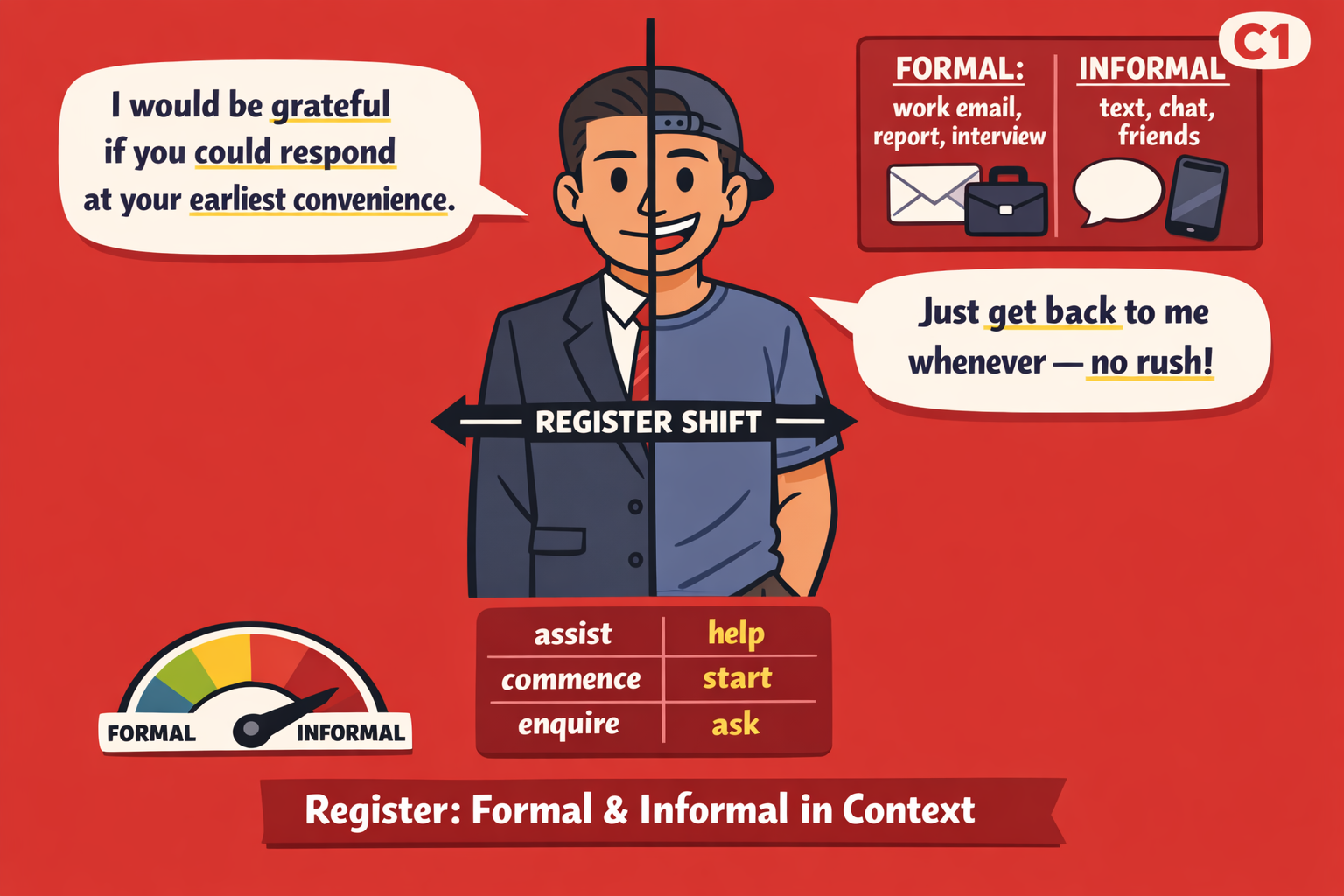
Inversion is almost always formal. In speech, only the agreement type (So do I / Neither can she) and the place-deixis type (Here comes the train) sound natural. Everything else (fronted negatives, inverted conditionals, So convincing was her argument…) belongs in written or carefully formal contexts.
- Had I known about the change, I would have called. (formal letter, business email, legal context)
- If I'd known about the change, I would have called. (everything else: conversation, casual writing, most emails)
Used well, inversion sharpens rhetoric and signals control of register. Overused, it makes writing sound theatrical. In an IELTS or CAE essay, two or three well-placed inversions are an asset; ten are a liability. Like cleft sentences and other fronting and focus structures, inversion is a tool for emphasis, and emphasis loses force when applied to everything.
Common mistakes
- Rarely she visits her grandparents.
- Rarely does she visit her grandparents.
- Only after did the guests left, we cleaned up.
- Only after the guests left did we clean up.
- Hadn't I called the doctor, she would have gone untreated.
- Had I not called the doctor, she would have gone untreated.
- No sooner had we arrived when the rain started.
- No sooner had we arrived than the rain started.
- Hardly had we arrived when the rain started.
- Never saw I such a thing.
- Never had I seen such a thing.
- Down the road came he.
- Down the road came a stranger. / Down the road he came.
- Not only he speaks French, but also German.
- Not only does he speak French, but he also speaks German.
Quick summary
- Inversion = auxiliary (or be) before the subject, just like in a question, but used for emphasis or formality, not for asking.
- After a fronted negative or restrictive adverbial (never, rarely, not until, only by, under no circumstances), invert the main clause.
- In Pattern 1, only the auxiliary moves; the main verb stays put. Never had I seen, not Never saw I.
- If the verb has no auxiliary, insert do/does/did.
- Three conditionals can drop if and invert: should, were, had. Use full not, not contractions.
- Pattern 2 (full-verb inversion) needs a noun-phrase subject and a verb of position, motion, or appearance. Pronouns block it.
- Use inversion deliberately. Two or three well-placed inverted clauses in an essay strengthen your writing; a flood of them weakens it.
Related topics
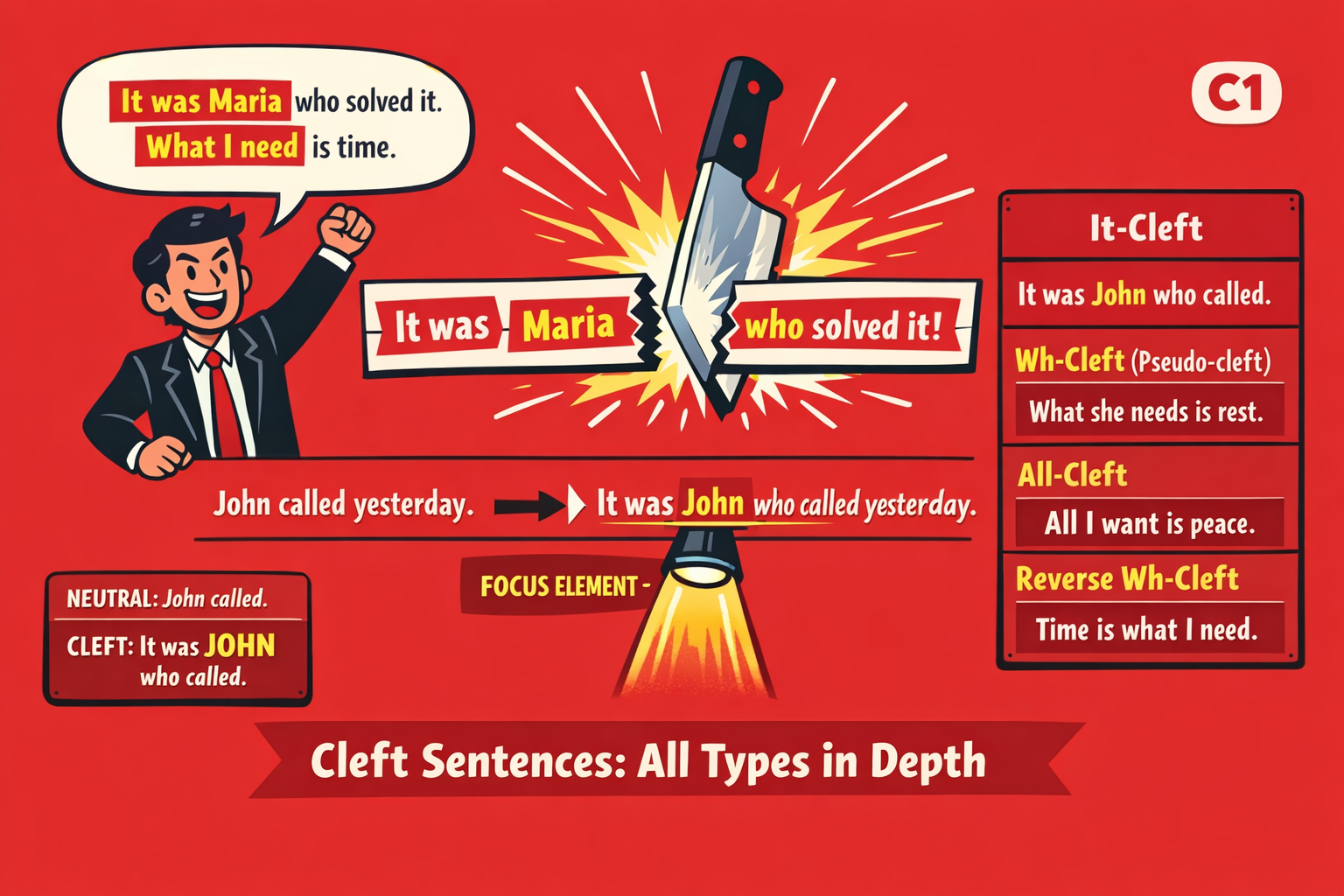
- Cleft sentences: another structure for shifting emphasis to a chosen element.
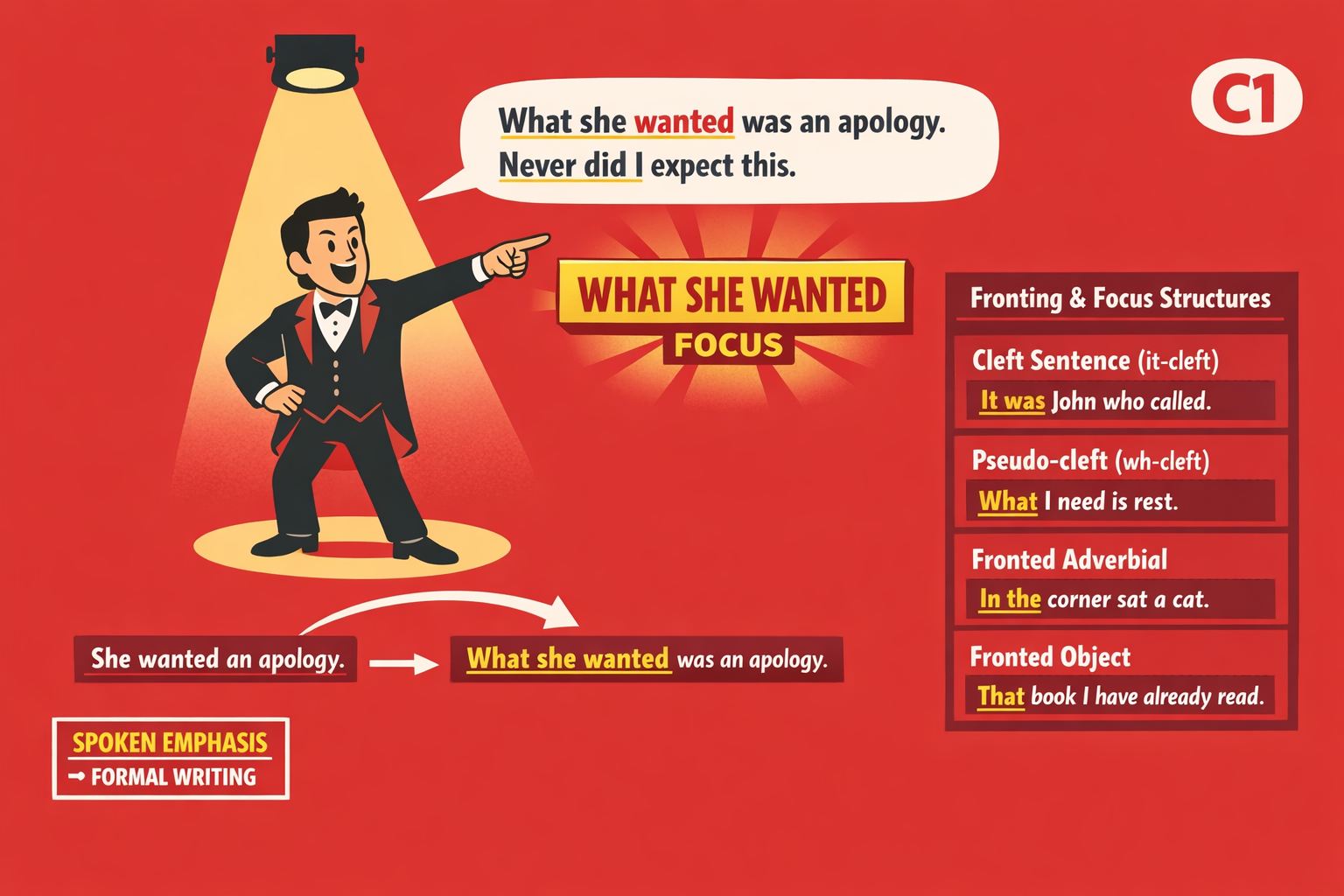
- Fronting and focus structures: the wider family of word-order changes for emphasis.
- Advanced conditionals: the standard forms behind the inverted conditional patterns above.
Comments