You're telling a friend about last night. I was watching TV when my phone rang. Two things happened: one was already going on, and the other interrupted it. English uses two tenses together to show this: the Past Continuous for the longer action in progress, and the Past Simple for the short action that broke into it.
These two tenses work as a team. You need to know how each one is built, when to use it alone, and how they combine in a single sentence.
Past Simple
Subject
+
verb + -ed
/
irregular past form
| Form |
Example |
| Positive |
She walked to school. / He saw the film. |
| Negative |
She didn't walk to school. |
| Question |
Did she walk to school? |
In negatives and questions, the main verb returns to the base form. The word did already carries the past meaning. For the spelling of -ed endings and a list of common irregular forms, see past simple irregular verbs.
Past Continuous
Subject
+
was / were
+
verb + -ing
| Form |
Example |
| Positive |
I was reading. / They were playing. |
| Negative |
I wasn't reading. |
| Question |
Were they playing? |
Use was with I, he, she, it. Use were with you, we, they.
In speech and informal writing, you'll almost always hear the short forms wasn't and weren't. The full forms was not and were not sound formal or emphatic.
When to use the Past Simple
A completed action in the past
Use the past simple for an action that started and finished at a clear time before now.
- Marco cooked dinner yesterday.
- We visited my grandmother last Sunday.
A series of finished actions
When you list things that happened one after another, every verb is past simple. Sequence words like first, then, after that, finally often appear with this pattern.
- I got up, made coffee, and checked my email.
- She opened the door, saw the dog, and smiled.
- First I locked the door, then I walked to the bus stop, and finally I caught the 7:15 bus.
- The waiter brought the menu, we ordered, and the food arrived ten minutes later.
When to use the Past Continuous
An action in progress at a moment in the past
The action started earlier and was still happening at the time you mention. The time is often given by a clock time, a date, or another past action.
- At 9 p.m. last night, I was studying.
- At 10 o'clock yesterday, we were flying to Madrid.
- What were you doing at 8 p.m. last night?
Two actions happening at the same time
Use past continuous for both verbs when two long actions were in progress together. You can join them with while, but you don't have to — two separate sentences also work.
- While Dad was cooking, Mum was setting the table.
- I was listening to music while my sister was painting.
- I was doing my homework. My brother was watching TV.
Background description in a story
Past continuous sets the scene. It tells you what was already going on before the main events.
- The sun was shining. Birds were singing. It was a perfect morning.
Putting them together
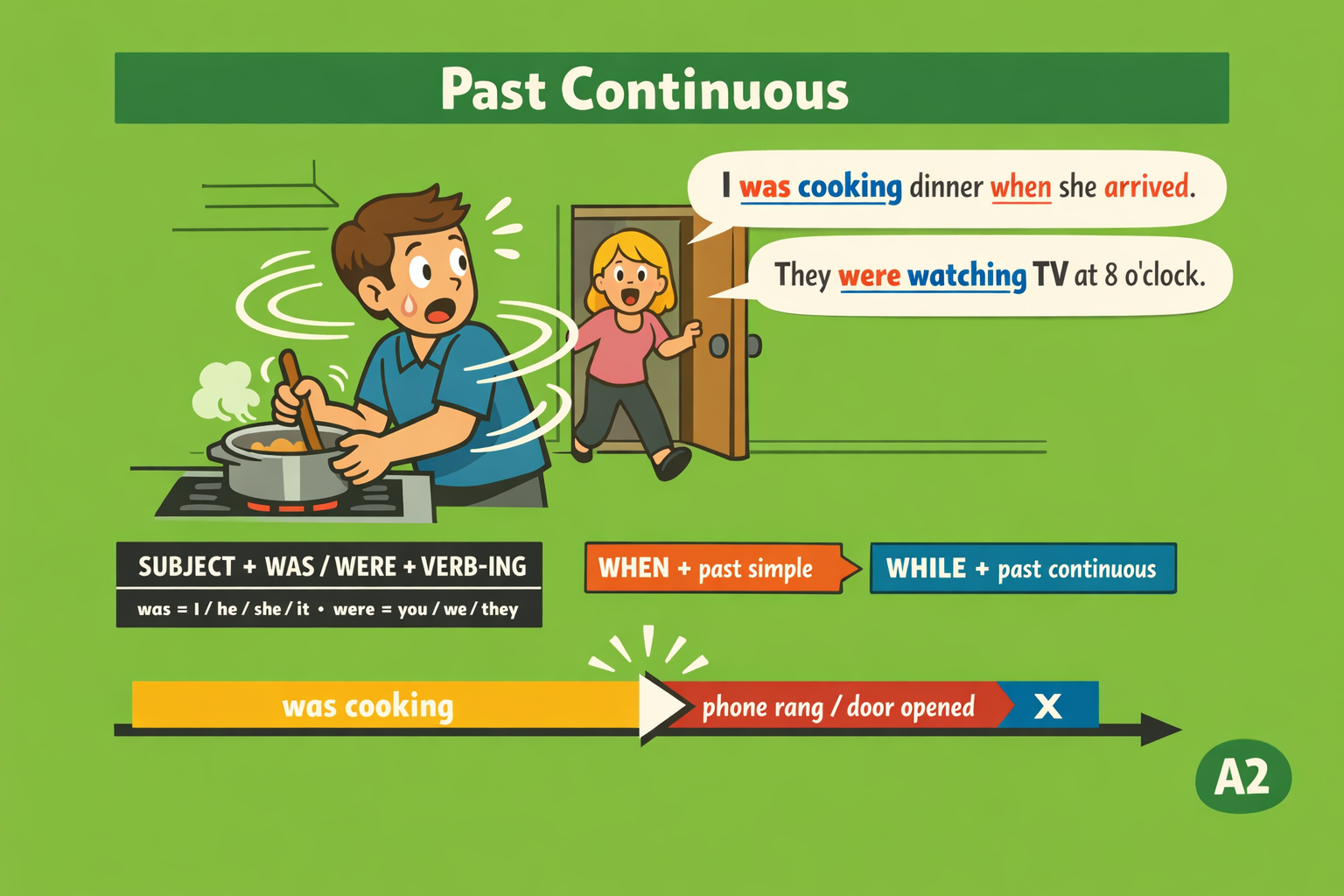
This is the most common use of the two tenses. Think back to the opening sentence: I was watching TV when my phone rang. One long action was in progress (past continuous) when a short action happened (past simple) and interrupted it.
Long action
→
past continuous
|
Short action
→
past simple
- I was watching TV when my phone rang.
- I was having lunch when Tom called.
- While we were walking home, it started to rain.
- As I was leaving the house, the postman arrived.
- She was reading in bed when the lights went out.
You can also flip the order. The meaning stays the same.
- Tom called while I was having lunch.
Signal words
Certain words point to one tense or the other.
| Tense |
Common signal words |
| Past Simple |
yesterday, last week, in 2010, two days ago, then |
| Past Continuous |
at 7 p.m., all morning |
| Linking words |
when, while, as |
Tip When, while, and as don't belong to one tense — they link the two clauses together. After while and as, you usually find the past continuous. After when, you usually find the past simple.
Common mistakes
I was eat dinner when he arrived. → I was eating dinner when he arrived.
Past continuous needs was/were + -ing. Don't drop the -ing.
She was watching TV when the phone was ringing. → She was watching TV when the phone rang.
The short interrupting action is past simple, not past continuous.
I were cooking at 8 p.m. → I was cooking at 8 p.m.
Use was with I, he, she, it.
What you were doing yesterday? → What were you doing yesterday?
In questions, was/were comes before the subject.
I was knowing the answer. → I knew the answer.
Some verbs are called state verbs — they describe a situation, not an action, so they're not normally used in the continuous form. Common examples: know, like, love, hate, want, need, believe, understand, remember, own. Use the past simple instead.
While I was walking home, I was meeting an old friend. → While I was walking home, I met an old friend.
Meeting someone is a short action. The long action (walking) is past continuous; the short one (met) is past simple.
Past Simple vs Past Continuous
|
Past Simple |
Past Continuous |
| Type of action |
Finished, often short |
In progress, longer |
| Focus |
The action is complete |
The middle of the action |
| In a story |
The main events |
The background |
| Typical time word |
yesterday, last week, ago |
at 8 p.m., while, all evening |
| Example |
The phone rang. |
I was sleeping. |
Look at the difference one tense makes:
- When I arrived, she made coffee. (first I arrived, then she made coffee)
- When I arrived, she was making coffee. (she started before I arrived; the coffee was already in progress)
- When the film started, we ate popcorn. (we started eating after the film began)
- When the film started, we were eating popcorn. (we were already eating when the film began)
Which tense fits?
Try these. Choose past simple or past continuous for each gap, then check the answers below.
- At 6 p.m. yesterday, I _____ (wait) for the bus.
- She _____ (open) the box and _____ (find) a letter inside.
- While we _____ (drive) home, we _____ (see) an accident.
- What _____ you _____ (do) when I called?
Answers: 1. was waiting (action in progress at a moment). 2. opened / found (series of finished actions). 3. were driving / saw (long action + short action). 4. were you doing (action in progress, interrupted by the call).
Quick summary
- Past simple = finished action. Past continuous = action in progress.
- Past continuous = was/were + verb + -ing.
- For interruptions: long action (continuous) + short action (simple).
- While and as usually go with past continuous. When usually goes with past simple.
- Don't use the continuous with state verbs like know, like, want, believe.
The past continuous has one more use you'll meet later: was/were going to for plans in the past that didn't happen — I was going to call you, but I forgot.

Comments