
She has lived in Paris for ten years. She has lived in Paris since 2014. Both sentences use the present perfect and both describe the same situation — but for and since work in completely different ways. For tells you how long. Since tells you when it started.
The Core Difference
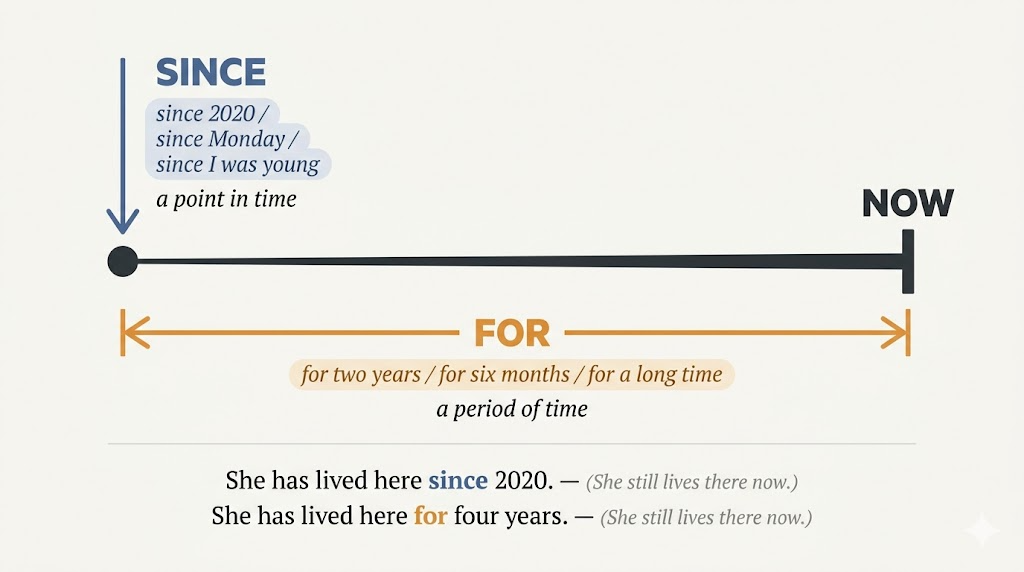
For
+
a period of time — how long something has lasted
Since
+
a point in time — when something started
| For — a period of time | Since — a point in time |
|---|---|
| for two hours | since 9 o'clock |
| for three days | since Monday |
| for a week | since last week |
| for six months | since June |
| for two years | since 2022 |
| for a long time | since I was a child |
For — a Period of Time
Use for with any expression that measures a duration — a number of minutes, hours, days, weeks, months, or years. You are answering the question How long?
- I have worked here for six months.
- They have been married for twenty years.
- We have known each other for a long time.
- He has had that car for three years.
Since — a Point in Time
Use since with a specific moment — a clock time, a date, a year, a day, or a phrase that names when something started. You are answering the question From when?
- I have worked here since March.
- They have been married since 2003.
- We have known each other since school.
- He has had that car since last year.
Tense: Present Perfect
In most cases, for and since appear with the present perfect because they describe a situation that started in the past and continues now. The present perfect connects the past starting point to the present moment.
- She has studied English for two years. (She still studies it now.)
- She has studied English since 2022. (She still studies it now.)
Common Mistakes
| Wrong | Correct | Why |
|---|---|---|
| I have lived here since five years. | I have lived here for five years. | Five years is a duration → for |
| She has worked here for 2019. | She has worked here since 2019. | 2019 is a point in time → since |
| He has been sick since three days. | He has been sick for three days. | Three days is a duration → for |
| I know her since a long time. | I have known her for a long time. | Needs present perfect + duration → for |
| We are friends since we were children. | We have been friends since we were children. | Situation continues now → present perfect |
| They have waited since two hours. | They have waited for two hours. | Two hours is a duration → for |
Summary
- Use for + a period of time: for two hours, for ten years, for a long time.
- Use since + a point in time: since Monday, since 2020, since I was young.
- Both words usually appear with the present perfect when the situation continues now.
- A quick test: if you can put a number in front, use for. If you can put a year or date, use since.
Frequently Asked Questions
What is the difference between "for" and "since" in English?
For is used with a period of time to say how long something has lasted: for three years, for a week. Since is used with a point in time to say when something started: since 2020, since Monday. In I have worked here for six months, for tells you the length. In I have worked here since April, since tells you the starting point.
Do I use "for" or "since" with a year?
Use since with a year because a year is a point in time, not a duration: I have lived here since 2018. If you want to express the length of time, calculate it and use for: I have lived here for six years. The mistake to avoid is since six years — six years is a duration, so it always takes for.
Is "since a long time" correct in English?
No — the correct form is for a long time. A long time is a duration, not a point in time, so it takes for. Since a long time is a very common error, especially among speakers of French, Spanish, and Italian, where the equivalent phrase uses the word for since. In English, always use for with durations.
What tense do I use with "for" and "since"?
When the situation continues to the present moment, use the present perfect: I have lived here for two years / since 2022. When the situation is finished, use the past simple with for only: I worked there for five years. You cannot use since with the past simple to describe a finished situation.
Can I use "for" and "since" with the present simple?
Not when you are describing how long a situation has been going on. I know her since three years and I am here for two days are both incorrect in this context. Use the present perfect: I have known her for three years. The present simple describes habits and facts, not duration from a past starting point.
How do I know when to use "for" or "since"?
Ask yourself: is it a duration or a starting point? If you can measure it with a number (three hours, five years, a long time), use for. If it is a specific moment on the calendar or clock (Tuesday, 2019, last summer, nine o'clock), use since. Another quick test: if the word ago would fit, it is a duration — use for.
Related Topics
- Present Perfect — for and since appear most often with the present perfect; this topic covers the full form and all uses.
- Past Simple — for can also appear with the past simple when a situation is finished; understanding both tenses clarifies when each applies.
- Present Perfect vs Past Simple — the tense choice directly affects whether for and since are possible; this comparison resolves the most common confusion at A2 level.

Comments