
Fronting and Focus Structures— C1 Grammar Exercises
Published March 23, 2026
Exercise 1 — Gap Fill Select
Only did she realize the importance of the project.
did he understand the consequences of his actions.
the manager had spoken, the team started working immediately.
Under no circumstances you reveal this secret.
Only after the meeting the decision was made.
So difficult the exam that many students failed.
Rarely such a beautiful performance.
Not only the project delayed, but it also went over budget.
At no point she consider giving up.
Only by working hard you achieve success.
Compare two sentences with the same content:
- I have never seen such chaos.
- Never have I seen such chaos.
Same words, same facts, but the second sentence pushes never to the front, forces the auxiliary before the subject, and lands with a force the first version can't match. This is fronting: moving an element out of its normal position to spotlight what matters. Combined with cleft sentences, which split one clause into two to isolate a focus, fronting gives you the tools to control emphasis in formal English.
English word order is relatively fixed, so any departure from Subject–Verb–Object carries weight. These structures are common in journalism, political speech, literary prose, and academic writing.
What fronting actually does
Fronting means moving a constituent (an object, complement, adverbial, or participle phrase) to the beginning of the clause. The element keeps its grammatical role; only its position changes. The effect is one of contrast, emphasis, or cohesion with the previous sentence.
Fronted order: Fronted element + Subject + Verb + (rest)
| Neutral | Fronted | Effect |
|---|---|---|
| She loved the second novel most. | The second novel she loved most. | Contrast with another novel |
| The proposal sat on the table. | On the table sat the proposal. | Scene-setting; vivid placement |
| I will never forgive him. | Never will I forgive him. | Strong emotional emphasis |
Fronting without inversion
Most fronting leaves the subject and verb in their normal order. You simply move a phrase to the front for contrast or topic continuity. No auxiliary movement is required.
Fronted objects
Move a direct object forward to contrast it with something already mentioned or to highlight it as the topic of discussion.
- The red wine I enjoyed; the white I found ordinary.
- His earlier work critics admired, but the later novels disappointed them.
Fronted complements
Adjective and noun complements often shift to the front in literary or emphatic writing. This adds weight and rhythm.
- Brilliant though the argument was, it failed to convince the committee.
- A more cautious negotiator you will never meet.
Fronted prepositional and adverbial phrases
Place, time, and manner phrases move forward easily, especially in narrative writing. With phrases of place and direction, the verb sometimes moves before the subject; this is called locative inversion.
- In the corner of the garden stood an old apple tree.
- Down the hill rolled the abandoned cart.
Fronted participles
Present and past participle phrases can be fronted to tighten the link with the following clause. This is a feature of formal and literary register.
- Exhausted by the journey, the delegation retired to their rooms.
- Hidden behind the curtain was the original manuscript.
Fronting with inversion (negative and restrictive adverbials)
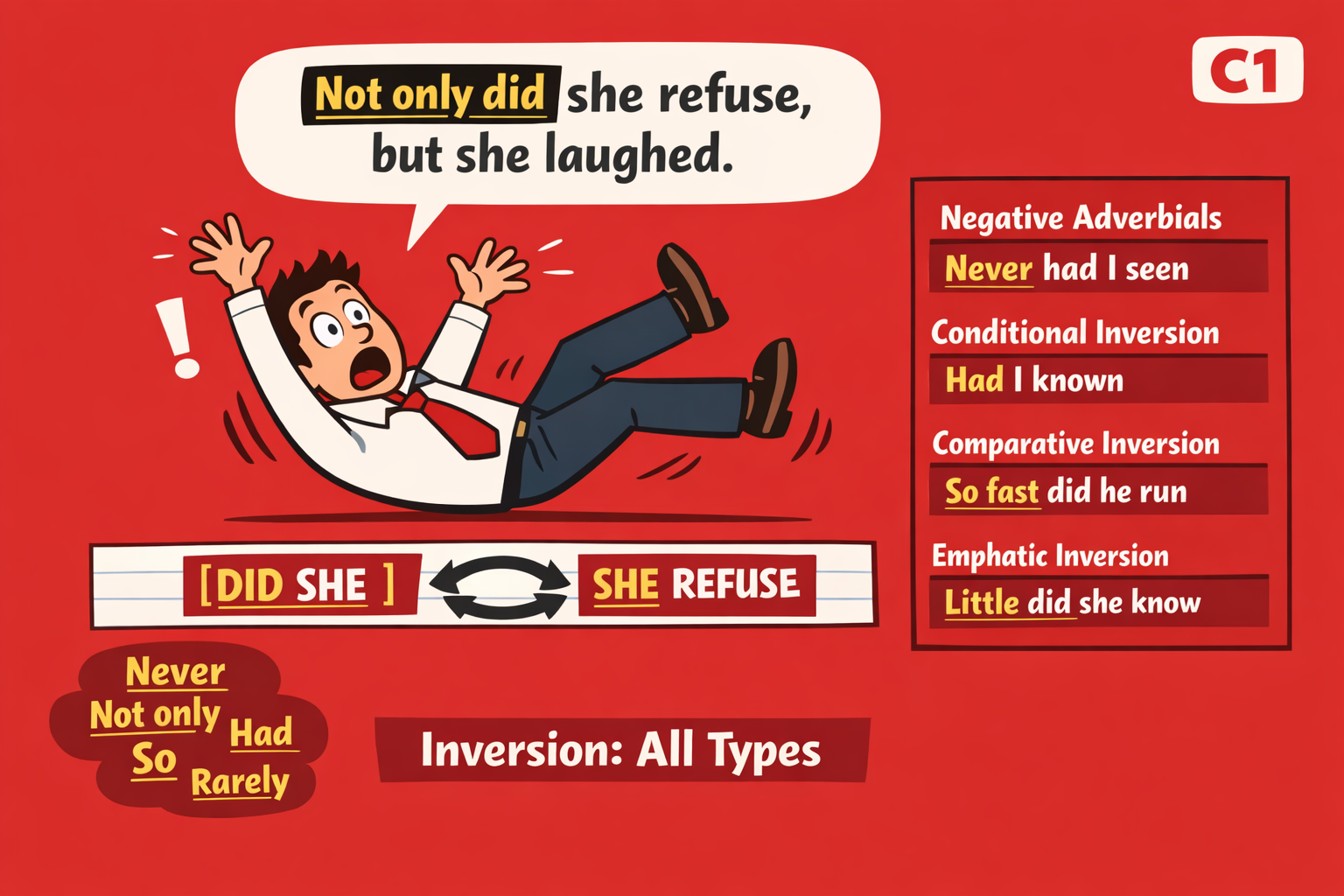
When a negative or restrictive adverbial is fronted, the subject and auxiliary must invert, using the same word order as in questions. This is the most testable area of the topic at C1 and the one learners most often get wrong.
If the original sentence has no auxiliary, you add do/does/did, exactly as in question formation.
| Neutral | Fronted with inversion |
|---|---|
| I have never seen such chaos. | Never have I seen such chaos. |
| He realised the danger only then. | Only then did he realise the danger. |
| We had hardly arrived when the storm broke. | Hardly had we arrived when the storm broke. |
| You should not under any circumstances open this door. | Under no circumstances should you open this door. |
Triggers for inversion
The triggers fall into five patterns. Learn the pattern, not the list; once you see the underlying logic, new triggers fit on their own.
| Pattern | Triggers |
|---|---|
| Outright negatives Anything meaning "not" or "never" |
never, nowhere, nor, neither, not since, not until, not only … but also, at no point, on no account, under no circumstances, in no way |
| Restrictive only-phrases All begin with only; all act as "and nothing else" |
only after, only when, only if, only then, only by, only later, only in this way |
| Negative-frequency adverbs Single words meaning "almost never" |
seldom, rarely |
| Correlative time pairs First clause inverts; second clause follows the fixed partner word |
hardly … when, scarcely … when, no sooner … than |
| Degree fronting A degree word fronts and pulls the verb with it |
so + adjective/adverb … that, such + noun phrase … that |
Little: a special case
The adverb little triggers inversion too, but only with mental-state verbs: know, realise, suspect, imagine, dream, think.
- Little did she suspect that the contract was a forgery.
- Little did we know what the morning would bring.
- Little did she eat at the party. (eat isn't a mental-state verb, so this doesn't work.)
The so and such patterns
These two patterns front a degree expression and invert the subject. Both patterns almost always require a that-clause expressing the consequence. So convincing was her argument on its own is incomplete; the listener is waiting for what happened next.
- So convincing was her argument that nobody objected.
- Such was the demand that tickets sold out in minutes.
Cleft sentences: splitting for focus
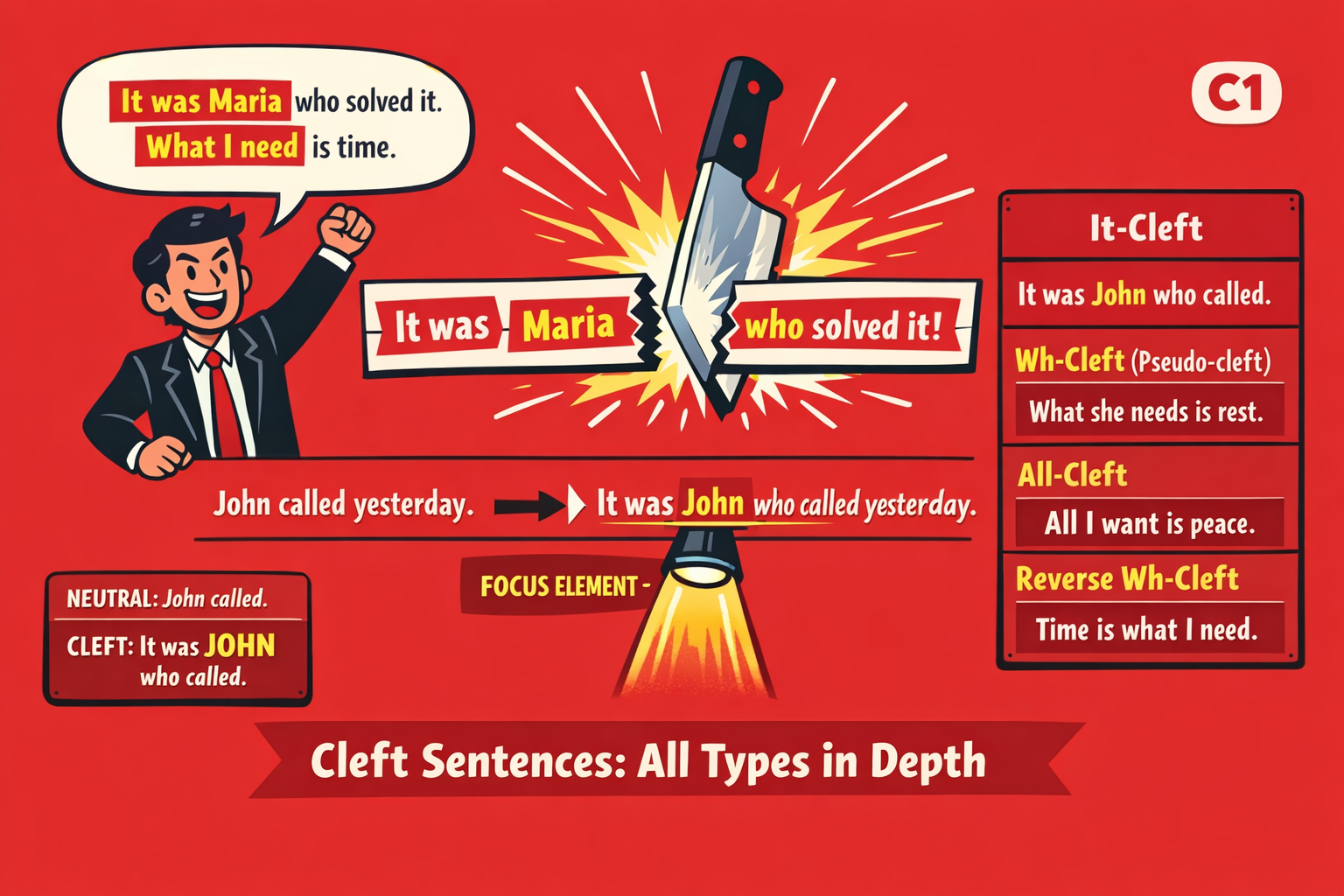
A cleft sentence breaks one clause into two, putting the focused element in a prominent slot. There are two main types: it-clefts and wh-clefts (also called pseudo-clefts).
It-clefts
The structure highlights one element by isolating it after It is / was. The rest of the information moves into a relative clause. It-clefts work best when you are identifying one item from a set of possible alternatives — answering an implicit "which one?".
- Neutral: The manager approved the budget on Friday.
- It was the manager who approved the budget on Friday. (not the director)
- It was the budget that the manager approved on Friday. (not the contract)
- It was on Friday that the manager approved the budget. (not Thursday)
Wh-clefts (pseudo-clefts)
The focused element shifts to the end, where end-weight gives it natural prominence. What stands for an unspecified thing or action.
- What surprised me most was the silence.
- What you need is a long holiday.
- All she wanted was an apology.
- The thing that bothers me is the tone of the letter.
What or the thing that?
These two openers are often interchangeable, but they pull in different directions. What is preferred when the focus is abstract, eventive, or general — silence, freedom, an apology, a decision. The thing that sounds more natural with concrete or specific referents.
- What I want is silence. (abstract focus)
- The thing that broke was the handle. (specific physical object)
Focusing on the action: What X did was…
To focus on the action itself rather than a participant, use a verbal wh-cleft. The verb in the relative clause is usually do, and the focused verb appears in the bare infinitive after was.
- What she did was resign on the spot.
- All he does is complain about the weather.
Common mistakes
- Never I have eaten such a good meal.
- Never have I eaten such a good meal.
- Yesterday did I meet your sister.
- Yesterday I met your sister.
- Hardly did we had arrived when it started raining.
- Hardly had we arrived when it started raining.
- No sooner had he left when the phone rang.
- No sooner had he left than the phone rang.
- Only if you apologise I will reconsider.
- Only if you apologise will I reconsider.
- Rarely have I seen such talent?
- Rarely have I seen such talent.
- What surprised me the silence.
- What surprised me was the silence.
- What I really want is you listen to me.
- What I really want is for you to listen to me.
Fronting vs cleft: which structure for which effect
| Fronting / Inversion | Cleft sentences | |
|---|---|---|
| Mechanism | Single phrase moves to the front; rest of clause stays intact. | One clause splits into two; focused element is isolated. |
| Effect | Strong emphatic or literary effect, often emotional. | Identifying or contrastive effect, often analytical. |
| Example | Never had she felt so alone. | It was the silence that frightened her most. |
| Typical context | Speeches, journalism, narrative fiction. | Explanations, definitions, summaries; everyday conversation. |
| Avoid when… | Writing casually, texting, or emailing in a friendly register — sounds theatrical. | Every other sentence becomes What I think is… — overuse drains the emphasis. |
Register and frequency
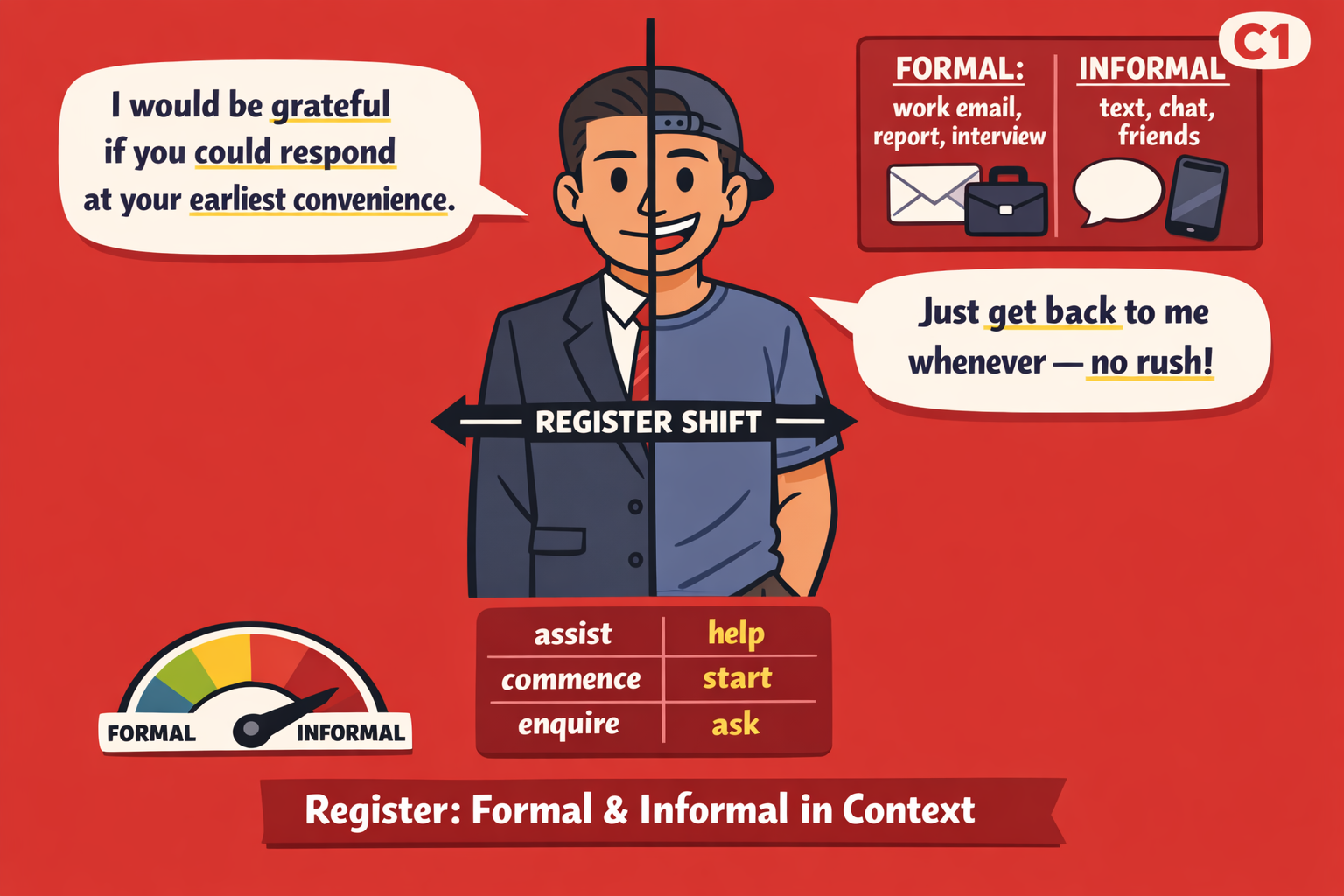
Fronting with inversion is markedly formal. You will hear it in political speeches, see it in editorials, and find it in literary fiction. In everyday conversation it sounds theatrical; use it sparingly. Clefts, by contrast, are common in both speech and writing because they help organise information naturally; What I need is a coffee is perfectly conversational.
This topic overlaps with inversion structures and with emphasis and emphatic structures. A solid grasp of relative clauses is essential before tackling clefts, since the second half of every cleft is a relative-like clause.
- Front an element to contrast, emphasise, or link to what came before.
- Invert subject and auxiliary only after negative or restrictive adverbials, and after so/such.
- Add do/does/did when no auxiliary is present, just as in questions.
- Past and present participle phrases front easily in formal writing: Hidden behind the curtain was the manuscript.
- Use it-clefts to identify which one from a set of alternatives; use wh-clefts to build up to a focused element at the end.
- Inversion is formal; clefts work in both speech and writing.
Comments