
Cleft Sentences: All Types in Depth— C1 Grammar Exercises
Published March 23, 2026
Exercise 1 — Gap Fill Select
It John who won the award last night.
What interesting about the story is the ending.
It was who called you last night.
It was in Paris they met for the first time.
What surprised me was her sudden decision to leave.
It was that made the difference in the final score.
It was that we decided to cancel the meeting.
What important is that we meet the deadline.
It was who explained the problem clearly.
It was at midnight the announcement was made.
Three witnesses saw the accident. A neutral statement, but watch what happens when the same fact is split into two clauses to throw the spotlight elsewhere: It was three witnesses who saw the accident (not two, not four). What three witnesses saw was the accident (not the aftermath, not the suspect). All three witnesses saw was the accident (and nothing more; they didn't see the cause). Same facts, same words: three different emphases.
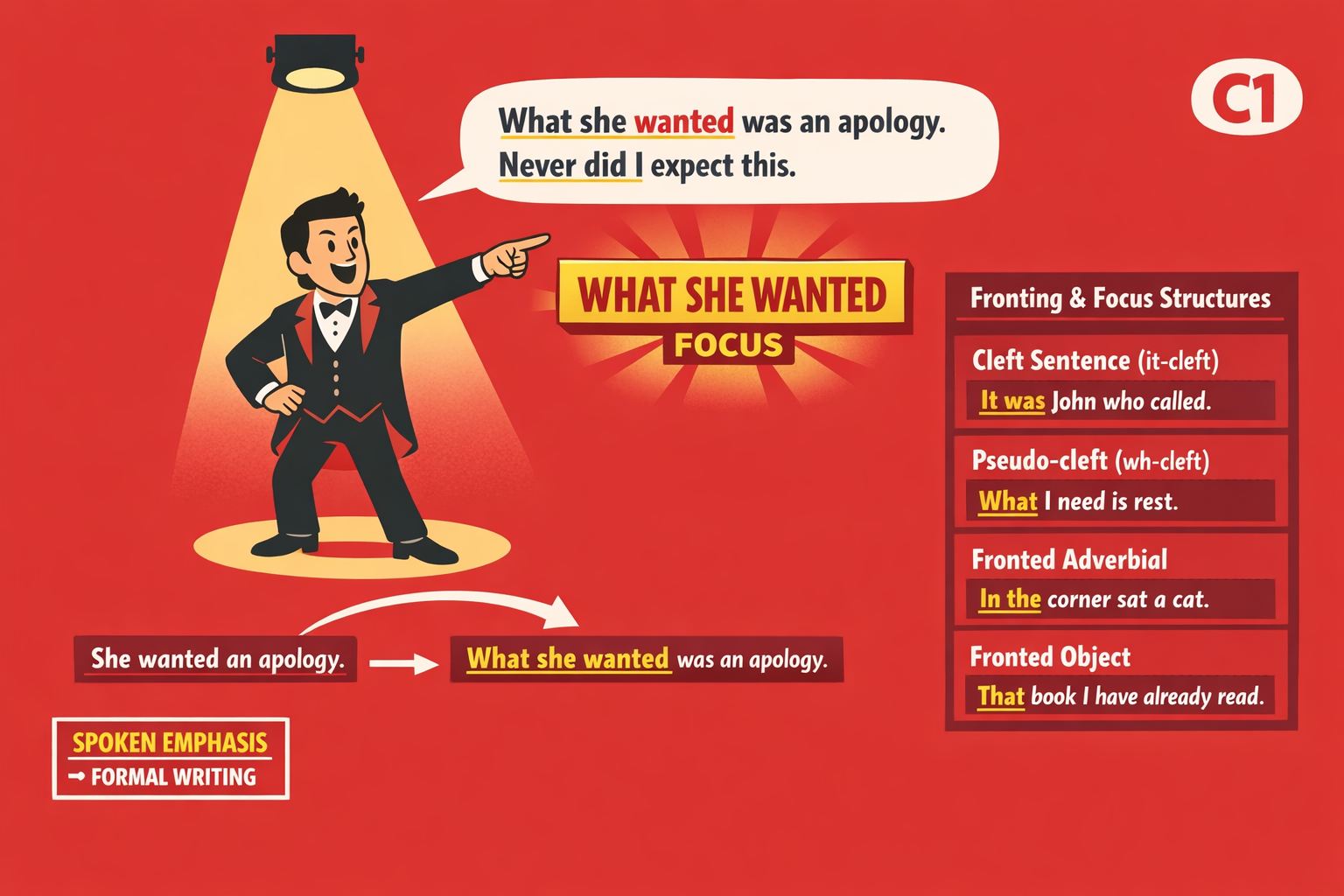
A cleft sentence takes a single clause and divides ("cleaves") it into two, restructuring the information so that one element carries marked focus. The reordering does the work that intonation alone would do in speech. Mastery at C1 means knowing which cleft type produces which kind of emphasis, and which register each belongs in.
English has several cleft patterns, each with its own typical use. The two core types, it-clefts and wh-clefts (pseudo-clefts), cover most cases; the rest are variants or specialised forms. All of them serve the same underlying purpose: redistributing emphasis without changing the truth-conditional content of the sentence.
Why cleft sentences exist
In a plain declarative, main stress falls on the end of the clause, and new information typically appears there. When a speaker or writer wants to mark a different element as prominent, or to contradict an assumption, correct a misunderstanding, or signal what's at stake, the standard word order is too neutral. Cleft sentences solve this by promoting one constituent into a syntactically marked slot.
| Neutral | Cleft | Effect |
|---|---|---|
| The accountant noticed the discrepancy on Tuesday. | It was the accountant who noticed the discrepancy on Tuesday. | Identifies who, contradicting an assumption it was someone else. |
| The accountant noticed the discrepancy on Tuesday. | It was on Tuesday that the accountant noticed the discrepancy. | Locates when, correcting a wrong date. |
| The accountant noticed the discrepancy on Tuesday. | What the accountant noticed on Tuesday was the discrepancy. | Foregrounds what, building suspense or contrast. |
It-clefts
The it-cleft is the most frequent type. It promotes one constituent into a position after It is / It was, and pushes everything else into a relative clause introduced by who, that, which, or sometimes when or where.
It + be + FOCUSED ELEMENT + that / who / which… (the rest of the clause)
What can be focused
Almost any constituent can occupy the focus slot, noun phrase, prepositional phrase, adverbial, but not the main verb itself.
- Subject It was Marta who finalised the contract.
- Object It was the proposal that the committee rejected, not the budget.
- Prepositional phrase It was in Geneva that the negotiations broke down.
- Reason clause It was because of the storm that the flight was cancelled.
Choosing the relative pronoun
The pronoun in the second clause follows broadly the same rules as in defining relative clauses, with a few cleft-specific patterns. Use who or that for a person in subject position (It was the manager who signed off); that or nothing for objects (It was the proposal we rejected); that for non-personal subjects, time, place, and reason (It was the leak that caused the damage). After a fronted prepositional phrase, that is the default: It was at midnight that the call came. Don't strand the preposition; keep the full prepositional phrase in the focus slot.
Tense and agreement
The verb be in the cleft matches the tense of the original event. When the focused element is plural, be still stays singular; the syntactic subject of the cleft is the dummy it, not the focused noun.
- The team finished the report yesterday. → It was the team that finished the report yesterday.
- It was the auditors who raised the concern. (not It were the auditors)
Emphasis and contrast
It-clefts cover three related uses. The first is corrective: denying an assumption and offering the correct version.
- "I thought your sister called." "It wasn't my sister who called; it was my mother."
The second is contrastive without correction: flagging which element among several matters most, often signalling what's at stake in the surrounding discussion.
- It's the principle that matters here, not just this case.
- It's the lack of follow-up that's worrying, not the original complaint.
The third is rhetorical setup: using the cleft to mark a turning point in the narrative or argument, often paired with only, not until, or a similar marker.
- It was only later that we realised what had happened.
- It was not until 1989 that the law was finally repealed.
Pronoun form: he or him?
Traditional grammar prescribes the subject form when the relative clause opens with who, on the logic that the focused pronoun is the antecedent of a subject relative: It was he who left the door unlocked. In practice, the object form is now standard in nearly all modern British English, including broadsheet journalism and most academic prose: It was him who left the door unlocked. The subject form is not wrong, but it can sound stilted outside deliberately formal contexts. The same applies to I / me, she / her, we / us, and they / them. Use the subject form when the register genuinely calls for it; otherwise the object form is safe.
Wh-clefts (pseudo-clefts)
The wh-cleft uses a free relative clause (typically opening with what) as the subject, then a form of be, then the focused element. The effect is to delay the key information until the end of the sentence, building anticipation or signalling that a contrast or conclusion is coming.
What / The thing / All + clause + is / was + FOCUSED ELEMENT
- What surprised the panel was the candidate's silence.
- What the company did wrong was ignore early warning signs.
What can follow the wh-cleft
The focus slot in a wh-cleft is more flexible than in an it-cleft. It can take a noun phrase, a clause, an infinitive, or even a bare verb phrase.
| Focused element type | Example |
|---|---|
| Noun phrase | What I want is a straight answer. |
| That-clause | What worries me is that no one has admitted responsibility. |
| Infinitive | What you should do is call a lawyer. |
| Bare verb phrase | What he did was (to) walk out of the meeting. |
The bare-verb pattern (What he did was walk out) is distinctive to the wh-cleft and has no it-cleft equivalent. The to is optional and more common in writing.
Reverse wh-clefts
The order can be inverted: focused element first, then be, then the wh-clause. This shifts emphasis to the front and sounds more decisive.
- Standard: What we need is a clearer timeline.
- Reverse: A clearer timeline is what we need.
- Standard: What he wanted was an apology.
- Reverse: An apology was what he wanted.
Reverse wh-clefts are common in spoken English and in argumentative writing, where the focused element doubles as the topic of the surrounding discussion.
All-clefts
The all-cleft is a specialised wh-cleft that adds exclusivity or limitation: "this and nothing more". The focused element is presented as the only thing that matters, was done, or is wanted.
- All I want is a quiet weekend.
- All they did was apologise; no offer of compensation.
- All that's needed is a signature.
The exclusivity is built into the meaning. All I want is a quiet weekend does not mean the speaker wants many things including a quiet weekend; it means a quiet weekend is the entirety of what they want. Replacing all with what removes that exclusivity.
There-clefts
The there-cleft uses existential there to introduce a focused element, often followed by a relative clause expressing what that element does or is.
- There's one thing I don't understand: why nobody objected at the time.
- There was something about her tone that worried me.
- There are two issues we haven't addressed.
This pattern is common in spoken English for introducing a topic the speaker is about to expand on: it functions as a discourse cue meaning "what follows is the new topic".
If-clefts
The if-cleft is less common but worth recognising. It frames the focused element as a conditional, typically in concessive or contrastive contexts, and is usually paired with an it-cleft delivering the focus.
- If anyone deserves the promotion, it's Anna.
- If there's one rule worth keeping, it's this one.
- If anything went wrong, it was the timing.
This if… it… pairing is a fixed rhetorical pattern: the if-clause sets up the focus, and the it-clause delivers it.
Choosing between it-clefts and wh-clefts
The two main types are not interchangeable. They impose different constraints on what can be focused, different register profiles, and different discourse functions.
| It-cleft | Wh-cleft (pseudo-cleft) |
|---|---|
| Focuses single constituents: noun phrases, prepositional phrases, adverbials. | Can focus clauses, infinitives, and bare verb phrases as well. |
| Typically corrective or contrastive: "not X, but Y". | Typically presentational: building up to the focus, often at the end. |
| Equally common in writing and speech. | More common in spoken English and informal writing, especially the reverse pattern. |
| Often appears in news headlines, legal prose, formal corrections. | Often appears in conversation, opinion pieces, summaries. |
| It was the auditor who flagged the issue. | What flagged the issue was the auditor's persistence. |
Cleft sentences in context
In writing
Cleft sentences are a key resource of formal and analytical prose. Academic writing, legal documents, journalism, and corporate reports use them to manage emphasis without resorting to italics or capitalisation. Compare:
- Flat: The committee rejected the proposal. The rejection surprised many observers. The chair's intervention was decisive.
- Restructured with clefts: The committee rejected the proposal, and it was the rejection that surprised many observers. What proved decisive was the chair's intervention.
The second version reads as analysis, not a list of facts. Each cleft signals which element the reader should weigh against the previous sentence.
In speech
In conversation, clefts function as discourse cues: opening a topic, marking what the speaker keeps coming back to, or flagging the actual point of a longer turn. The there-cleft and reverse wh-cleft do most of this work:
There's one thing I keep coming back to, and that's why nobody flagged it earlier. What I don't get is how it slipped through three reviews.
Three clefts in three sentences, each doing a different conversational job: the there-cleft opens the topic, the reverse wh-cleft (that's why…) names the focus, and the standard wh-cleft delivers the question driving the turn.
Cleft sentences and other emphasis structures
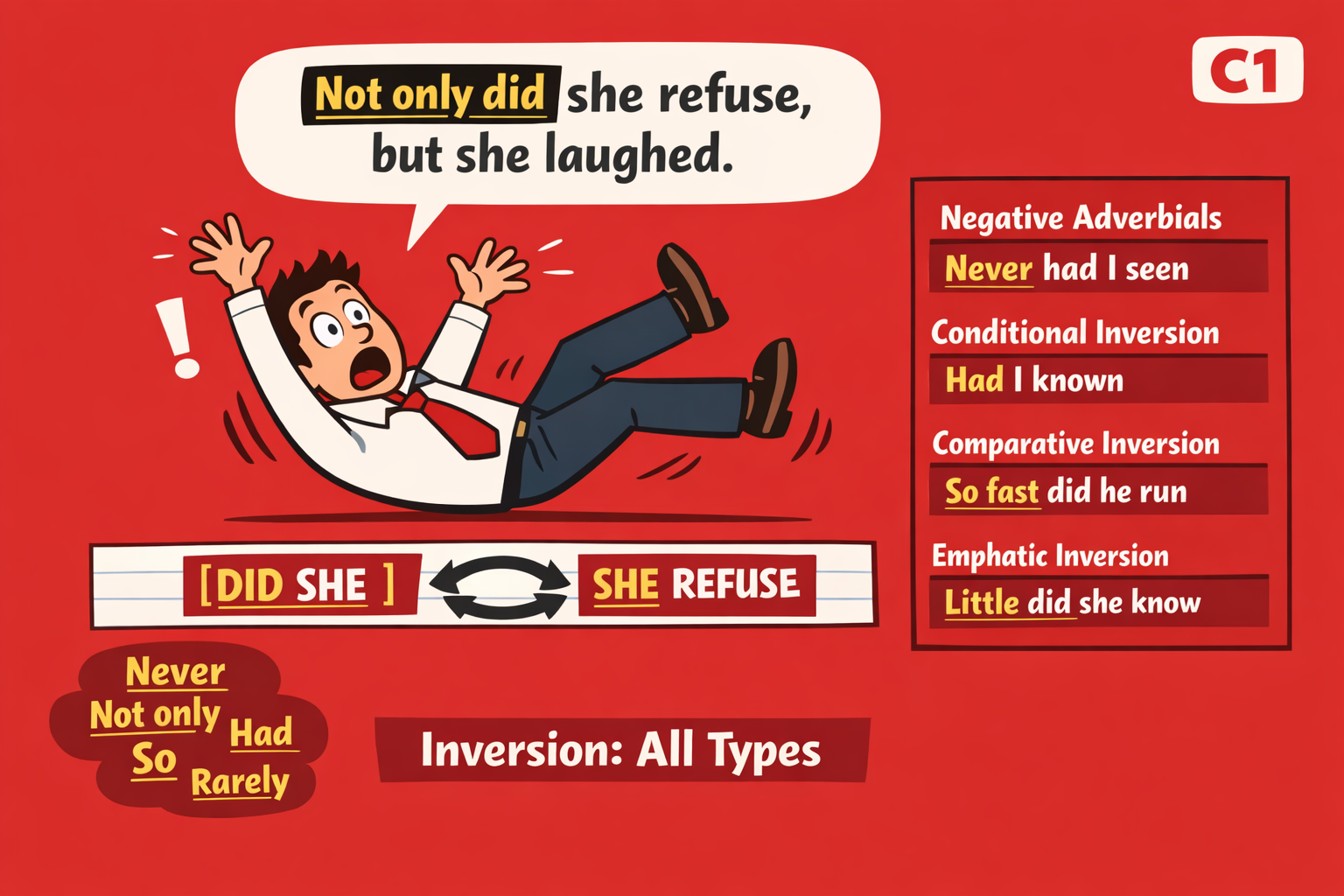
Clefts are one of several mechanisms English uses to redistribute emphasis. Inversion after negative adverbials, fronting of objects or adverbials, and the advanced passive all foreground or background information without splitting the clause. The same underlying proposition can be rendered four ways:
| Mechanism | Sentence | What it foregrounds |
|---|---|---|
| Neutral | The auditor flagged the discrepancy on Tuesday. | End-weight default; nothing specifically marked. |
| Cleft | It was the auditor who flagged the discrepancy on Tuesday. | Identifies who: corrective or contrastive. |
| Fronting | The discrepancy, the auditor flagged on Tuesday. | Topicalises what: sets it as the current subject of discussion. |
| Inversion | Only on Tuesday did the auditor flag the discrepancy. | Dramatises when: adds rhetorical weight to the time element. |
| Passive | The discrepancy was flagged on Tuesday. | Backgrounds the agent: removes who from focus entirely. |
A C1 speaker chooses among these consciously, depending on whether they want to identify, topicalise, dramatise, or background. Clefts are the precision tool for identification and contrast; the others handle the rest.
Common mistakes at C1
Errors with cleft sentences at C1 are typically about agreement, the gap inside the relative clause, the pronoun used after all, and stranding prepositions.
It were the auditors who first noticed the irregularity.
It was the auditors who first noticed the irregularity.
The verb be in an it-cleft agrees with it, not with the plural focused noun. Always singular.
What I did was to leave the room. (awkward in writing about a completed action)
What I did was leave the room.
In a wh-cleft with a bare verb phrase, the to is usually dropped: especially when the action is completed and the cleft is in the past. What you should do is call a lawyer (advice, infinitive sense) is fine with or without to; What he did was walk out takes no to.
It is the speed which it was processed at that impressed me.
It was the speed at which it was processed that impressed me.
Don't strand the preposition in the relative clause. The full prepositional phrase belongs in the focus slot, with that introducing the relative clause.
All what I want is some quiet.
All (that) I want is some quiet.
After all, use that or no pronoun at all: never what. What already contains its own antecedent and cannot follow all.
It is the report that I want to discuss it.
It is the report that I want to discuss.
The focused element fills the relative-clause gap: don't repeat it inside the clause as a resumptive pronoun.
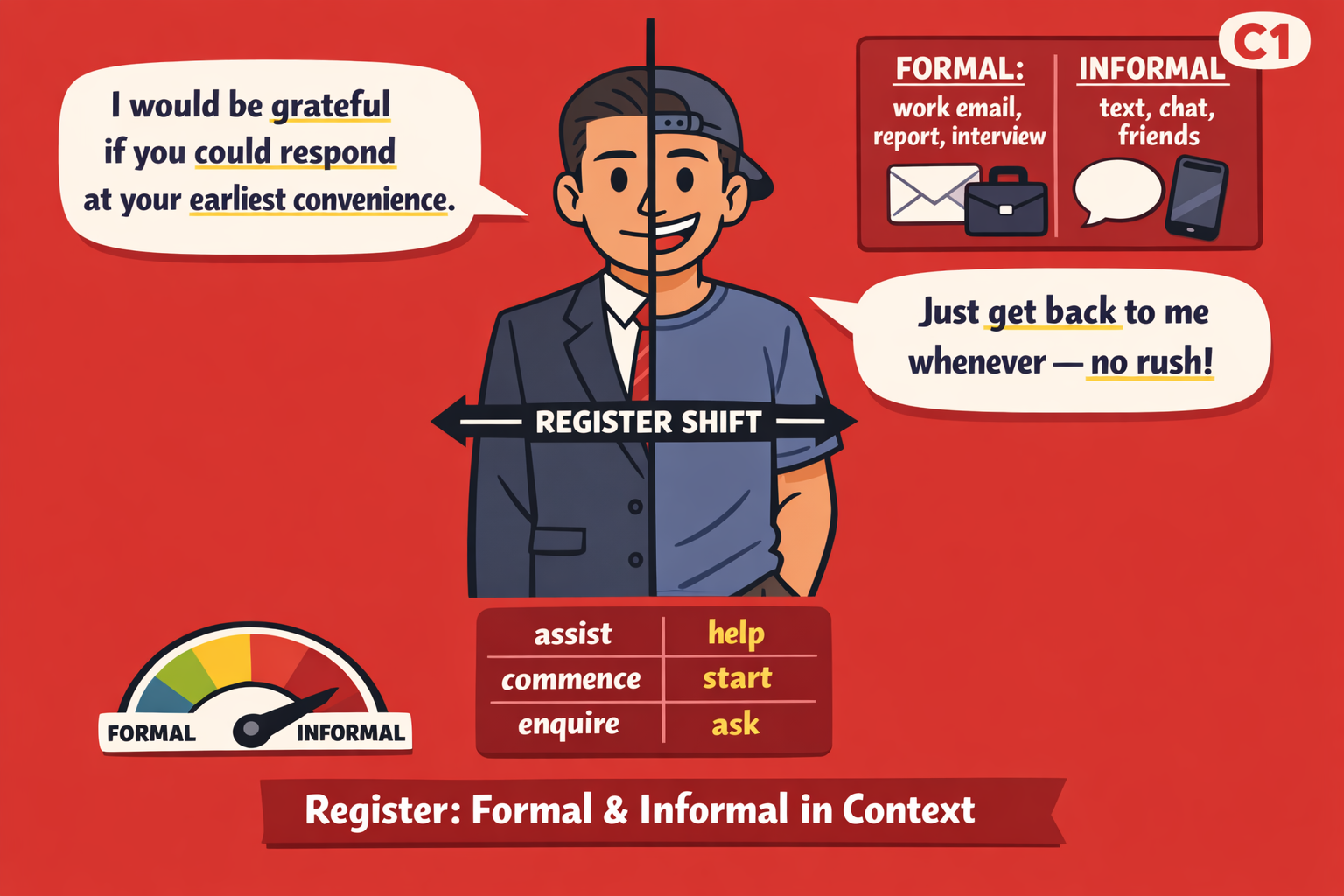
Register and frequency
Not all cleft types belong in every register. The table below sketches the broad pattern, though context can always override it.
| Cleft type | Typical register | Discourse function |
|---|---|---|
| It-cleft | Neutral to formal; written and spoken | Identification, correction, contrast |
| Wh-cleft | Neutral; very common in speech | Build-up, summary, presenting a conclusion |
| Reverse wh-cleft | Conversational and journalistic | Decisive emphasis, opinion-marking |
| All-cleft | Neutral to informal | Exclusivity, minimisation, complaint |
| There-cleft | Conversational | Topic introduction |
| If-cleft | Formal and rhetorical | Concession, qualified emphasis |
Over-using clefts in writing makes prose feel laboured. A paragraph in which every sentence reorganises emphasis loses the effect: emphasis depends on contrast with neutral structures. In formal register, one or two well-placed clefts in a paragraph is usually enough; in conversation, the wh-cleft and there-cleft can appear more freely as discourse cues.
Quick summary
• A cleft sentence splits one clause into two to mark one element with emphasis. The truth-conditional content does not change.
• It-clefts focus single constituents and are typically corrective: It was the rain that delayed us.
• Wh-clefts (pseudo-clefts) delay the focused element to the end and can focus full clauses or verb phrases: What we need is more time.
• Reverse wh-clefts move the focus to the front for decisive emphasis: More time is what we need.
• All-clefts add exclusivity; there-clefts introduce topics; if-clefts frame qualified emphasis.
• The verb be in an it-cleft is always singular, regardless of the focused element.
• Clefts are emphasis tools: overuse cancels the effect.
Comments