
Third conditional— B1 Grammar Exercises
Published April 5, 2026
Exercise 1 — Gap Fill Select
If she harder, she would have passed the exam.
If they earlier, they wouldn't have missed the train.
If I the directions, I wouldn't have gotten lost.
If he the meeting, he would have known about the changes.
If we more carefully, we wouldn't have made so many mistakes.
If you me, I could have helped you.
If they the instructions, the machine wouldn't have broken.
If I more time, I would have finished the project.
If she the warning, she would not have been late.
If we the map, we wouldn't have taken the wrong road.
You missed the train this morning. You arrived late to work. Looking back, you think: If I had left earlier, I would have caught it. The whole sentence is about something that didn't happen — it's a regret, an alternative version of yesterday. That's the third conditional.
The third conditional describes past situations that didn't happen, and their imagined results. It's the structure for regret, blame, hypothetical history, and explanations of why things went wrong. It's also the only conditional that talks about the past.
Form
The if-clause uses the past perfect (had + past participle). The main clause uses would have + past participle. The clauses can swap order — when the main clause comes first, drop the comma.
- If she had studied harder, she would have passed the exam.
- She would have passed the exam if she had studied harder.
| Form | Example |
|---|---|
| Positive | If we had taken a taxi, we would have arrived on time. |
| Negative | If we hadn't taken a taxi, we wouldn't have arrived on time. |
| Question | What would you have done if you had missed the flight? |
Both sides of the sentence describe things that didn't happen. The if-clause is about an unreal past condition (she didn't study hard); the main clause is about an unreal past result (she didn't pass). Going back to the missed-train scenario from the opening: If I hadn't missed the train, I wouldn't have arrived late at work.
Spoken contractions
In speech and informal writing, had and would have almost always contract.
| Full form | Contraction |
|---|---|
| If I had known… | If I'd known… |
| She would have helped. | She would've helped. |
| We would not have noticed. | We wouldn't have noticed. |
'd is ambiguous between had and would, but the position tells you which: 'd in the if-clause is always had; 'd in the main clause is always would. If I'd known, I'd have called you = If I had known, I would have called you.
Watch out: would've ≠ would of. In speech, would've sounds almost identical to would of — and millions of native speakers misspell it that way. Would of is always wrong. The correct forms are would have, would've, and wouldn't have. The same applies to could've, should've, and might've — never could of, should of, might of.
Usage
Regret about the past
The most common use. The speaker imagines a different past — usually a better one — and reflects on what would have happened.
- If I had set an alarm, I wouldn't have overslept.
- If we had booked earlier, we would have got cheaper tickets.
Criticism or blame
Used to point out what someone should have done differently. Often softened in delivery, but the structure carries an implicit "you didn't, and that's why this happened".
- If you had listened to me, this wouldn't have happened.
- If they had checked the contract, they would have spotted the mistake.
Explaining why something happened
Used to explain why a past event turned out the way it did, by pointing to a missing condition.
- If the weather had been better, we would have gone hiking.
- If Marco hadn't been sick, he would have come to the wedding.
Alternative history — large-scale "what if"
Used in storytelling, history, and big-picture hypotheticals about the world or someone's life as a whole.
- If the Romans had built stronger defences, the empire would have lasted longer.
- If you had been born in a different country, your life would have been completely different.
- If the printing press hadn't been invented, education would have stayed in the hands of a tiny elite.
Could have and might have
You don't have to use would have in the main clause. Could have and might have work when the result is a possibility rather than a certain outcome.
- If I had taken that turn, I could have got there in ten minutes. (it was possible)
- If she had asked, he might have said yes. (possibility, not certainty)
- If she hadn't reminded me, I might not have remembered our anniversary. (negative possibility)
- If we had left earlier, we would have arrived by now. (confident result)
The choice signals how certain the speaker is about the imagined result.
Second conditional vs third conditional
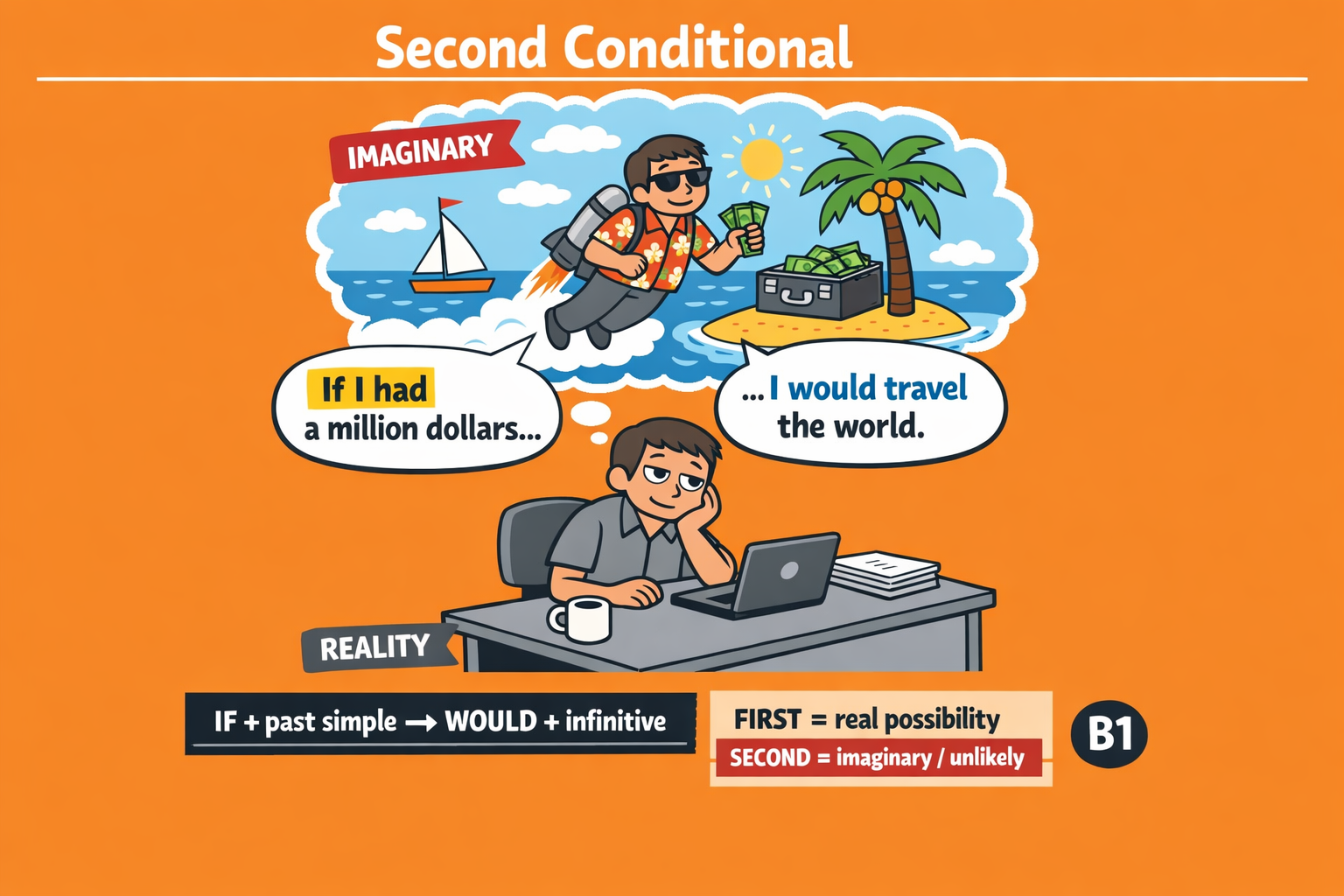
This is the comparison that matters most for B1 learners. Both conditionals describe unreal situations. The difference is when the situation is set.
| Second conditional: unreal present/future | Third conditional: unreal past |
|---|---|
| If + past simple, would + base verb | If + past perfect, would have + past participle |
| If I had more money, I would buy a car. | If I had had more money, I would have bought a car. |
| I don't have money now. | I didn't have money then. |
| If she studied, she would pass. | If she had studied, she would have passed. |
| The exam hasn't happened yet — she might still study. | The exam is over — she didn't study, and she failed. |
"Had had" is not a typo. In If I had had more money, the first had is the auxiliary that forms the past perfect; the second had is the main verb (the past participle of have). It looks strange but it's correct — and you'll see it whenever have is the verb in a third-conditional if-clause.
The same situation takes different conditionals depending on whether you're imagining the present or revisiting the past. Picking the right one tells your listener whether the door is still open or already closed.
Common mistakes
Using would have in the if-clause.
If I would have known, I would have helped.
If I had known, I would have helped.
Would have belongs only in the main clause. The if-clause takes the past perfect.
Mixing the two halves of the third conditional.
If I studied medicine, I would have become a doctor.
If I had studied medicine, I would have become a doctor.
Past simple in the if-clause belongs to the second conditional. The third conditional needs the past perfect (had studied) to match would have become.
Using the past simple instead of the past perfect.
If she came earlier, she would have seen him.
If she had come earlier, she would have seen him.
The third conditional if-clause needs had + past participle, not just the past simple.
Forgetting have in the main clause.
If I had known, I would told you.
If I had known, I would have told you.
The main clause needs all three pieces: would + have + past participle. The have is essential.
Using will have instead of would have.
If we had left earlier, we will have caught the train.
If we had left earlier, we would have caught the train.
Hypothetical past results take would have, never will have.
Mixed conditional: when past and present collide
Sometimes the condition is in the past but the result is in the present. This is the mixed conditional, which combines the third-conditional if-clause with the second-conditional main clause.
If I had studied medicine, I would be a doctor now. (past condition, present result — both grammatically correct)
This is technically a B2 topic, but it appears so often in real conversation that it's worth recognising. If you've understood the third conditional and the second conditional, you've already met both halves of it.
Third conditional and I wish
The third conditional uses the same verb form as I wish + past perfect — both express regret about the past.
- I wish I had brought an umbrella. → If I had brought an umbrella, I wouldn't have got wet.
- I wish she had told me earlier. → If she had told me earlier, I would have changed my plans.
For the full pattern of regret structures, see wish, if only and the unreal past.
Quick summary
- Form: If + past perfect, + would have + past participle.
- Use it for past situations that didn't happen — regret, blame, alternative history.
- Both clauses describe unreal events: neither the condition nor the result actually happened.
- Could have and might have can replace would have when the result is possible rather than certain.
- In speech, contract: If I'd known, I'd have called. But never write would of — only would have or would've.
- Had had in an if-clause is correct, not a typo.
- The third conditional is for the past; the second conditional is for the present or future.
Related topics
- Second conditional: the present/future counterpart; the most important comparison to make.
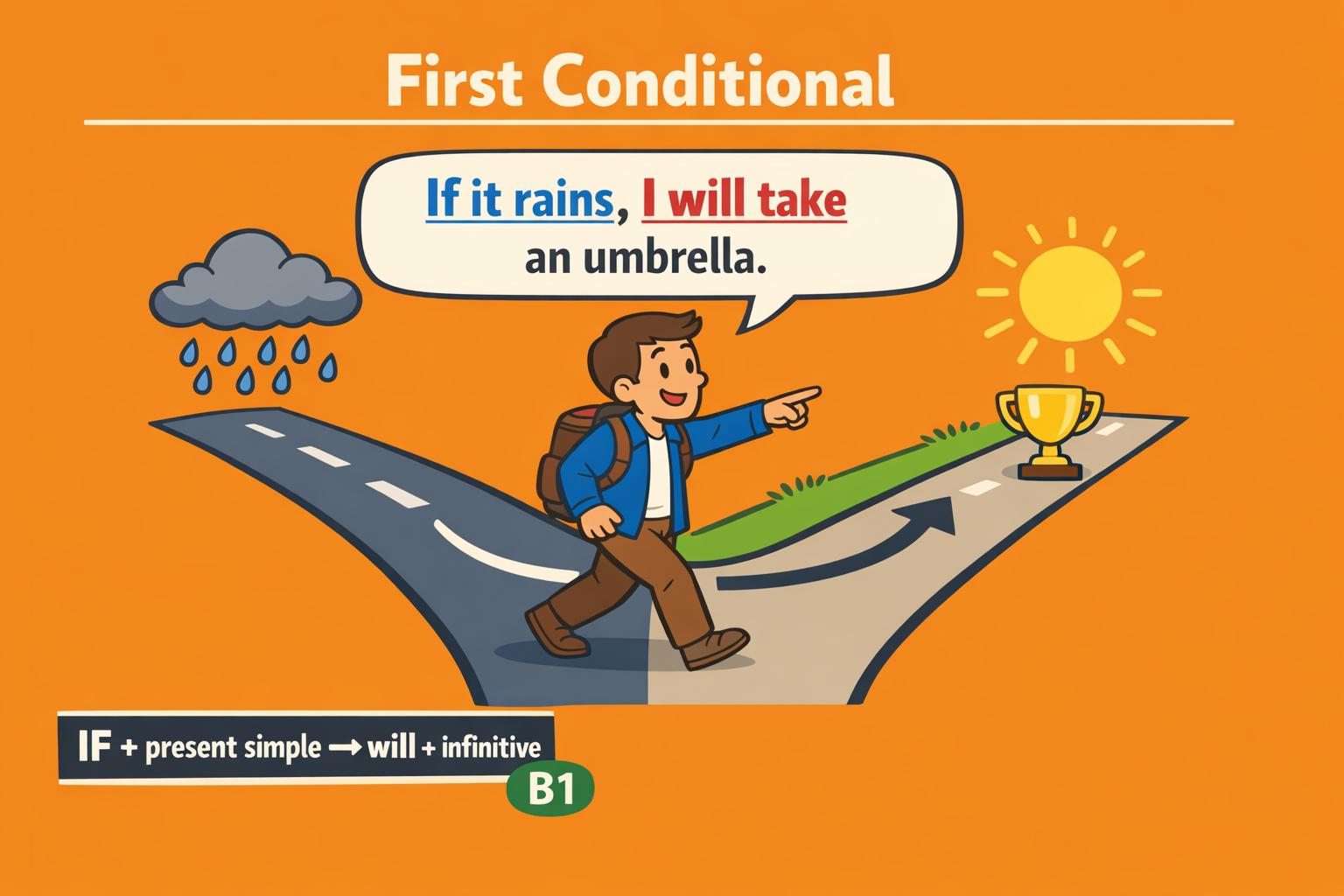
- First conditional: completes the conditional sequence for B1 learners.
- Mixed conditionals: what happens when the condition and the result belong to different time frames.
Comments