You want to make plans. You say
"Let's meet on Monday." Not
in Monday. Not at Monday. The day takes on. The
month ("in January") takes
in. The season ("in summer"),
also in. The time of year is the same word, but the rules behind it
change.
The names of days, months, and seasons are simple to learn. The grammar around
them (which preposition to use, when to use a capital letter, when to use
the) is what trips A1 learners up. This page covers all three.
The seven days of the week
Days of the week always start with a capital letter, even in
the middle of a sentence.
|
Day
|
Short form
|
|
Monday
|
Mon
|
|
Tuesday
|
Tue / Tues
|
|
Wednesday
|
Wed
|
|
Thursday
|
Thu / Thurs
|
|
Friday
|
Fri
|
|
Saturday
|
Sat
|
|
Sunday
|
Sun
|
British English usually writes short forms without a full stop (Mon, Tue, Wed). American English often adds one (Mon., Tue., Wed.). Both are
correct.
In English, the week often starts on Monday in calendars and
diaries (UK style), but on Sunday in many American calendars.
Both are correct.
Saturday and Sunday together are
the weekend. The other five days (Monday to Friday) are
weekdays or working days.
Tricky pronunciation:
-
Wednesday = /ˈwenzdeɪ/. The first d is silent.
Say "wenz-day," not "wed-nes-day."
-
Tuesday /ˈtjuːzdeɪ/ and Thursday /ˈθɜːzdeɪ/ are easy to
confuse. Thursday starts with the th sound.
-
February /ˈfebrʊəri/; the first r is often dropped in
casual speech /ˈfebjʊəri/. Both are heard.
The twelve months of the year
Months also always start with a capital letter. Each has a short form (3
letters) used in dates and calendars.
|
Month
|
Short form
|
Days
|
|
January
|
Jan
|
31
|
|
February
|
Feb
|
28 (29 in a leap year)
|
|
March
|
Mar
|
31
|
|
April
|
Apr
|
30
|
|
May
|
May
|
31
|
|
June
|
Jun
|
30
|
|
July
|
Jul
|
31
|
|
August
|
Aug
|
31
|
|
September
|
Sep / Sept
|
30
|
|
October
|
Oct
|
31
|
|
November
|
Nov
|
30
|
|
December
|
Dec
|
31
|
The four seasons
Seasons describe the four parts of the year. In British English, they usually
start with a small letter. In some American writing they appear with a
capital, but small letters are standard.
|
Season
|
Months (Northern Hemisphere)
|
Typical weather
|
|
spring
|
March, April, May
|
warm, rainy, flowers
|
|
summer
|
June, July, August
|
hot, sunny, long days
|
|
autumn / fall
|
September, October, November
|
cool, windy, falling leaves
|
|
winter
|
December, January, February
|
cold, dark, sometimes snowy
|
Southern Hemisphere note. In Australia, Argentina, South
Africa, New Zealand and other countries south of the equator, the seasons are
six months later: summer runs from December to February,
winter from June to August. The names of the seasons are the same; only the
months change.
British English uses autumn. American English uses fall.
Both are correct.
Capital letters: a fixed rule
This rule is simple but learners forget it constantly because many languages
(Spanish, French, Russian, Italian, Polish) write days and months with small
letters.
Always capitalise: days of the week and months of the year,
even in the middle of a sentence.
Don't capitalise: seasons (in standard British English).
|
✗ Wrong
|
✓ Right
|
|
I see her on monday.
|
I see her on Monday.
|
|
My birthday is in july.
|
My birthday is in July.
|
|
It is cold in Winter.
|
It is cold in winter.
|
Prepositions: on, in, at
This is the part learners get wrong most often. The preposition depends on the
type of word, not the meaning.
on + days
(on Monday, on Friday)
in + months, seasons, years
(in July, in summer, in 2026)
at + the weekend, holidays
(at the weekend, at Christmas)
|
Word type
|
Preposition
|
Examples
|
|
Day
|
on
|
on Monday,
on Saturday morning,
on 5 May
|
|
Month
|
in
|
in January,
in March
|
|
Season
|
in
|
in summer,
in winter
|
|
Year
|
in
|
in 2026,
in 1999
|
|
Weekend / holiday
|
at
|
at the weekend,
at Christmas,
at Easter
|
When a part of the day is attached to a specific day, the whole phrase takes
on, not in: on Monday morning,
on Friday evening, on Saturday night. The day "wins."
Examples in full sentences:
- I have a meeting on Tuesday.
- We go to the beach in August.
- It often rains in autumn.
- I was born in 2002.
- I see my parents at the weekend.
In American English, on the weekend is also common:
I see my parents on the weekend. Both are correct.
For a complete guide to time prepositions, see
prepositions of place and time.
No preposition with next, last, this,
every
This is the trap that catches almost every A1 learner. When a day or month
follows next, last, this, or every, you
use no preposition at all.
Drop the preposition:
next Monday · last summer · this March ·
every Friday
|
✗ Wrong
|
✓ Right
|
|
I'll see you on next Monday.
|
I'll see you next Monday.
|
|
We went to Greece in last summer.
|
We went to Greece last summer.
|
|
She's busy on this Friday.
|
She's busy this Friday.
|
|
They meet on every Tuesday.
|
They meet every Tuesday.
|
Articles with days, months and seasons
This is where the rules get less obvious. There are three patterns to
remember.
Pattern 1: No article: with specific days, months, and most
uses of seasons.
I love winter. ·
School starts in September.
Pattern 2: Use the: with weekend, and
sometimes with seasons when you mean a specific one.
What did you do at the weekend? ·
I'll see you in the summer.
Pattern 3: Use a / an: with descriptive sentences
about a single day or season.
It was a cold winter. ·
I had a busy Monday.
Both in summer and in the summer are correct.
In summer is a general statement; in the summer often refers
to a specific summer (e.g. this summer or the summer just past). At A1, either
is safe. For more on articles, see
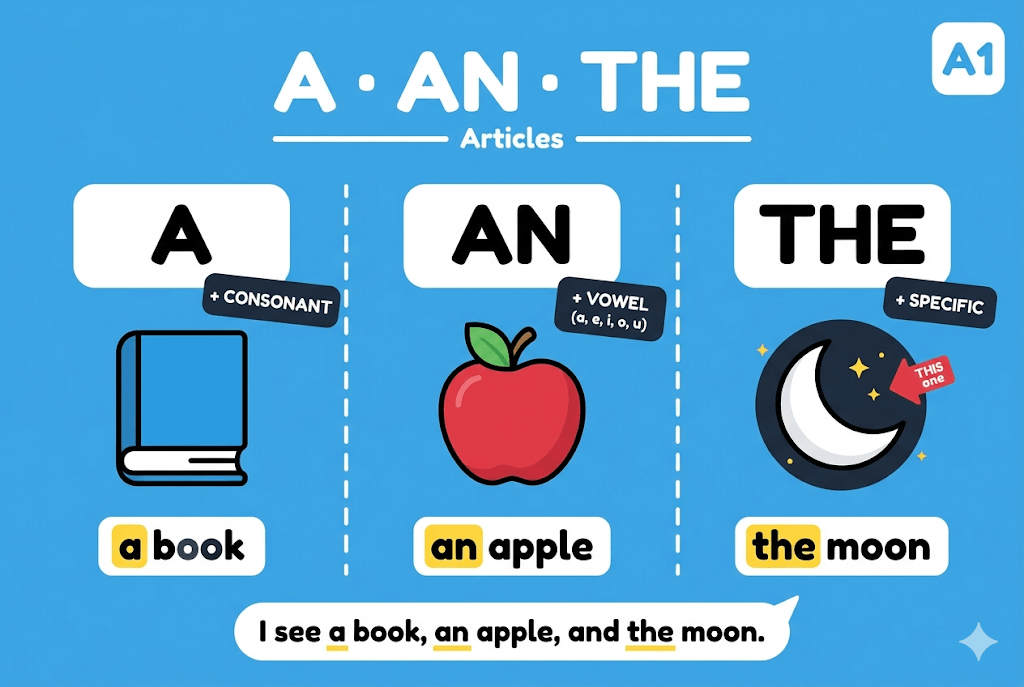
a, an, the.
Saying and writing dates
There are two main ways to say a date in English.
|
British English
|
American English
|
|
Spoken
|
the tenth of June
|
June tenth
|
|
Written (long)
|
10 June 2026 (also: 10th June 2026)
|
June 10, 2026
|
|
Written (short)
|
10/06/2026 (day/month/year)
|
06/10/2026 (month/day/year)
|
In numerical dates, the order is different in the UK and the US.
10/06/2026 means 10 June in the UK but
6 October in the US. When in doubt, write the month in words.
Days are read as ordinal numbers (first, second, third…), not
cardinal (one, two, three). You write 5 but you say
"the fifth".
- 1 May → the first of May / May first
- 2 May → the second of May / May second
- 3 May → the third of May / May third
- 21 May → the twenty-first of May
In British writing, you also see the ordinal suffix on the page:
5th May 2026, 21st March 2026. American English usually
leaves the suffix off in writing (May 5, 2026) but keeps it in
speech.
Plurals and patterns
Days, months, and seasons all have regular plurals (just add -s):
- I work five days a week.
- The course lasts six months.
-
I have visited Paris in all four seasons.
To talk about something that happens regularly on a certain day, use the
plural form with no preposition:
-
The shop is closed on Sundays.
(every Sunday)
-
I work from home on Fridays.
(every Friday)
Common mistakes
1. Wrong preposition with days, months and seasons.
I'll see you in Monday. →
I'll see you on Monday.
My birthday is on March. →
My birthday is in March.
Days take on; months and seasons take in.
2. Adding a preposition with next, last, this,
every.
See you on next Monday. →
See you next Monday.
Drop the preposition entirely with these words.
3. Small letter for days and months.
I start work on monday in january. →
I start work on Monday in January.
Always capitalise days and months in English, even in the middle of a
sentence.
4. Reading dates as cardinal numbers.
My birthday is on May five. →
My birthday is on May fifth.
(or: the fifth of May)
Use the ordinal number (first, second, third, fourth, fifth) when you
say a date.
5. Adding the before a single day or month.
I work on the Monday. →
I work on Monday.
Don't add the before a single named day or month. The is
correct in at the weekend and with seasons when you mean a specific
one (in the summer).
Frequently asked questions
Do I use in, on, or at with days, months, and
seasons?
- on + days: on Monday, on 5 May
-
in + months, seasons, years:
in July, in summer, in 2026
-
at + weekends and holidays:
at the weekend, at Christmas
The preposition depends on the type of time word, not the meaning of the
sentence.
Why are days and months capitalised in English?
In English, all days of the week and months of the year are written with a
capital letter, even in the middle of a sentence. This rule is fixed. Many
other languages (Spanish, French, Russian, Polish) use small letters for these
words, so it's a common spelling mistake. Seasons are usually written with a
small letter in standard British English.
Is it in summer or in the summer?
Both are correct. In summer is a general statement:
It's hot in summer. In the summer often refers to a specific
summer or this summer: I'll see you in the summer. At A1 level, you
can use either; both are natural. The same is true for
in winter / in the winter.
How do you write a date in English?
British English usually puts the day first: 10 June 2026 or
10/06/2026. American English usually puts the month first:
June 10, 2026 or 06/10/2026. When you say the date, you use
ordinal numbers: the tenth of June (UK) or June tenth (US).
To avoid confusion in numerical dates, write the month in words.
Do I say next Monday or on next Monday?
Say next Monday, with no preposition. The same is true for
last Monday, this Monday, and every Monday. The
words next, last, this and every already do the job of
placing the day in time, so the preposition is dropped. Use
on Monday only when the day stands alone, with no
next/last/this/every.
What is the difference between on Monday and
on Mondays?
On Monday means one specific Monday, usually the next or last one.
On Mondays (plural) means every Monday, regularly. Compare:
I have a meeting on Monday (this Monday) vs
I have meetings on Mondays (every Monday). The plural -s is
what makes it a habit.
Why is it autumn in British English and fall in American
English?
Both words are correct, just different. Autumn comes from Latin and
is the standard word in the UK, Ireland, Australia, and most other
English-speaking countries. Fall comes from the older English phrase
fall of the leaf, which used to be used on both sides of the Atlantic
before autumn took over in British English. Use whichever fits the
variety of English you are learning.
Quick summary
-
Always use a capital letter for days and months. Seasons
stay lower-case.
-
on + day · in + month / season / year ·
at + weekend / holiday.
-
With next, last, this, every, drop the preposition:
next Monday, not on next Monday.
-
Say dates with ordinal numbers:
the tenth of June, not June ten.
-
UK: 10 June 2026. US: June 10, 2026. The numerical order
is reversed.


Comments