You can count apples: one apple, two apples, three apples. But you
can't count water the same way. You don't say "two waters"; you say
two glasses of water. English nouns split into two groups:
countable nouns (things you can count one by
one) and uncountable nouns (things you measure or
describe as a whole).
This page focuses on the key vocabulary: which everyday words
are countable, which are uncountable, and the small group that surprises
learners. Once you know the words, the grammar becomes much easier.
What is a countable noun?
A countable noun is a thing you can count:
one book, two books, three books. Countable nouns have a singular
form and a plural form. You
can use a or an with the singular, and a number with the
plural.
-
I have a car. → I have two
cars.
-
She bought an apple. → She bought five
apples.
-
There is a child in the garden. → There are
three children in the garden.
What is an uncountable noun?
An uncountable noun is a thing you can't count one by one. It's usually a
substance, a liquid, a powder, an idea, or a feeling. Uncountable nouns:
- have only one form: no plural with -s.
- don't take a or an.
-
use a singular verb:
The water is cold, not
The water are cold.
Test: Can you count it one by one?
Yes → countable.
No → uncountable.
Key vocabulary: countable nouns
Most everyday objects, people, and animals are countable. Here are the main
groups you need at A1.
|
Group
|
Examples (singular → plural)
|
|
People
|
a friend → friends, a child → children, a man → men, a woman → women, a
teacher → teachers
|
|
Animals
|
a dog → dogs, a cat → cats, a bird → birds, a fish → fish, a horse →
horses
|
|
Objects in the home
|
a chair → chairs, a table → tables, a cup → cups, a plate → plates, a
bed → beds
|
|
Clothes
|
a shirt → shirts, a hat → hats, a shoe → shoes, a coat → coats, a sock →
socks
|
|
Food (separate items)
|
an apple → apples, a banana → bananas, an egg → eggs, a sandwich →
sandwiches, a biscuit → biscuits
|
|
Places and buildings
|
a house → houses, a school → schools, a shop → shops, a city → cities, a
country → countries
|
|
Time units
|
a minute → minutes, an hour → hours, a day → days, a week → weeks, a
year → years
|
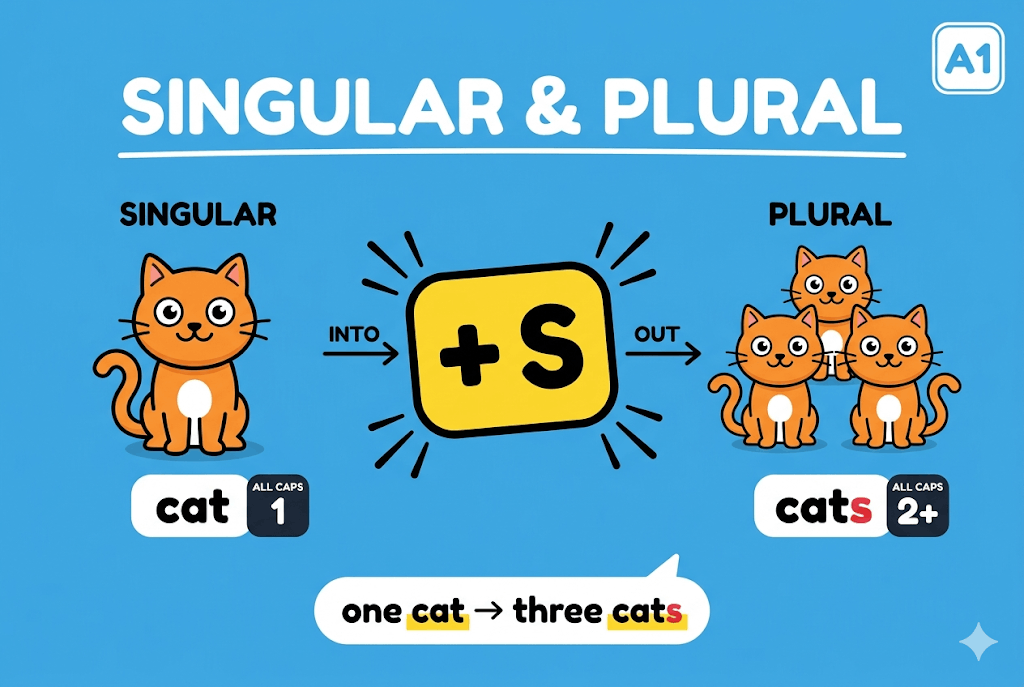
For help with how to make plurals, see
singular and plural nouns.
Key vocabulary: uncountable nouns
Uncountable nouns are usually substances, liquids, powders, gases, or abstract
ideas. They don't take a / an and they don't have a plural form.
|
Group
|
Common A1 words
|
|
Liquids
|
water, milk, tea, coffee, juice, oil, soup, wine
|
|
Food (whole substances)
|
bread, rice, pasta, cheese, butter, sugar, salt, meat, fish, chocolate
|
|
Materials and powders
|
paper, wood, metal, glass, plastic, sand, flour
|
|
Gases and weather
|
air, smoke, snow, rain, ice, wind
|
|
Subjects and activities
|
music, art, English, history, homework, work
|
|
Feelings and ideas
|
love, happiness, time, money, help, advice, news, information
|
Notice that money, news, information,
advice, and homework are uncountable in English, even though
they can feel "countable" to learners. Don't say
an information or
two homeworks. Say
some information,
a piece of advice,
a lot of homework.
How to count uncountable nouns
You can't count uncountable nouns directly, but you can count the
container, the piece, or the
unit of measure. This is one of the most useful patterns at
A1.
|
Uncountable noun
|
Way to count it
|
Example
|
|
water
|
a glass / bottle of
|
two glasses of water
|
|
coffee
|
a cup of
|
three cups of coffee
|
|
bread
|
a slice / loaf of
|
two slices of bread
|
|
cheese
|
a piece / slice of
|
a piece of cheese
|
|
paper
|
a sheet / piece of
|
a sheet of paper
|
|
advice
|
a piece of
|
a piece of advice
|
|
news
|
a piece of
|
some news / a
piece of news
|
|
sugar
|
a spoonful / kilo of
|
a spoonful of sugar
|
Tricky words: countable in your language, uncountable in English
Some words feel countable, but English treats them as a single mass. These are
the most common ones to memorise.
|
Word
|
Wrong
|
Correct
|
|
information
|
an information,
informations
|
some information,
a piece of information
|
|
advice
|
an advice,
advices
|
some advice,
a piece of advice
|
|
news
|
a news,
the news are good
|
good news,
the news is good
|
|
homework
|
a homework,
homeworks
|
some homework,
a lot of homework
|
|
furniture
|
a furniture,
furnitures
|
some furniture,
a piece of furniture
|
|
luggage / baggage
|
a luggage,
two luggages
|
some luggage,
two pieces of luggage
|
|
money
|
a money, moneys
|
some money,
a lot of money
|
|
bread
|
a bread,
two breads
|
some bread,
two slices of bread
|
Words that can be countable AND uncountable
A few words change meaning depending on whether you count them. The form is
the same, but the idea is different.
|
Word
|
Uncountable (the substance)
|
Countable (a type or a serving)
|
|
coffee
|
I like coffee.
|
Two coffees, please.
(= two cups)
|
|
tea
|
Do you drink tea?
|
Two teas for table four.
(= two cups)
|
|
chicken
|
I'm cooking chicken tonight.
|
I have three chickens in the garden.
(= three birds)
|
|
chocolate
|
I love chocolate.
|
Have a chocolate!
(= one piece from a box)
|
|
hair
|
She has long hair.
|
There's a hair in my soup.
(= one strand)
|
Articles with countable and uncountable nouns
This is where the vocabulary connects to grammar. Use
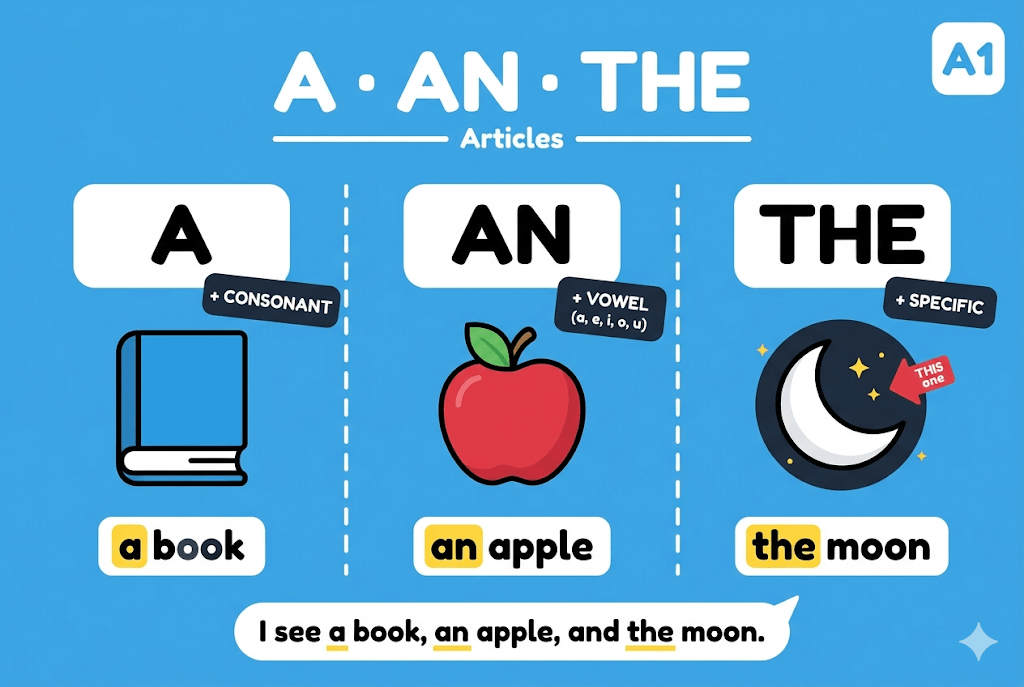
a / an / the
like this:
|
Noun type
|
a / an
|
the
|
no article
|
|
Singular countable
|
✅ a book
|
✅ the book
|
❌ never
|
|
Plural countable
|
❌ never
|
✅ the books
|
✅ books (in general)
|
|
Uncountable
|
❌ never
|
✅ the water (specific)
|
✅ water (in general)
|
Common mistakes
|
Wrong
|
Correct
|
Why
|
|
I need an information.
|
I need some information.
|
Information is uncountable. Use some, not
a / an.
|
|
She gave me two advices.
|
She gave me two pieces of advice.
|
Advice is uncountable. Count the pieces, not the advice itself.
|
|
The news are bad.
|
The news is bad.
|
News looks plural but is uncountable and singular.
|
|
I have a lot of homeworks.
|
I have a lot of homework.
|
Homework has no plural.
|
|
Can I have a water?
|
Can I have some water? or
Can I have a glass of water?
|
Water is uncountable. Use some or a container word.
|
|
I bought a bread.
|
I bought some bread. or
I bought a loaf of bread.
|
Bread is uncountable. Count the loaf or use some.
|
|
There are many furnitures.
|
There is a lot of furniture.
|
Furniture is uncountable and takes a singular verb; see
verb to be.
|
|
I have two moneys.
|
I have some money.
|
Money is uncountable. Count coins, notes, or
dollars instead.
|
Quick checklist
When you meet a new noun:
-
Can you count it one by one? → It's
countable: use a / an, make a
plural with -s.
-
Is it a substance, liquid, powder, or idea? → It's probably
uncountable: no a / an, no plural.
-
To count an uncountable noun, count the container or
piece: a glass of water,
a piece of advice.
-
Memorise the tricky ones: information, advice,
news, homework, furniture, luggage,
money, bread.
-
Uncountable nouns take a singular verb:
The news is good, not
The news are good.
Frequently asked questions
What is the difference between countable and uncountable nouns?
-
Countable nouns: things you can count one by one. They have
a singular and a plural form (one book, two books).
-
Uncountable nouns: things you can't count individually.
They have only one form and don't take a or
an (water, not a water or two waters).
To count an uncountable noun, count its container or piece instead:
two glasses of water, a piece of advice.
Is "water" countable or uncountable?
Water is uncountable. You can't say a water or
two waters in standard English. To count it, use a container word:
a glass of water, two bottles of water, some water.
In a café, you might hear "Two waters, please" as informal shorthand
for "two glasses of water"; that's spoken English, but the safer form is
two glasses of water.
Information is uncountable in English even though it might be
countable in other languages. You can't say an information or
two informations. Use some information,
a lot of information, or count the pieces:
a piece of information, two pieces of information. The same
rule applies to advice, news, and homework; they're
all uncountable in English.
Is "news" singular or plural?
News looks plural because it ends in -s, but it is
uncountable and takes a singular verb: The news is bad today (not
The news are bad). To talk about a single news item, say
a piece of news or a news story. The same is true for
politics, economics, and mathematics; they end in
-s but take singular verbs.
Can a noun be both countable and uncountable?
Yes; some nouns change meaning depending on whether you count them.
Coffee is uncountable as a substance (I like coffee) but
countable as a serving (two coffees, please = two cups).
Chicken is uncountable as food (I'm cooking chicken) but
countable as a bird (three chickens in the garden). The form is the
same; the meaning shifts with the context.
Do you say "much" or "many" with uncountable nouns?
Use much with uncountable nouns and many with plural
countable nouns: much water, much information,
many books, many people. A lot of works with both:
a lot of water, a lot of books. You'll study these
quantifiers in detail at A2; see
quantifiers.

Comments