
Verb Patterns: Gerunds and Infinitives— B2 Grammar Exercises
Published March 14, 2026
Exercise 1 — Multiple Choice
Complete the sentence: I remember _____ off the lights before leaving the office.
Choose the correct option: She stopped _____ her shoelaces in the middle of the race.
Select the best choice: I tried _____ the engine, but it still wouldn't start.
Identify the correct form: Taking this shortcut means _____ through a rough neighborhood.
Choose the correct alternative: I regret _____ you that the event has been cancelled.
Complete the sentence: After explaining the theory, the professor went on _____ its practical applications.
Select the right answer: He forgot _____ the windows before going to bed.
Fill in the blank: The printer needs _____ before we can use it again.
Choose the correct option: I like _____ early on weekdays.
Complete the sentence: She prefers _____ her meetings in the morning.
You can enjoy swimming but you can't enjoy to swim. You can decide to leave but not decide leaving. And you can start reading or start to read (both work, and they mean the same thing). The rule isn't about logic; it's about which form each verb takes. When one verb follows another in English, the second verb appears as either a gerund (-ing) or an infinitive (to + base verb), and the choice is fixed by the first verb.
There's no shortcut around learning which verb takes which pattern. But the patterns aren't random; verbs cluster into groups, and a small number of verbs change meaning depending on which form follows. Get the groups straight and you've solved most of the problem.
The four patterns at a glance
| Pattern | Example | Common verbs |
|---|---|---|
| verb + gerund | She enjoys reading. | enjoy, finish, avoid, mind, suggest, recommend |
| verb + infinitive | He decided to leave. | decide, want, hope, promise, refuse, agree |
| verb + object + infinitive | They asked me to wait. | ask, tell, want, expect, remind, invite |
| verb + either (same meaning) | It started to rain. / It started raining. | start, begin, continue, like, love, hate, prefer |
Verbs followed by a gerund
These verbs are followed by -ing form. The gerund acts like a noun: the thing you enjoy, finish, avoid, and so on.
Common gerund verbs: enjoy, finish, avoid, mind, suggest, recommend, consider, imagine, miss, practise, deny, admit, postpone, risk, give up, keep, can't help, can't stand, feel like.
- I don't mind waiting.
- Have you finished writing the report?
- She suggested taking a later train.
- He admitted lying about his qualifications.
- We can't afford to postpone making a decision.
Verbs followed by an infinitive
These verbs are followed by to + base verb. The infinitive often points to a future action, a goal, or a decision.
Common infinitive verbs: decide, want, hope, plan, agree, refuse, promise, offer, manage, learn, choose, fail, pretend, seem, appear, afford, deserve, expect, wish, threaten.
- They agreed to meet next Friday.
- She refused to answer the question.
- I can't afford to take a year off.
- He pretended to understand.
- We've decided to sell the flat.
Verb + object + infinitive
Some verbs need a person (or thing) between them and the infinitive. The pattern is verb someone to do something.
Common verbs in this pattern: ask, tell, want, expect, remind, invite, allow, encourage, force, persuade, advise, warn, order, teach.
- She asked me to call her back.
- My boss expects us to finish by Friday.
- The instructions warn users not to open the case.
- He persuaded his sister to lend him the car.
A few verbs in this group (want, ask, expect, need) can also take just the infinitive without an object: I want to leave vs. I want you to leave. The object changes who's doing the action.
Verbs that take either form: same meaning
With a small group of verbs, both forms work and the meaning doesn't change. Use whichever feels natural; both are correct.
Common verbs: start, begin, continue, like, love, hate, prefer, intend, propose, can't bear.
- It started to rain. = It started raining.
- I like cooking. = I like to cook.
- She continued to speak. = She continued speaking.
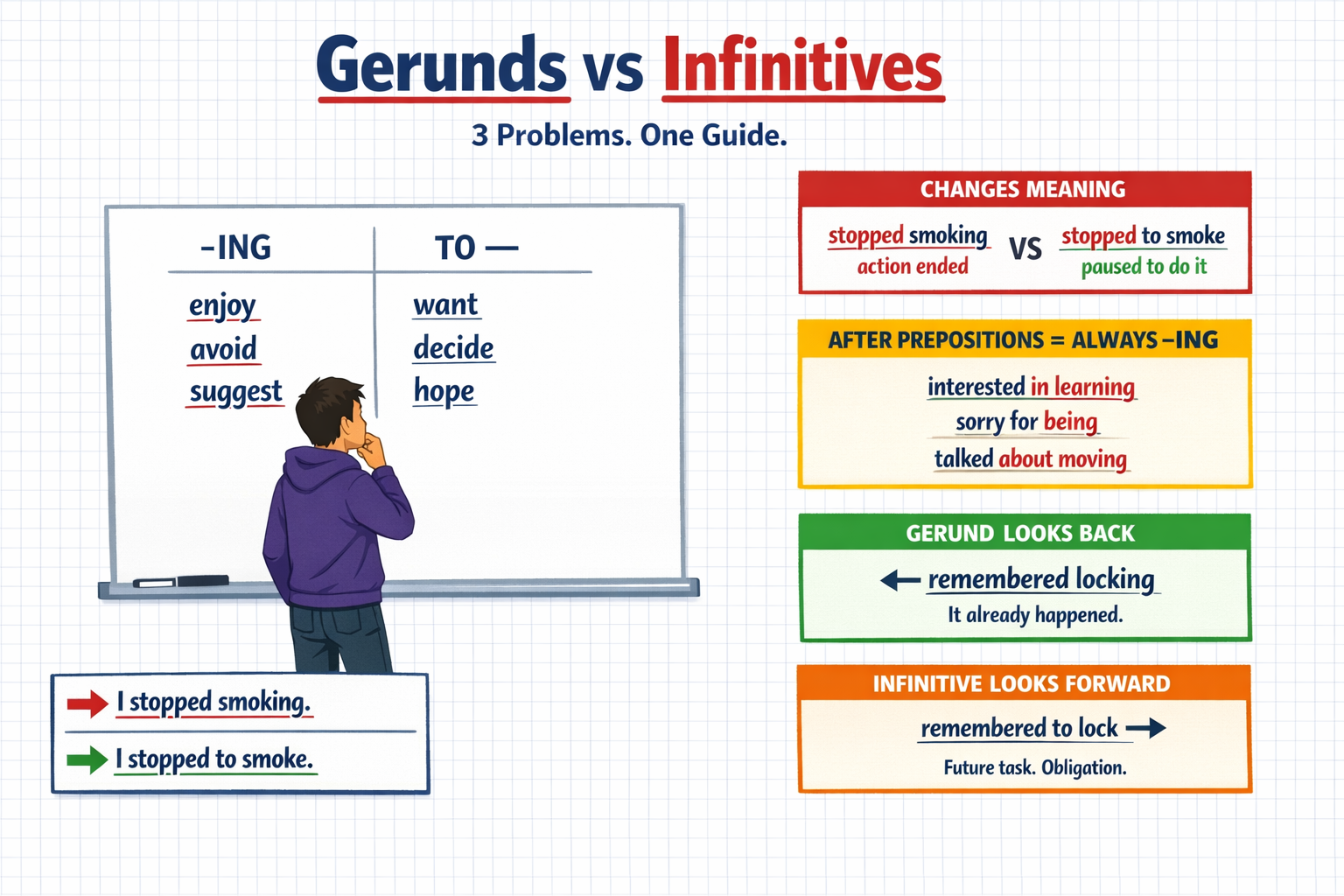
Verbs whose meaning changes with the form
This is where most learner errors happen. A handful of verbs take both forms, but the meaning shifts.
| Verb | + gerund | + infinitive |
|---|---|---|
| remember | recall a past action I remember locking the door. (I did it, and I recall doing it.) |
not forget to do something Remember to lock the door. (Don't forget!) |
| forget | fail to recall a past action I'll never forget meeting her. |
fail to do something I forgot to call my mum. |
| stop | end an activity She stopped smoking last year. |
pause in order to do something else She stopped to smoke. (She paused her walk to have a cigarette.) |
| try | experiment with a method Try turning it off and on again. |
attempt something difficult I tried to open the jar but I couldn't. |
| regret | feel sorry about a past action I regret saying that. |
be sorry to deliver bad news (formal) We regret to inform you that your application was unsuccessful. |
| mean | involve / have as a consequence Moving abroad means leaving my family. |
intend I meant to call you, but I forgot. |
| go on | continue the same activity She went on talking for hours. |
do something next She went on to talk about her childhood. (Next, she talked about…) |
After prepositions: always the gerund
When a verb follows a preposition (at, of, in, on, about, for, by, without, before, after), it must be in the -ing form. This is a hard rule.
- She's good at solving problems.
- I'm tired of waiting.
- He apologised for being late.
- Think before speaking.
This includes to when to is a preposition rather than part of an infinitive — common with look forward to, get used to, be opposed to, object to.
- I'm looking forward to seeing you. (not to see)
- She's not used to working nights.
Common mistakes
I enjoy swimming in the sea.
Enjoy always takes the gerund. So do avoid, finish, mind, suggest, recommend, can't stand.
She decided to go to the party.
Decide always takes the infinitive. So do agree, refuse, promise, plan, hope.
I'm looking forward to seeing you.
Here to is a preposition, not part of an infinitive. After a preposition, use the gerund.
Remember to close the window before you leave.
Future task = remember to do. Past memory = remember doing.
She stopped smoking last year.
Stop + gerund = quit. Stop + infinitive = pause to do something else.
My parents wanted me to become a doctor.
After want, use object + infinitive — not a that-clause.
He suggested calling later.
Suggest takes the gerund directly — no object slot. If you need to mention the person, use a that-clause: He suggested that I call later.
Quick summary
- The first verb decides the form of the second. Learn the verbs in groups.
- Gerund verbs: enjoy, avoid, mind, suggest, finish, recommend, admit, deny.
- Infinitive verbs: decide, want, hope, agree, refuse, promise, plan, learn.
- Object + infinitive: ask, tell, expect, remind, allow, encourage, advise.
- Either form, same meaning: start, begin, continue, like, love, hate, prefer.
- Meaning changes: remember, forget, stop, try, regret, mean, go on.
- After any preposition (including to as a preposition): always gerund.
Comments