
Register shift: formal vs informal— B2 Grammar Exercises
Published March 25, 2026
Exercise 1 — Gap Fill Select
Could you please me the report by tomorrow?
I to the party last night; it was amazing!
It is that we finish the project by Friday.
Hey, can you me a hand with this?
We would like to our gratitude for your assistance.
I’m sorry, I can’t come because I’m with work.
Please the attached document for your review.
I’m to hear that you’re moving to a new city!
The meeting will at 10 a.m. sharp.
I’m going to a quick nap before dinner.
You text a friend: Sorry, can't make it tonight; something came up. You email your manager about the same situation: I'm afraid I won't be able to attend this evening due to an unexpected commitment. The meaning is identical. The register isn't. Choosing the wrong one (sending the email to your friend or the text to your boss) is a social mistake, not a grammar mistake, and it's the kind native speakers notice instantly.
Register is the level of formality you choose for a given situation. It isn't a separate grammar; it's a coordinated set of choices across vocabulary, sentence structure, contractions, and punctuation. Get one element wrong and the whole message feels off.
What changes between registers
Register shifts touch five main areas at once. A formal message tends to do all five; an informal message tends to do the opposite of all five.
| Feature | Formal | Informal |
|---|---|---|
| Vocabulary | Longer, often Latin-derived single-word verbs (request, assist, purchase) | Phrasal verbs (ask for, help out, pick up) |
| Contractions | Avoided (I will not, do not) | Standard (I won't, don't) |
| Sentence length | Longer, often with subordinate clauses | Shorter, often with simple clauses |
| Voice | Passive common (It has been decided) | Active dominant (We decided) |
| Pronouns | Avoids you; uses impersonal forms | You, we, I used freely |
Vocabulary shift
Most register shifts start with word choice. Formal English often favours longer, Latin-derived words, while informal English favours phrasal verbs and shorter Anglo-Saxon roots. This is a tendency, not a strict rule; plenty of short, common verbs (use, change, ask, help) are neutral and fit either register. The pairs below are reliable register signals.
| Informal | Formal |
|---|---|
| ask for | request |
| get | receive / obtain |
| need | require |
| help out | assist |
| buy | purchase |
| show | demonstrate |
| find out | determine / discover |
| put off | postpone |
| turn down | decline |
| get in touch with | contact |
| set up | establish / arrange |
| look into | investigate |
Contractions and abbreviations
Contractions are the clearest single signal of register. Formal writing spells words out; informal writing contracts freely.
| Informal | Formal |
|---|---|
| I'm, you're, we've | I am, you are, we have |
| don't, won't, can't | do not, will not, cannot |
| it's, there's, who's | it is, there is, who is |
| gonna, wanna, gotta | going to, want to, have got to |
Abbreviations like info, uni, app, and ad belong in informal contexts. Formal writing uses the full form: information, university, application, advertisement. Acronyms (NATO, CEO, UN) are fine in both registers once introduced.
Emoji, punctuation, and chat conventions
Punctuation and visual marks are register signals too. Formal writing avoids emoji, multiple exclamation marks, ellipses for tone (...), all-caps for emphasis, and chat abbreviations like lol, btw, tbh, imo. These belong firmly in informal contexts. A single exclamation mark is fine in semi-formal writing for warmth (Thanks for your message!) but more than one shifts the tone sharply toward casual.
Greetings and sign-offs
The opening and closing of a message are the loudest register signals it carries. They have to match each other and match the rest of the message. A formal greeting paired with a casual sign-off (or vice versa) reads as careless even when the content is correct.
| Register | Greeting | Sign-off |
|---|---|---|
| Informal | Hi / Hey / Hiya | Cheers / Thanks / Talk soon |
| Semi-formal | Hi [first name] / Hello [first name] | Best / Best wishes / Thanks again |
| Formal | Dear [first + last name] / Dear [Mr/Ms surname] | Kind regards / Best regards |
| Very formal | Dear Hiring Manager / Dear Sir or Madam | Yours sincerely (named recipient) / Yours faithfully (unnamed) |
Sentence structure
Formal sentences are usually longer and more complex, often using subordinate clauses, relative clauses, and linking phrases. Informal sentences are shorter and chain together with simple connectors.
| Informal | Formal |
|---|---|
| so | therefore, consequently, as a result |
| but | however, nevertheless, although |
| also / plus | furthermore, moreover, in addition |
| so that | in order that, with a view to |
| to sum up | in conclusion, to summarise |
Compare the same idea expressed at both registers:
- Informal: The train was late, so I missed the meeting. Plus my phone died, so I couldn't call.
- Formal: As the train was delayed, I was unable to attend the meeting. Furthermore, my phone battery had failed, which prevented me from contacting the office.
Active vs. passive voice
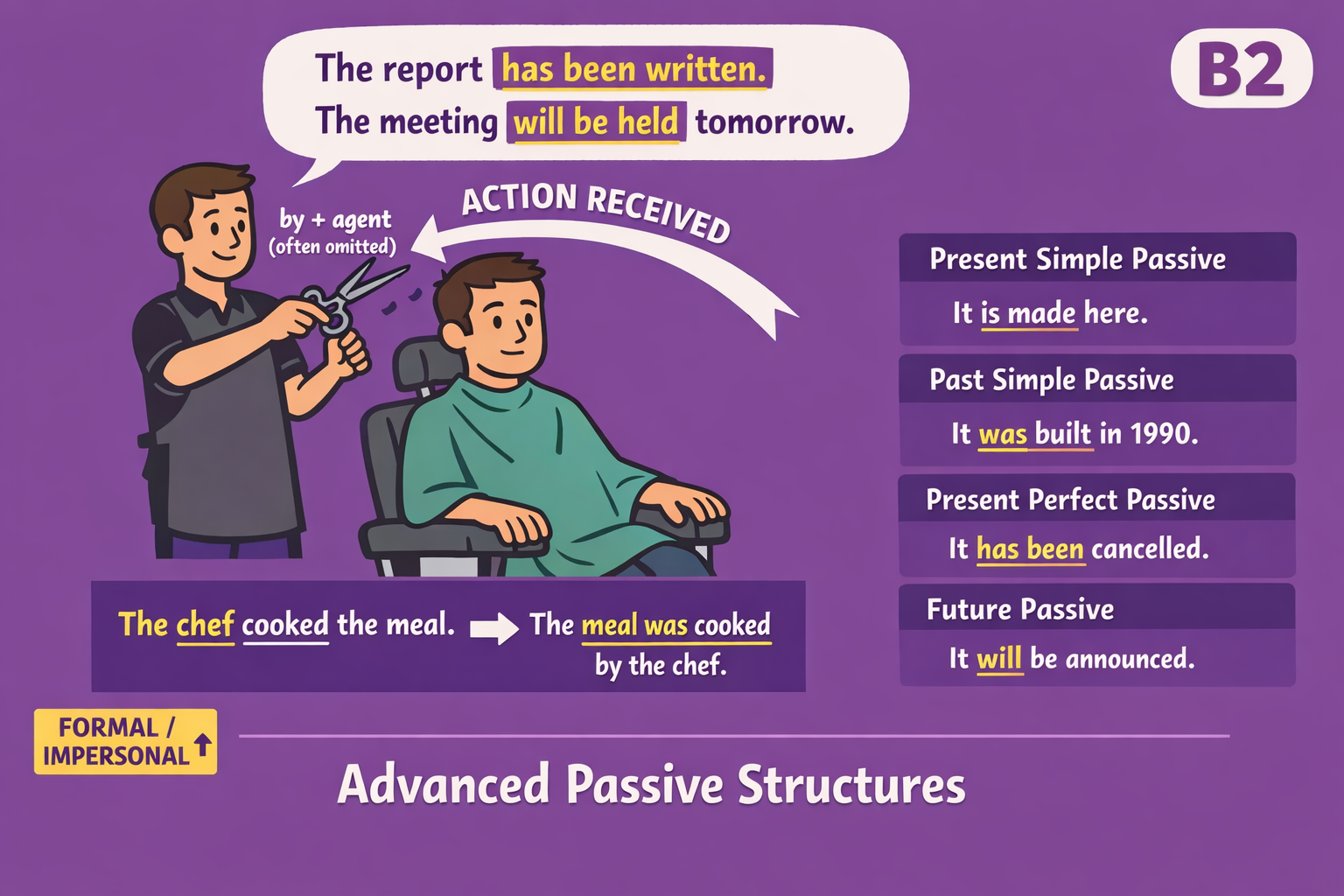
Formal English uses the passive voice more often, particularly when the action matters more than who performed it, or when the writer wants distance from a difficult message. Informal English keeps the active voice as the default.
- Informal: We've changed the meeting time.
- Formal: The meeting time has been changed.
- Informal: I made a mistake on the order.
- Formal: An error was made on the order.
Politeness softeners
Formal English builds in distance through modal verbs, indirect questions, and hedging phrases. Direct requests sound abrupt in formal contexts.
| Function | Direct (informal) | Softened (formal) |
|---|---|---|
| Request | Send me the file. | Could you possibly send me the file? |
| Request | Can you help? | I wonder if you could help. |
| Disagreement | You're wrong. | I'm not sure I entirely agree. |
| Refusal | No, I can't. | I'm afraid that won't be possible. |
| Bad news | We can't refund you. | Unfortunately, we are unable to offer a refund on this occasion. |
Register in speech
The same principles apply to spoken English, with extra signals layered on top. Informal speech uses fillers (um, like, you know, sort of), heavy contraction (gonna, wanna, dunno), interruptions, and incomplete sentences. Formal speech (job interviews, presentations, customer-facing communication) drops most of those, slows down, and uses complete sentences with explicit connectors.
One useful rule for spoken register: when the situation feels formal, replace gonna with going to, wanna with want to, and reduce fillers consciously. The effect on how you come across is immediate.
The same message at three levels: scheduling
Register isn't binary. Most real situations fall somewhere on a scale between very informal and very formal.
| Register | Message | Context |
|---|---|---|
| Informal | Hey, sorry, can't make Friday. Let's reschedule? | Text to a friend |
| Neutral / semi-formal | Hi Sarah, I won't be able to make Friday's meeting. Could we reschedule for next week? | Email to a colleague |
| Formal | Dear Ms Patel, I regret to inform you that I will be unable to attend Friday's meeting. Would it be possible to reschedule for next week? | Email to a new client |
The same message at three levels: complaining
Complaints are where register goes wrong most often. The instinct is to match anger with bluntness, but the more formal the complaint, the more weight it carries.
| Register | Message | Context |
|---|---|---|
| Informal | Service was awful tonight. Waited 40 mins for a starter and the waiter was rude. | Text to a friend about the evening |
| Neutral / semi-formal | Hi, I wanted to flag that our service last night fell well below what we expected. We waited 40 minutes for a starter, and the server was abrupt when we asked about it. | Email to the restaurant manager |
| Formal | Dear Sir or Madam, I am writing to express my dissatisfaction with the service I received at your establishment on the evening of 8 May. The starter was served after a wait of approximately forty minutes, and the conduct of the server in response to our enquiry was unacceptable. | Letter of formal complaint to the head office |
Common mistakes
Dear Hiring Manager, I am writing to enquire about the position.
Formal salutation + informal language = mismatch. If you open with Dear Hiring Manager, the rest must match.
Hi! I can't make the cinema tonight.
The opposite problem. Hi! sets a casual tone — what follows shouldn't sound like a court document.
The applicant did not receive the position as they were unable to demonstrate the required skills.
In formal contexts, replace phrasal verbs and contractions consistently — not just the obvious ones.
Furthermore, I believe it is an excellent idea, and I would be glad to assist.
Formal linking words (furthermore, moreover, nevertheless) need to be matched by formal vocabulary around them.
Are you free at 3?
Over-formality is just as wrong as under-formality. With a colleague you message every day, formal English sounds cold or sarcastic.
I would like to apply for this position. I have strong IT skills and would be available to start in June.
Short, choppy sentences read as casual or curt. Formal writing usually links ideas with subordinate clauses.
Where each register belongs
| Context | Register |
|---|---|
| Text messages to friends and family | Very informal |
| Social media posts, group chats | Informal |
| Slack/Teams messages within a team you know | Informal to neutral |
| Emails to colleagues you know well | Semi-formal / neutral |
| LinkedIn messages, customer reviews | Neutral / semi-formal |
| Customer service emails, professional networking | Neutral / semi-formal |
| Job applications, cover letters, CVs | Formal |
| Academic essays, reports, official letters | Formal |
| Legal documents, contracts, formal complaints | Very formal |
Quick summary
- Register is a coordinated shift across vocabulary, contractions, sentence length, voice, and politeness — not a single change.
- Formal: longer Latin-derived verbs, no contractions, longer sentences, more passive voice, softened requests.
- Informal: phrasal verbs, contractions, shorter sentences, active voice, direct requests.
- Match greeting, body, and sign-off. Dear Hiring Manager + wanna is worse than a consistent neutral email.
- Over-formality in casual contexts sounds cold or sarcastic. Match the register to the situation.
- When in doubt for written communication, default to neutral — polite but not stiff.

Comments