
Zero conditional— A2 Grammar Exercises
Published April 4, 2026
Exercise 1 — Gap Fill Select
If water to 100 degrees Celsius, it boils.
If you sugar in tea, it tastes sweet.
If it cold, the water freezes.
If you the button, the machine starts.
If people too much, they get tired.
If you the gas, it smells bad.
If the sun , it gets hot.
If you the door, the light goes off.
If you the ice, it melts.
If you the plants, they grow.
The shampoo bottle says: If it gets in your eyes, rinse with water. The recipe says: If the oil starts to smoke, lower the heat. The fire sign says: If you hear the alarm, leave the building. All of these use the zero conditional.
The zero conditional connects a condition and a result. Both parts are true every time. If A happens, B happens: always. There is no will in either clause, and that's what separates this structure from the first conditional.
Form
The zero conditional has two parts: an if-clause and a result clause. Both clauses use the present simple.
If + subject + present simple , subject + present simple
You can also start with the result clause. The meaning is the same. When if comes first, you need a comma. When it comes second, you don't.
| Order | Example |
|---|---|
| If first (use a comma) | If you heat ice, it melts. |
| If second (no comma) | Ice melts if you heat it. |
Positive, negative, and question
| Form | Example |
|---|---|
| Positive | If it rains, the streets get wet. |
| Negative | If it doesn't rain, the streets stay dry. |
| Question | What happens if it rains? |
When to use the zero conditional
The zero conditional never uses will in either clause. Every example below describes something that happens every single time the condition is met, not one future event.
1. General truths and habits
Use the zero conditional for things that are always true: facts about the world, and habits that repeat every time. With a habit, the result depends on the condition: the second action only happens because the first one does, every single time.
- If you mix yellow and blue, you get green.
- Plants die if they don't get water.
- Water freezes if the temperature drops below zero.
- If I feel tired, I go to bed early.
- My dog barks if someone knocks on the door.
- Sara doesn't drink coffee if it is after 6 p.m.
2. Rules and instructions
Use the zero conditional for rules at school, at work, or in games: anything that's true every time it applies.
- If you break a rule at work, you get a warning.
- You don't get a point if you miss the ball.
- If the fire alarm goes off, everyone leaves the building.
- Students lose marks if they arrive late to the exam.
- If you land on a red square, you miss a turn.
3. Instructions with the imperative
The result clause is often an instruction. In this case, you use the imperative form (the base verb) instead of the present simple. You see this everywhere on labels, signs, and recipes.
- If you feel dizzy, sit down.
- If the light turns red, stop.
- If the water boils too fast, turn down the heat.
- Call the doctor if the pain gets worse.
- If you see smoke, don't open the door.
Signal words
Several words can introduce the condition. They all carry the meaning "every time this happens":
- if — the most common; leaves the condition open.
- when — same structure, but suggests the condition is certain.
- whenever — stresses that it happens every single time, without exception.
- every time — same emphasis as whenever, slightly more conversational.
- as soon as — adds the idea of sequence: B happens immediately after A.
Examples:
- Whenever I drink coffee at night, I can't sleep.
- Every time Tom hears that song, he sings along.
- As soon as the lesson ends, the children run outside.
Common mistakes
If you will heat water, it boils.
If you heat water, it boils.
Don't use will in the if-clause. Both clauses are in the present simple.
If it rains, the streets will get wet.
If it rains, the streets get wet.
For a general truth, don't use will in the result clause. Use will only when you talk about a specific future event: that's the first conditional.
If she is tired she goes to bed.
If she is tired, she goes to bed.
You need a comma when the if-clause comes first.
If he don't eat, he gets angry.
If he doesn't eat, he gets angry.
Use doesn't with he, she, and it. Check your subject-verb agreement.
If you press this button, the door opening.
If you press this button, the door opens.
Don't use the -ing form. Use the present simple in both clauses.
Zero conditional vs first conditional
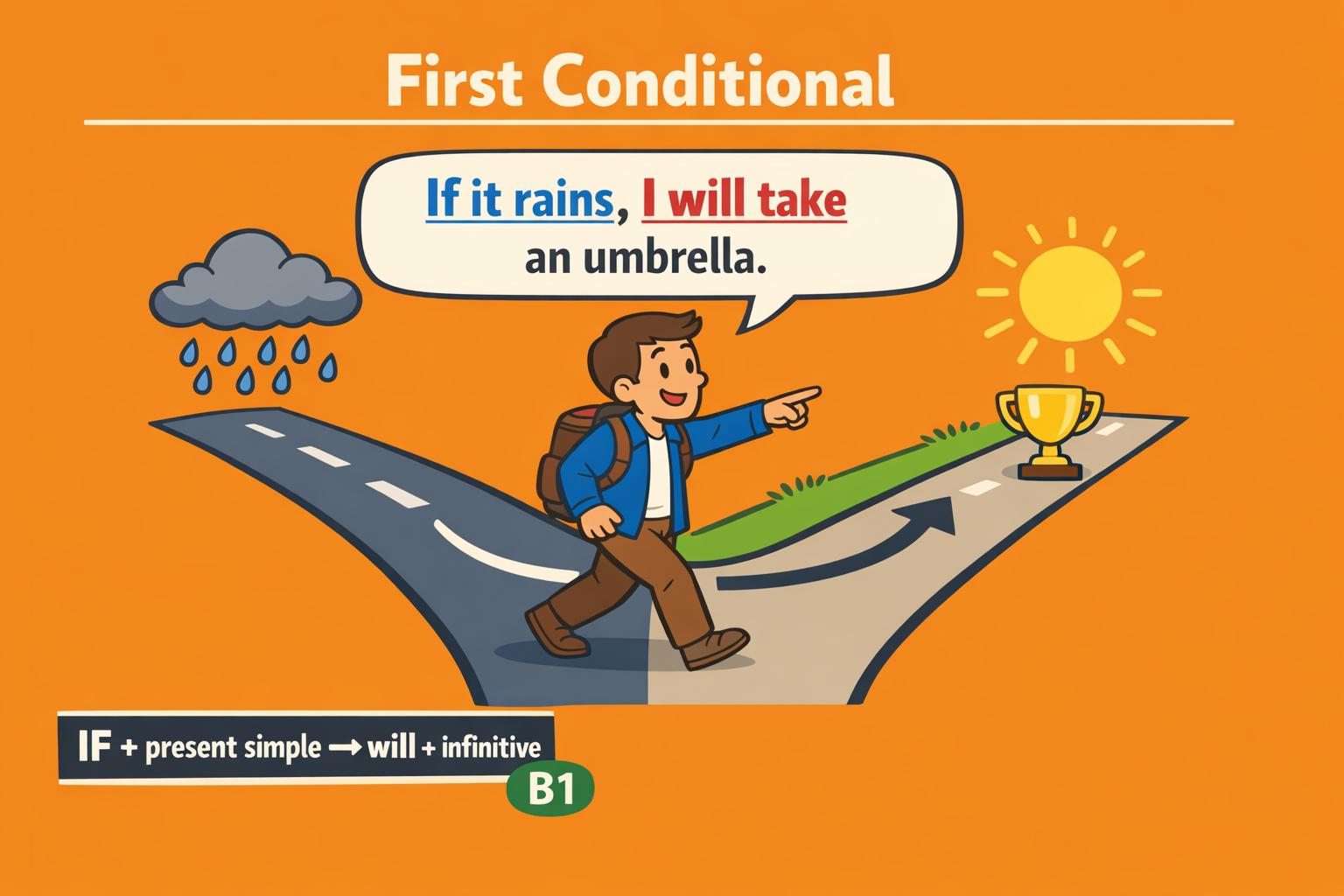
These two structures look similar, but they mean different things. The zero conditional describes what is always true. The first conditional describes one specific future situation. The same situation can take either form depending on what you mean: a general rule that applies every time (zero), or a prediction about this specific moment (first).
| Zero conditional | First conditional |
|---|---|
| Always true | One specific future event |
| If + present, present | If + present, will + verb |
| If you drop a glass, it breaks. (every time, a general fact about glasses) |
If you drop that glass, it will break. (this specific glass, right now) |
Quick summary
- Use the zero conditional for things that are always true: facts, habits, rules, and instructions.
- Both clauses use the present simple. No will.
- The result clause can also be an imperative: If you feel dizzy, sit down.
- Use a comma when if comes first.
- If leaves the condition open; when suggests it's certain.
- Other signal words: whenever, every time, as soon as.
Related topics
- Present simple — the tense used in both clauses.
- Imperative — for instructions in the result clause.
- First conditional — for specific future situations.
Comments