
Reported speech / indirect speech— A2 Grammar Exercises
Published March 31, 2026
Exercise 1 — Gap Fill Select
She said she happy yesterday.
He said he go to the party last night.
They told me they finished their homework.
She said she like to visit London next year.
He said he going to the cinema that evening.
She told me she the book the day before.
He said he never been to Paris.
She said she going to the gym every day.
He said he help me with my homework.
She said she tired because she had worked all day.
Your friend Anna phones you. "I'm tired," she says. Later, you meet someone and tell them about the call: Anna said she was tired. You've just used reported speech. The original words came out of Anna's mouth; you've passed them on, but you've changed two things to make the sentence fit the new moment: the verb, and the pronoun.
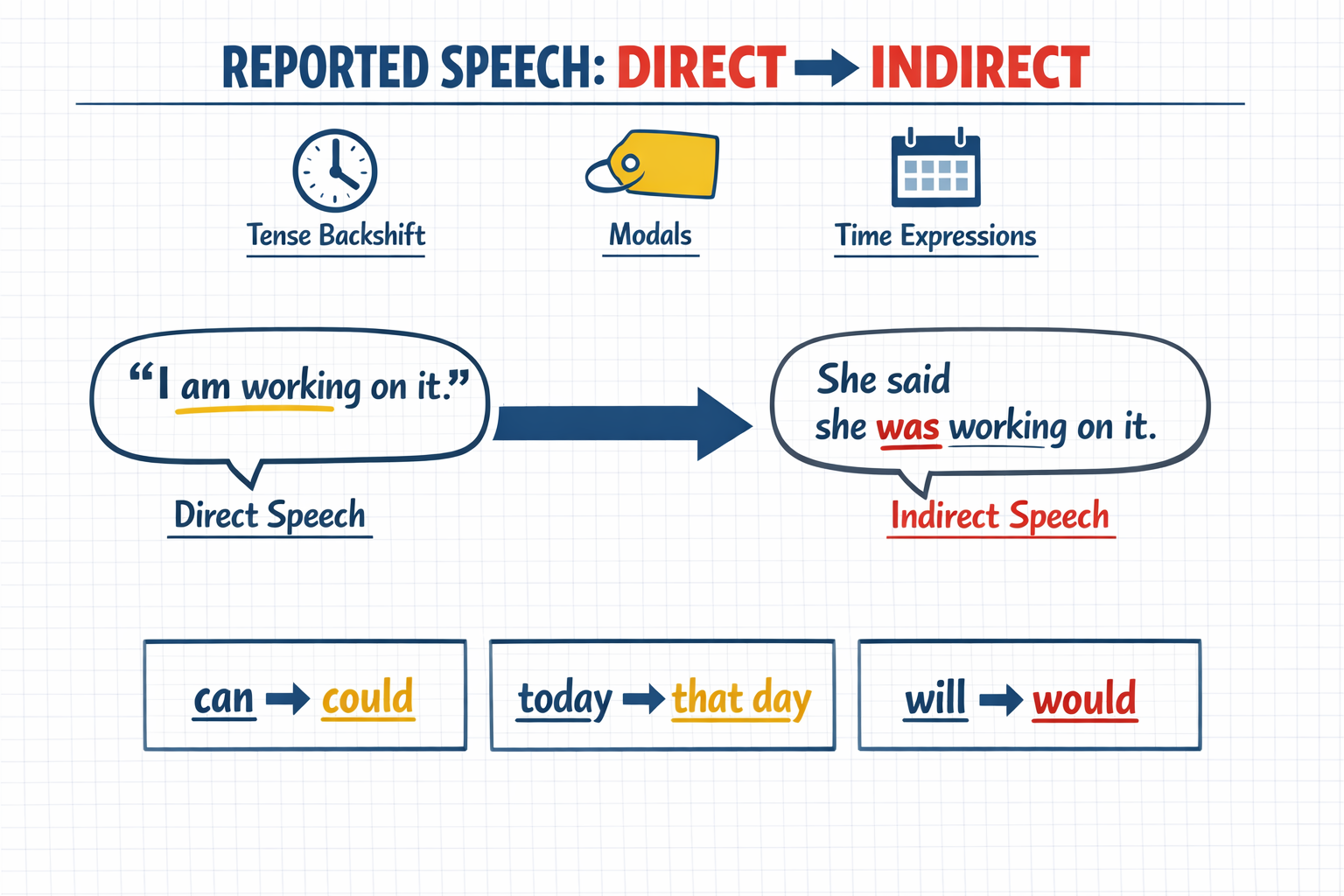
Reported speech (also called indirect speech) is how you tell someone what another person said. You don't use quotation marks, and the sentence usually shifts in two small ways: the verb moves into the past, and the pronouns change to match the new speaker.
Direct speech vs reported speech
Direct speech repeats the exact words inside quotation marks. Reported speech tells what was said, without quotation marks.
| Direct speech | Reported speech |
|---|---|
| Anna said, "I am tired." | Anna said she was tired. |
| Tom said, "I like pizza." | Tom said he liked pizza. |
| The teacher said, "The test is on Friday." | The teacher said the test was on Friday. |
Two changes happen at the same time: I becomes she or he, and the present verb (am, like, is) becomes the past verb (was, liked, was).
Say or tell?
Both verbs introduce reported speech, but they're not interchangeable. The rule is about who hears the words.
Say: no person after the verb.
Tell: a person after the verb.
- Anna said she was tired.
- Anna told me she was tired.
- The teacher said the test was on Friday.
- The teacher told us the test was on Friday.
Said me is wrong. Tell needs a person when you're reporting what someone said: He told me…, not He told…. If you can't name the listener, choose said.
How the verb changes
When the reporting verb is in the past (said, told), the verb in the reported part usually moves one step into the past. At A2 level, you mostly need these three patterns:
| Direct speech | Reported speech | Example |
|---|---|---|
| am / is / are | was / were | "I am tired." → Anna said she was tired. |
| Present simple (work, like, live…) |
Past simple | "I live in Rome." → She said she lived in Rome. |
| have / has | had | "I have a car." → He said he had a car. |
Some past verbs are irregular; have in the table above is one example (not haved). The full set of backshift patterns, including modal verbs and the past simple → past perfect shift, is on the B1 page.
How the pronouns change
When you report what someone said, you usually need to change the pronouns. The original speaker said I, but now you are talking about them, so I becomes he or she. Object pronouns (me, us) and possessives (my, our) shift in the same way.
| Pronoun type | Original speaker says | You report |
|---|---|---|
| Subject | "I am happy." (Maria) | Maria said she was happy. |
| Subject | "We are ready." (the kids) | The kids said they were ready. |
| Object | "Tom likes me." (Sara) | Sara said Tom liked her. |
| Object | "The teacher helps us." (the students) | The students said the teacher helped them. |
| Possessive | "My bag is heavy." (Ben) | Ben said his bag was heavy. |
| Possessive | "Our car is new." (the Smiths) | The Smiths said their car was new. |
Common mistakes
She said me she was tired.
She told me she was tired. / She said she was tired.
You can't put a person after said. Use told when you name the listener.
He told that he was busy.
He told me that he was busy.
When you report what someone said, tell needs a person after it. You can't say tell that….
Anna said she is tired.
Anna said she was tired.
When the reporting verb is in the past, the verb in the reported part also moves into the past.
Original: Tom said, "I like pizza."
Tom said that I liked pizza.
Tom said that he liked pizza.
You don't keep I from the original words. Change the pronoun to match the new speaker — Tom said it about himself, so use he.
Original: Sara said, "Tom likes me."
Sara said Tom liked me.
Sara said Tom liked her.
Object pronouns shift too. The me in Sara's words refers to Sara — when you report it, it becomes her.
She said, she was cold.
She said she was cold. / She said, "I am cold."
Pick one or the other. Either keep the speaker's exact words inside quotation marks (direct), or change the verbs and pronouns (reported). Never mix both, and no comma before reported speech.
Quick summary
- Reported speech changes two things: the verb (one step into the past) and the pronouns (to match the new speaker).
- Say: no person after it. Tell: a person after it when reporting what was said.
- Common verb shifts at A2: am/is/are → was/were, present simple → past simple, have/has → had.
- Pronoun shifts apply to subjects (I → he/she), objects (me → him/her), and possessives (my → his/her).
- That is optional: She said (that) she was tired.
- The full rules (backshift to past perfect, modal verbs, questions, commands) come at B1.
Comments